Sunday, November 6, 2016

Cosco Izmir - smallest ship

It's not often that a smallest ship gets much attention, but today's arrival of Cosco Izmir is worth noting. It is the smallest ship to appear in Halifax for the Columbus loop operated by CMA CGM, UASC and Coscon. Since the line began calling in Halifax in late 2015, we have seen the record for largest container ship in Halifax set twice by that line, and every ship has been one of the (old) post-Panamax size.

Cosco Izmir at Halterm is the smallest ship to arrive for the Columbus Loop. 
It was built in 2013 by Jiangsu Yangzijiang Shipyard in Jiangyin. It is 40,465 grt, 49,952 dwt.


Cosco Izmir however is a 4256 TEU ship, which places it firmly on the endangered species of old Panamax ships, suddenly outmoded by the opening of the enlarged Panama canal in June.
According to various reports the old Panamax ships of 3,000 to 5,000 TEU have become liabilities and are being scrapped even though they only may be seven to ten years old. Of those not scrapped yet, 101 are reported to be idled for lack of work. The neo-Panamax ships, of up to 11,500 TEU are the new thing and ports around the world have begun to scramble to accommodate them - Halifax among them.

Stay tuned - Shipfax will be unveiling its master plan in the near future.


CMA CGM will taking on new partners under a new grouping called Ocean Alliance, which will include OOCL, Evergreen, and  Coscon (the merger of CSCL and Cosco). It is expected to start up in April 2017, now that it has passed the scrutiny of regulators. There has been talk than Hyundai Merchant Marine (HMM) would join this group, but that is still unsettled, but if it does it will need Chinese government approval, if not others.
.

Saturday, November 5, 2016

Saturday sailings

It was a day for outbound ships as all arrivals were in early morning or early evening darkness.


Colorado Highway made a brief visit to Autoport, arriving early morning and sailing before noon.


The K-Line ship was built in 2005 by Naikai, Setoda, Japan with a grt of 44,382 and a very light dwt of 8,546. It was probably not originally intended for round the world service in view of its size, but that is what it is doing now. It is interesting to see how much auto carrier design has evolved in 10 years or so.

USCG Bristol Bay WTGB-102 is on its way from Baltimore via New York and Boston, to the Great Lakes to take up station. Fresh from a Service Life Extension Project [SLEP] refit at the CG base in Baltimore, the light icebreaker looked very spruce as it sailed mid-afternoon. It left its Detroit, MI home port in August 2015 for the extensive upgrade.
 
Six of this "Bay" class of nine icebreaking tugs are based on the Great Lakes. The other three are based in Maine and the Hudson River. Bristol Bay is one of two such boats equipped to handle an Aids to Navigation [ATON] barge to service buoys. The barge carries a crane and workshop for buoy maintenance  and replacement. Many Great Lakes buoys are lifted for the winter due to ice and the barge is well suited for that work in sheltered waters.


The durable Atlantic Huron put in a call at National Gypsum, arriving late last night. It sailed early this afternoon with a full load bound for the St.Lawerence Seaway.


It is the last of three CSL ships with similar names, Atlantic Superior scrapped in 2015 in China and Atlantic Erie en route to scrap in Turkey [see yesterday's post] A fourth ship of similar class, Nanticoke is still sailing as Salarium on charter to Mines Seleine in the Magdalen Islands to carry salt.

Atlantic Huron is a long time caller in Halifax since it was built as Prairie Harvest in 1984. It was converted to a self-unloader 1989 and renamed. After a stint under Bahamas flag  from 1990 -1992 and again as Melvin H. Baker II from 1994-1997 on charter to National Gypsum, it returned to Canadian flag as one of the ships used to deliver magnetite slurry to the Hibernia gravity base, with fleet mates Atlantic Erie and Nanticoke in 1997.  
Over the winter of 2000-2001 Halifax Shipyard replaced its bottom steel and in 2002-2003 it was widened to the new maximum St.Lawrence Seaway width at Port Weller Drydock. Rumours of its demise have been rife for several years, but it soldiers on.

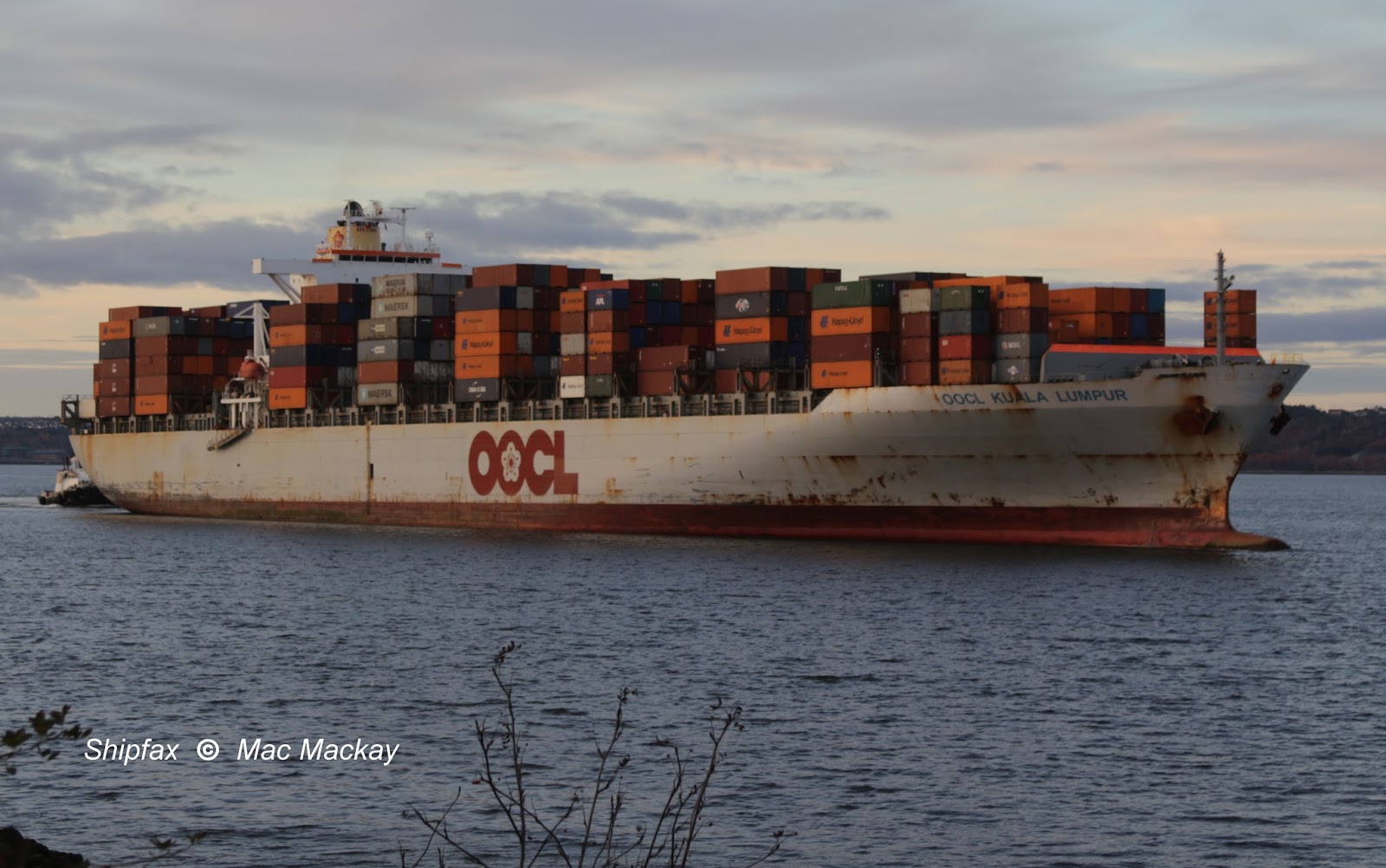
Also sailing this afternoon was the somewhat scruffy looking OOCL Kuala Lumpur. Ships of OOCL usually have smarter looking paint, but this ship has been hard driven with no time out. Built in 2007 by Koyo Dockyard Co in Mihara, Japan, the 66,462 grt, 66,940 dwt ship has a capacity of 5888 TEU (including 586 reefers) and was a post-Panamax ship until the opening of the new Panama Canal this year. Since 2010 it has been flying the Singapore flag for Kowloon owners Grace Ocean Investment Ltd, carrying on a charter to OOCL by original owners Nissen Kaiun.


The ship sails for the G6 Alliance which will be overhauled over the next year, along with several other container ship groupings.

With the return of Standard Time, we revert to the Dark Ages of Ship Watching. I will attempt to make up with items from various past eras.

.

Friday, November 4, 2016

Kathryn Spirit - another scrapping

A ship that has been in a sort of limbo for five years will finally be scrapped this winter. The Kathryn Spirit was to be broken up at Beauharnois, QC, just below the Seaway locks in 2011. However the buyer, Groupe Saint Pierre Inc was denied permission to scrap it and the barge Jean-Raymond at that location due to environmental concerns and objections by nearby residents.


The buyer then sold the ship to a Mexican scrapper, but the tug that was sent to get it got no farther than Halifax (and is still here.)The Craig Trans has been covered in Tugfax. See: Craig Trans


As the Kathryn Spirit remained in Beauharnois until the new owner, Reciclages Ecologicos Maritimos renounced ownership earlier this year. After local pressure, authorities finally stepped in to secure the ship. Although they removed some hazardous material, it continued to fill with rain water and it began to list dangerously. It was secured some more, and a Groupe Océan scow was brought in to keep it in place. The ship is in such a deteriorated condition that it cannot be moved.

At the Beauharnois scrapyard of Groupe Saint Pierre, with a former industrial site under demolition in the background. The ship is very close to the tail race of the Beauharnois power dam, which would spread contaminants over a wide area.

Now the government has decided that they must scrap the ship in situ and will build a coffer dam around it. Once that is completed the ship will be broken up over this winter and the cofferdam removed in time for the opening of navigation in the spring.


Kathryn Spirit will be remembered in Halifax as the ship that brought the first ever domestic cargo shipped from Churchill, MB. The ship arrived September 30, 2007 with grain for Dover Mills (now P+H Milling). That ill-fated port on Hudson Bay has been closed by its owner Omnitrax and may never re-open. Grain exports were no longer sustaining the port, and the operator has also closed its reduced freight service on its rail line from The Pas to once a week. (VIA Rail still runs the Polar Bear Express three times a week)* Some of the original supplies needed to build Churchill, and its predecessor at York Factory were shipped out of Halifax in the early decades of the 20th century. * REVISION 2016-11-06

Some of the following is a repeat of my ealier post in January:
http://shipfax.blogspot.ca/2016/01/kathryn-spirit-more-trouble-for.html


Kathryn Spirit
The ship began its life in 1967 when it was delivered by Lindolmens Varv in Goteborg as Holmsund as a 9261 grt forest product carrier. It was equipped with two 20 tonne capacity traveling gantries on deck to handled baled pulp, lumber and other unwieldy cargo packages. The gantries were roofed over, allowing cargo work in rainy weather. The ship had five hatches over five box shaped holds.
In 1997 the ship was renamed Menominee by the same owners and made many trips to the Great Lakes and eastern Canada ports such as Pictou, NS.

At Pictou, NS with some of its five hatches open, the gantries are positioned with their outriggers extended to load baled paper pulp.

In late 2006 McKeil Ships Ltd of Hamilton, ON bought the ship and renamed it Kathryn Spirit. Their first foray into ship owning, the tug and barge owners found work for the ship hauling aluminum out of Sept-Iles and delivering supplies to the such northern ports as Deception Bay. The fitted the ship with a big crawler crane to handle a small tug and a lightering barges.

 The small tug Flo-Mac and a scow sit on deck as the ship heads north with cargo. The crawler crane will handle cargo that the gantries can't manage. The ship's fine hull shape, sharp bow and spoon stern are sure signs of Swedish design.

Later in 2007 in arrived in Halifax with the aforementioned grain cargo. In April 2008 it also arrived in Halifax with an oversize cargo. Not long after the ship was laid up in Sorel, QC.

In layup at Sorel, with the crawler crane lande on the adjacent pier.

It remained in Sorel until 2011 when it was sold to Groupe Saint Pierre and towed by the tugs  Salvor and Jarret M to Beauharnois August 26, 2011.

The sale to Mexican interests took place in 2012 and the saga of the Craig Trans unfolded.

Jean-Raymond
Not mentioned in the most recent news is the barge Jean-Raymond that is tied up between the ship and the shore. It will be within the proposed coffer dam and likely will be scrapped at the same time.

It is also mentioned in my January 2016 post.

.

Thursday, November 3, 2016

Atlantic Erie - one for the books

The days are numbered for the self-unloading bulk carrier Atlantic Erie. Its Canadian register was closed October 5 and  CSL company markings have been painted over. It has been registered in St.Vincent and the Grenadines and will be taken in tow for the breakers in Turkey.

As built the ship had a black hull, which was typical for all CSL self-unloaders at the time.

Once a familiar sight in Halifax under two names and flags, it was also registered in Halifax for a time.
The ship was a pioneer of its type when launched November 1, 1984 by Collingwood Shipbuilding as Hon. Paul Martin. It was named for Senator Paul J.J.G. Martin (1903-1992), father of a future prime minister Paul E.P. Martin, the owner of Canada Steamship Lines. Mrs Eleanor Martin was sponsor for the ship named for her husband.


It was also built to the maximum allowable St.Lawrence Seaway dimensions of the day, and was thus the largest ship ever built by Collingwood up until then. However the ship was also built for ocean going, and after its first summer of service on the Great Lakes / St.Lawrence it arrived in Halifax September 1, 1985 and loaded gypsum for Tampa and New Orleans.

In December 1988 the ship was renamed Atlantic Erie in preparation for re-flagging to the Bahamas early in 1989 to work internationally. [Some sources say it was transferred in April, but it arrived in Halifax in February under Bahamas flag.]

On a frigid February day in 1989, the ship had been renamed and re-flagged to Nassau. It would have to wait for warmer climes to paint out the Canada Steamship Lines banner.
 
The ship continued to call in Halifax from time to time under foreign flag, but it ranged widely.


Ballasted down by the bow for prop and shaft maintenance at pier 23, the ship carries a pair of spare prop blades lashed to the house.


Powered by a reliable 6 cylinder Sulzer of 11,100 bhp, it had a controllable pitch prop in a steering nozzle.

Atlantic Erie worked on a CSL contract with National Gypsum until 1993 when it went to Europe ranging from Spain to the Netherlands, Germany and Norway. It returned to North American east coast gypsum work in late 1993.

Topping off the Bernhard Oldendorff in Bedford Basin was among the many duties the ship performed. The larger ship could not load to its maximum draft at the National Gypsum pier, but was able to take a full load with the top off. Both ships were in the CSL self-unloader pool.

Under foreign flag, the ship lost its white paint on the bow bulwark.

 In August 1996 the ship returned to the Canadian flag and was registered in Halifax.


In May 1997 the ship arrived at the IEL dock in Dartmouth joining fleet mates Atlantic Huron and Nanticoke for modifications to its cargo handling system. The ship had been chartered to deliver rock  ballast to the Hibernia gravity base. The huge concrete structure was towed out from Newfoundland to the Grand Banks where it was settled on the bottom and was then ballasted with iron ore. The heavy ore, called magnetite, was delivered by deck mounted conveyors to the  bow of the ship where a special nozzle added water to form a slurry.


When the project was completed, the ship returned to its normal configuration. In the meantime it had reacquired the white bulwark forward and an abbreviated company banner on the side.

During its late 1998 refit at Verreault in Méchins it  took on a red hull paint - the traditional CSL colour for non-self unloaders, but which had been adopted by the whole fleet. The story I heard is that since the self-unloaders used to carry so much coal, it was difficult to keep the red paint clean. Newer, cleaner,  technology and a desire to advertise CSL caused the company to paint all its ships red.

A frequent caller in Halifax for several years, Atlantic Erie delivered cargoes of corn and coal and loaded out gypsum. It also had a major refit alongside in Dartmouth in March April 2000. It did its winter layup / self-maintenance here from December 2001 to March 2002, and several other shorter stays for work.


Becoming a fully fledged member of the Canadian CSL fleet again, it adopted the now standard CSL red hull colour, and carried "www.csl.ca" on its flanks - claimed to be an industry first. 
Arriving at pier 9D with a cargo of coal in 1999. It repeated the performance in 2001 and 2002.


 A sunrise passing in the Seaway. 
Viewed from the bridge of the downbound CSLer Jean Parisien, Atlantic Erie (displaying its Halifax port of registry) is upbound in the Interpool between the Snell and Eisenhower Locks in the US Seaway.


A spring paint job in the Novadock at Halifax Shipyard had the ship looking neat as a pin for the 2009 season.


A work horse for CSL it often carried heavy and difficult cargoes such as petcoke and coal. It also carried salt, which is very destructive over time.

In later years the ship spent most of its time on the St.Lawrence.

However it was not the salt cargo, but the salt port of Grande Entrée, Magdalen Island that was the undoing of the ship in the end.

On January 11, 2015 while sailing from the Mines Seleine facility it strayed from the channel and grounded.  After lightering off 5,000 tonnes of salt, it was refloated January 14 by the tugs  Beverly M. 1 and  Tim McKeil.  A survey at Sept-Iles revealed extensive bottom damage. After delivering its cargo the ship laid up in Montreal January 18 and has not sailed since.

It is expected to put to sea at the end of a tow line November 4, with the tug Pacific Hickory in the lead.  That is just a few days past its launch date of November 1 thirty-three years ago.

For more on the tug see: Tugfax

.


Wednesday, November 2, 2016

ZIM Alabama


ZIM Alabama sailed at about 1730 hrs this afternoon, leaving pier 42. At pier 41 was ZIM Barcelona. With two sailings a week it is not hard to understand that ZIM Integrated Shipping Lines is an important, if not the biggest customer for Halterm and Halifax.
ZIM's* name has not been mentioned in the recent flurry of mergers and acquisitions, but even its time may be coming. As a relatively small company compared to the giants, it should be a target for some larger company, seeking to secure a bigger market share. 
There may be problems with that scenario however. ZIM has again gone to its lenders to adjust or re-settle debts. Lenders took a 50% bath in 2014, the last time ZIM asked for a resettlement.  Not only that, but they took a whopping 68% share in the company with a 3% yearly return as part of the deal.
It seems unlikely now that any potential purchaser would value the company as high as it was in 2014.
Those 68% owners includes banks, financial institutions and ship-owners with ships leased to ZIM.  Any purchase of ZIM would likely see early termination of a number of those very charters.

ZIM Alabama is one of those leased ships. Built in 2010 by Jiangsu Yangzijiang Shipyard in Jiangyin, China, it is a 40,542 grt, 50,158 dwt ship with 4256 TEU capacity. No longer considered efficient in comparison to mega ships, its operators, Rickmers Ship Management (Singapore) Pte Ltd probably hope to recoup their investment by seeing the ship out to the end of its charter.

Last year HAPAG-Lloyd attempted to buy Hamburg-Sud, but the deal fell through. H-L would now seem to be a logical potential purchaser for ZIM, with whom it obviously has a some slot charter arrangements, judging by the number of orange boxes on ZIM Alabama.

For now at least, ZIM sails on independently.

* I have been lazily spelling it Zim for years, but it is really ZIM. Also Hapag should be HAPAG.

.

Tuesday, November 1, 2016

Merger for Survival

Another huge coming together of shipping lines has been announced. This one is more than just an alliance, it is an actual merger and represents the desperate times most container shipping companies face. Following the collapse of Hanjin Shipping and with the future far from certain for Hyundai Merchant Marine, the financial tsunami is rippling out from Korea and has now engulfed Japan.


NYK Nebula

The three major Japanese shipping lines, NYY Line, Mitsui OSK Line (MOL) and Kawasaki Kisen Kaisha (K-Line)  have decided to create a new company that will take over the container operations of all three of these important lines. The new entity will represent 7% of the world container trade and it will be the second largest Asian line after China COSCO (which was formed this year by the merger of COSCO and CSCL).

 MOL Committment, Hamburg

Following required regulatory approvals from the EU, the US, China, Japan and others, the new line will be formed July 1, 2017, but will not actually begin operations until April 2018.  There will be 256 vessels in the  fleet (based on current ships) under one management with all synergies and other spin offs that implies.

Vecchio Bridge

NYK will own 38%, MOL 31% and K-Line 31% of the as yet unnamed new corporation. It will be strictly containers, with bulkers, terminals and other shipping interests of the three not included. (All have significant auto carrier fleets too.)

.


Monday, October 31, 2016

Thorco Liva - was looking for work


The multi-purpose general cargo ship Thorco Liva was anchored off port this morning and arrived at pier 9C later in the morning. It arrived from Belfast Lough anchorage, Northern Ireland where it had been anchored since late September, looking for cargo to take it to the US or Canadian East Coast.

Thorco Liva at pier 9c taking fuel from a tank truck, which is hidden from view behind a pair of  platform lifts and welding equipment that may be loaded aboard the ship for some work.

Later in the day trailers of steel fabrications arrived on the pier in preparation to load the frames for cable racks (known as tanks, due to their cylindrical form.) We have had several ships fitted out with cable tanks here, then proceed to Newington, NH, where the cable is manufactured, to load the material.

 Built in 2012 by the little known Honda* Heavy Industries of Saiki, Japan, the 13,110 grt, 16,901 dwt ship originally flew the Panama flag, but now uses Hong Kong. Thorco of Hellerup, Denmark has seven "L" class ships, all from the same yard, and all with typically Japanese fine-lined hulls and austere superstructures. The two-hold ships have movable tween decks and a pair of 50 tonne cranes.
[* Honda is a family name and the shipyard has no connection to the automobile manufacturer]