Showing posts with label Qamutik. Show all posts

Wednesday, November 14, 2018

Weather

It is often said that if Canadians did not have weather to talk about, conversations would grind to a halt. It is a more serious matter for mariners, who have to cope with all sorts of weather, some of it very dangerous. You will see from several recent posts here that weather can effect arrivals and departures and even vessels in the port. High winds for the last 24 hours, reaching the 90 kph range in Halifax have certainly delayed ships, but once the wind moved round from easterly to westerly, there was some lee created by the land and three ships were able board pilots and enter port, albeit later than planned.

Westerly winds blasting across Bedford Basin at times swept over the Bedford Institute pier.
 Cape Roger, moved to the lee side of the wharf.

Ships heading southwest were finding it hard going at sea and Qamutik anchored off Halifax at about 2200 hrs to get out of the weather.  The ship has had an adventurous summer. The last supply ship to call in Milne Inlet for the Baffinland iron mine project, its arrival was delayed by heavy ice. It then suffered a main engine failure October 19. Fortunately the icebreaker Botnica and the tugs Océan Tundra and Océan Raynald T were on hand ready to return south and they were able to get the ship out of the area, but it had another delivery to conduct before the two tugs could tow it home. The convoy also took shelter near Havre St-Pierre for a time and finally arrived Sept-Iles Bay November 5. It must have unloaded its return cargo of empty containers and the like while in Pointe Noire. It may also have loaded a cargo of aluminum.
The ship was apparently repaired in good order and it was able sail November 12 destined for Baltimore. The ship is bareboat chartered back to Spliethoff's until next summer. Built as their Edisongracht in 1994 it has a grt of 8448 and dwt of 12,760 and is fitted with three 60 tonne cranes. It has been chartered back to Spliethoff each winter since 2008 when the Logistec subsidiary acquired it.

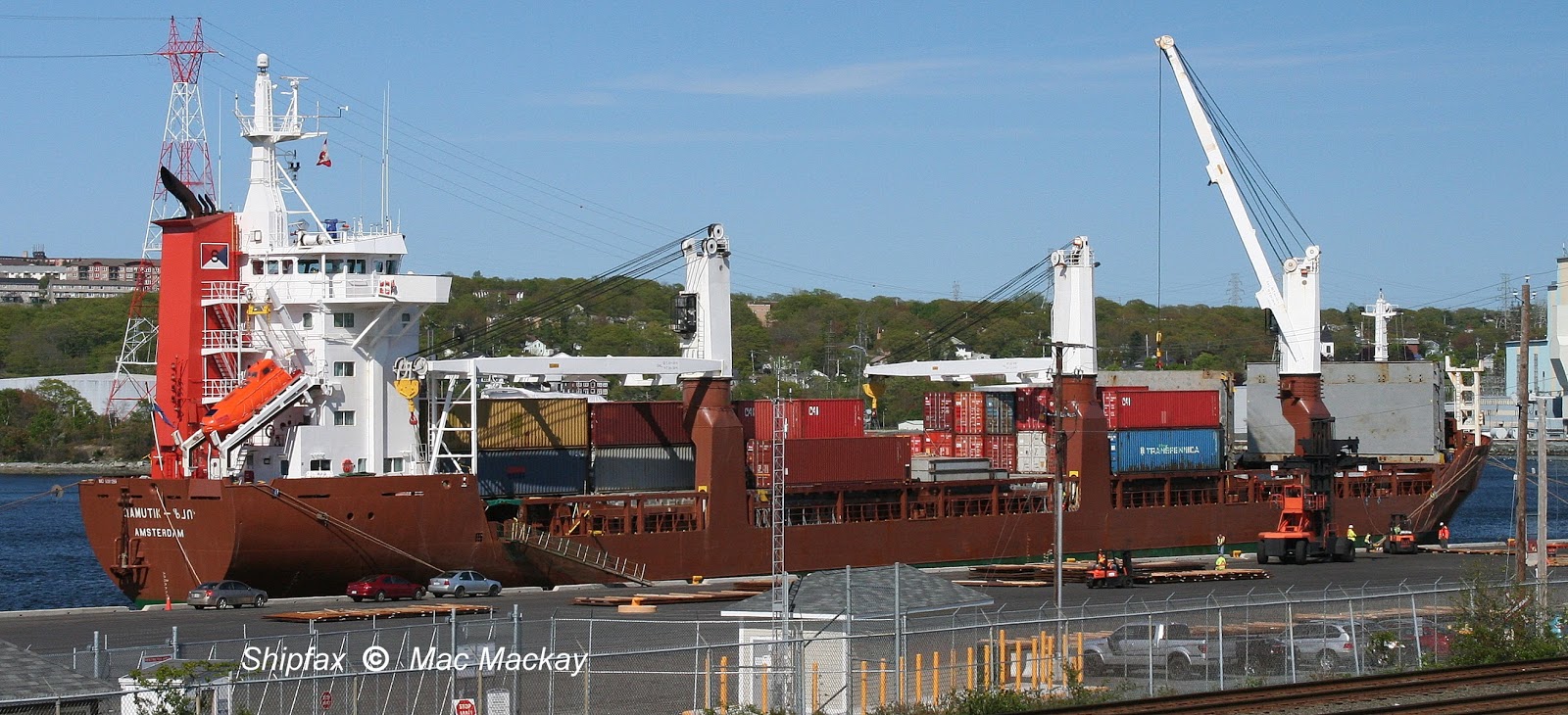
When the ship was in Halifax in 2015 it was carrying containers, some breakbulk, including steel plate, and a shrink wrapped power boat - typical cargo for Spliethoff.


The question has been raised if there have been more weather related delays. This may be an unanswerable question, because there are several factors at work.

The first is larger ships. The big container ships, some up to 10,000 TEUs, and autocarriers, are much more subject to windage than smaller ships, and thus much more difficult to bring into harbour and berth. It the winds are too high there is greater risk of damage to the ship or the port facilities with bigger ships. 

The huge slab sides of big container ships make them much more susceptible to windage.
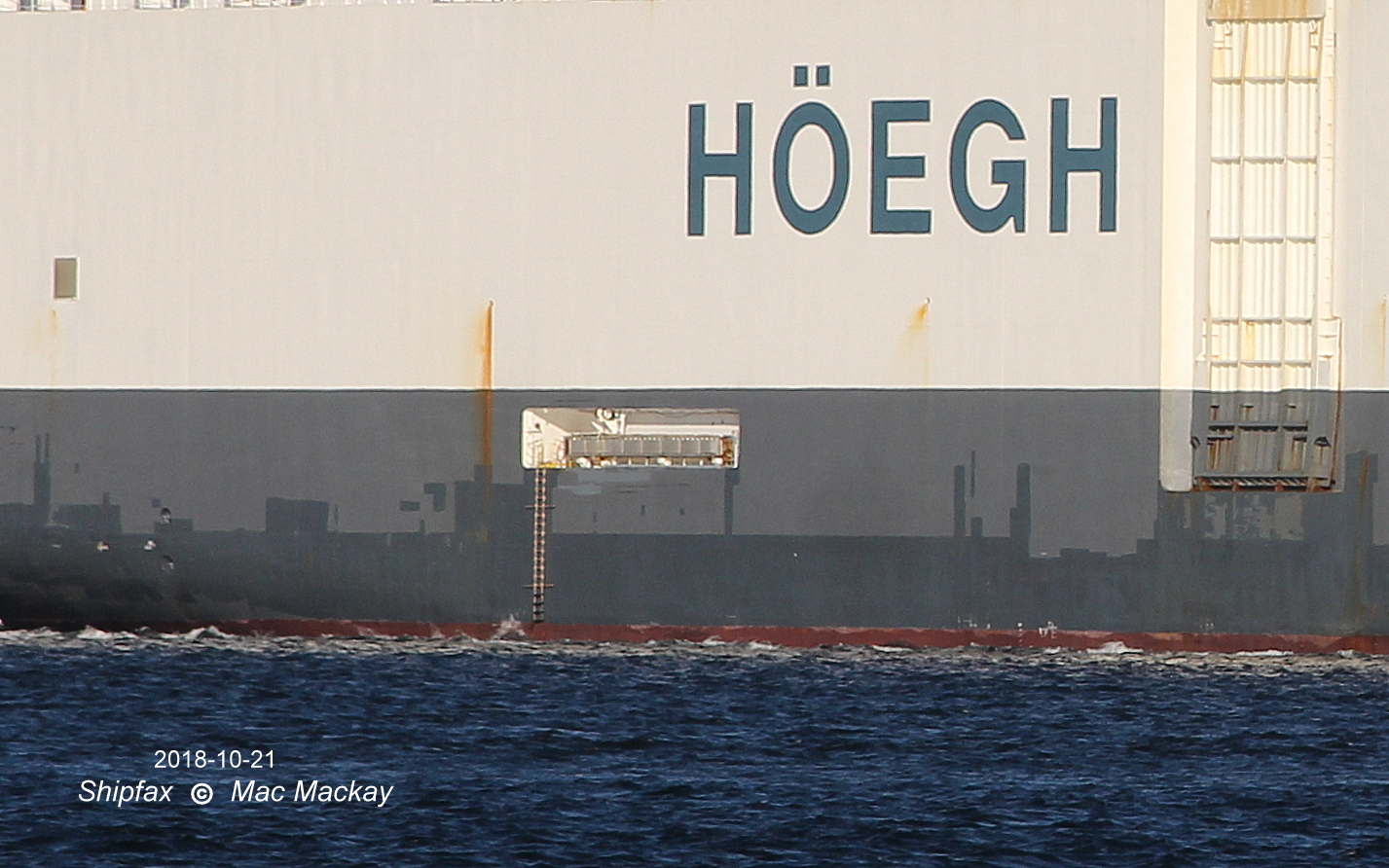
More critical however is the ability of pilots to embark and disembark in safety. The huge freeboard on these ships is a factor. Some are equipped with pilot doors set into the side of the ships, but most are not. Therefore the pilot must climb a ladder or step onto a platform from a wildly gyrating pilot boat.


Set low in the side of this autocarrier the pilot ladder and accommodation ladder are used in combination.

It is a long way up to the main deck on container ships.

That brings up the pilot boats themselves. Built for good speed to reach the pilot station quickly, they must also have good seakeeping ability (including maintaining a course). The current Halifax pilot boats may be a factor in recent delays, at least according to some, but I would not support this opinion as the sole factor.

The current pilot boats, Nova Pilot and Scotia Pilot (in yellow) certainly have low freeboard compared to the older boats such as A.P.A.No.18, in port for refit, and are somewhat smaller. They are also waterjet propelled.


Then there is the climate and the prevalence of bad weather recently. This may be related to the location of the jet stream that forces its way south causing high winds. A seasonal fluctuation in the location of  jet stream, caused by forces as far away as the Pacific Ocean can effect weather here. It may also vary from year to year. This may be one of those years.

Weather is a reality for shipping and port operations, and I am sure will excellent fodder for continuing  discussion.


Wednesday, July 18, 2018

News from the North

News from the north is generally hard to come by, but a few nuggets have escaped.

Ice conditions in the north are the worst in the last four years according to one report. They are so bad that even Fednav, have had to resort to reinforcements to make up for delays. Their Arctic is contracted to transport nickel concentrates from the Raglan Mine through the port of Deception Bay to Quebec City. However ice was so thick that the ship was delayed from June 1 to June 17 and they risk not being able to transport the required quantities of the ore, both to keep the mine operating, (stockpiling is limited at the port) and to feed the smelter in Sudbury.  They have therefore applied for a coasting license to use one of their foreign flag ships to make one trip in September or October to make up the potential deficit.

Speaking of Arctic this significant ship is due for retirement in 2020, and its replacement has been ordered from  Japan Marine United Corp Shipyard  (the merged Universal and IHI).


It was built in 1978 by Port Weller Dry Dock initially to serve the Nanisivik zinc-lead mine on the north coast of Baffin Island. In 1984-85 it was rebuilt as a combination ore / bulk / oil /carrier with a new bow. It then loaded oil from the Bent Horn field on Cameron Island, transshipping it at Rae Point to Imperial Bedford for refining in Montreal. The ship also landed some of the oil in Halifax for refining.

For some reason two of the cranes are missing their booms.

Nanisivik mine was closed in 2002 and Bent Horn in 1996. production started at the Raglan Mine in 1997.

In 2007 the ship went to Jiangyin China for life extension. The work was to allow the ship an extra ten to twenty years. It then went back to work running from Deception Bay, on Hudson Strait, to Quebec City during the eight month shipping season.

Arctic also carries general cargo in containers to provide supplies to the mine.
Fednav operates two other ice breaking bulk carriers in northern waters. Nunavik and Umiak I, the most powerful ice-class bulk carriers in the world.


Meanwhile the number of pleasure craft passing through northern waters is exploding. In 2017 no less than 23 pleasure craft completed a northwest passage. Two commercial passenger ships, three non-government icebreakers, two cargo ships and a tanker also made northwest passages. All this is on top of the necessary re-supply and ore extraction voyages to the north, and several other passenger ships that made incursions into the arctic waters.

On July 16 the yacht Ice Angel (registered in Douglas Isle of Man) sailed for Nuuk, Greenland, the jumping off point for a Northwest Passage. Built in 2009, and previously named C9 and Cloud 9, the 1307 grt vessel was built by CNM Yachts of Cherbourg, France, and refitted in 2017. It has a steel hull and aluminum superstructure. What specific features it may have for arctic work is not known.


 Ice Angel with some of its attendant craft leaving port.

It is the second vessel to sail from Halifax recently giving Nuuk as destination. The previous one was the sailing vessel Kamaxitha which left port July 8.

As reported in Tugfax numerous cargo ships are employed each summer to deliver cargo to remote communities. Most of these places have no port facilities, and cargo must be landed by barge. The ships carry the barges and small tugs to handle all the cargo.

Logistec operates the former Spliethoff ship Qamutik and four other ships for NEAS (Nunavut Eastern Arctic Shipping Inc and Nunavik Eastern Arctic Shipping Inc).

Transport Desgagnés operates five seven general cargo ships including Sedna Desgagnés and four tankers for northern supply. They have also chartered in a foreign flag ship to meet demand.

Other companies such as Woodward's Coastal Shipping also operate tankers in northern supply. All this activity will stretch the capabilities of the Canadian Coast Guard to cover such a vast area.

.


Monday, June 8, 2015

Qamutik update

The cargo ship Qamutik unloaded a quantity of steel plates yesterday and sailed in the evening for Valleyfield, QC.

Qamutik unloading on Sunday afternoon.

By this afternoon many of plates had been loaded on trailers and several trucked away. Some of the steel is no doubt headed for Irving Shipbuilding inc, but other parcels are destined for other users.

.

Saturday, June 6, 2015

Quiet on the eastern front

It was a quiet day on the waterfront - if you don't count herring seiners - which I do. There were six. All arrived this morning and it was a major traffic jam at pier 24 as they unloaded and some took on ice.
Aside from the four boats that have been here regularly, the Tasha Marie finally made an appearance.
Built in 1979 by John Manly Shipyard in Vancouver as Cindy H, it is owned by the intriguingly named Turpentine Seiners Ltd of Wedgeport, NS.

Tasha Marie tucked in at Queen's Wharf after unloading then returned to pier 24 to take on ice. 
The skull and cross bones on the right was part of a waterfront event, not associated with this boat.

Also arriving for the first time this year was Sealife II. It is now owned by Comeau's Seafoods Ltd of Saulnierviulle and sports the company's blue hull colour, but it was always a red hull before that.

Sealife II rounds up to come alongside the Tall Ships Quay.

Built in 1970 by Ferguson Industries in Pictou, NS, it is a sister to Lady Janice II, which started life as Sealife No.1 in the same yard in the same year. Sea Life Fisheries (1988) Ltd is a division of Comeau's Seafoods, however it was a previous company that owned these boats during the original herring boom. 
Comeau's is a large business and also has a ship repair facility in Saulnierville Meteghan, which includes a marine railway [edited]. When I was there last November, Sealife II was on the cradle.


Most of the other comings and goings of the day took place in pouring rain, which is my excuse for not taking photos.

However the air cleared off somewhat for the late afternoon arrival of the "off again/on again" Canadian ship Qamutik. The ship dates from 1994 when it was built by Friesian Welgelegen at Harlingen, Netherlands for Spliethoff's. Named Edisongracht, it traded for them until 2008 when an arrangement was made with Umialarak Transportation for seasonal service to do northern supply work in Canada.  To be managed by Transport Qamutik In (Logistec) it would return to Spliethoff's for the remaining eight months of the year. 
It was renamed Qamutik (translation: ice sled, also known as komatik) for the summers of 2008 and 2009. reverting to Edisongracht each fall. In 2010 it became Qamutik permanently, and is now bareboat chartered back to Spliethoff's in the off season without change of name.

 Amongst its deck load of containers, the ship is also carrying a shrink wrapped pleasure craft. Spleithoff's has a large business in transporting yachts.

Its arrival today was under the Dutch flag, but it is due in Valleyfield, QC, its loading terminal, later this month where it will hoist the Canadian flag again and sail June 21 for the north.

Still wearing Spliethoff's funnel marking and flying the Netherlands flag. Note the stern anchor, fitted for compliance with St.Lawrence Seaway rules, but also for anchoring in the north where there are no permanent harbours, and cargo must be lightered ashore.

The ship measures 8448 grt, 12,754 dwt and carries three 60 tonne cranes and can carry 730 TEU. It berthed at pier 9c where it will offload some containers.

.