Showing posts with label Eastcliffe Hall. Show all posts

Monday, August 28, 2023

Looking forward from the Past

 A recent post on Facebook reminded me that traditional Great Lakes freighters, built with the wheelhouse forward, are becoming rarer as time goes on. As older ships are removed from service and scrapped their replacements have the wheelhouse and all accommodation aft like modern bulkers around the world. This loss of distinctive appearance is regrettable, but understandable, as new technology has meant that the visibility provided from a forward wheelhouse is no longer essential to safe navigation.

Also ships that work the Great Lakes are now often built to work off the Lakes and beyond the Gulf of St.Lawrence for short sea voyages to Newfoundland, Nova Scotia and even to the Bay of Fundy coast of New Brunswick. Some even go farther afield and make ocean voyages.The forward mounted wheelhouse is much more exposed, subject to more pitching and isolated from the accommodation, galley and is thus a liability. Steering and engine control connections are also awkward and complex.

Halifax saw many ships with wheelhouse forward  over the years, although they were generally of the small canal sized vessels (some of which had been built in the UK and made transatlantic crossings in peace and war.)  The many locks on the old St.Lawrence River canals limited ships to 260 feet long and 45 feet wide with a maximum draft of 14 feet.


The Charles R. Huntley, built in 1926 in Scotland, was obsolete by the time the St.Lawrence Seaway opened in 1959, although it was still sound enough to be converted to a suction dredge. It worked on the construction of the South End Container Terminal in Halifax (then called Halterm) in 1969 and kicked around for several years thereafter, dredging in Saint John and St.Lawrence River channels. It also had some close calls at sea in bad weather. It was finally scrapped in 2003 as BV Reyna.
 

The Lachinedoc, built in 1956 in Newport, Wales, was one of the last ships built to the old canal dimensions. It carried a pair of cranes to handle newsprint cargoes, but also carried bulk grain to Halifax as in this 1970 photo. It remained in Canadian service until sold overseas in 1975 and was lost in Bahrain in 1981.

Once the St.Lawrence Seaway opened in 1959, and much larger ships could travel to and from the Great Lakes some of the canallers were lengthened and even deepened to increase their capacity.

Eastcliffe Hall was built in 1954 to suit the old canals but in 1959 was lengthened 90 ft ( 27.5m) from 258 ft (78.9m) to 349 ft (106.4m) and deepened. [It sank with  loss of life a few days after I took this photo in Halifax in July 1970.]

When the Nortcliffe Hall was sold south in 1975 it wisely fitted storm shields over the wheelhouse windows. (Built in 1952 as the first Frankcliffe Hall it was deepened in 1959, renamed in 1962 and returned to Canada as Roland Desgagnés in 1976. It sank off Pointe-au-Pic in 1982 with a cargo of salt from Pugwash, NS for Montreal.)

New ships, built to the maximum allowable size for the new Seaway locks (originally 730 feet by 75 feet), were basically enlarged versions of the traditional ships, with wheelhouse and some accommodation foward. Also they were not normally built strongly enough to go to sea. Their relatively long and slender shapes would need considerable reinforcement beyond what was needed for Great Lakes conditions, especially if they were to work off Lakes in winter, and as noted, the forward wheelhouse was a liability. Lakers also had limited sailing range, as fueling locations were plentiful on the Lakes. Even into the 1960s and beyond, many lakers still burned coal.

A new breed of "salty laker" was designed for both high seas (salt water) and Lakes work (fresh water). One of the first was an odd ship, a self-unloader, the Hallfax built in the UK, with wheelhouse forward. It was built to carry coal from Sydney, NS to Montreal and Toronto and often back-hauled grain to  Halifax. Well shy of the maximum dimensions for the Seaway, it was enlarged, but never really fit in and must be considered an experiment.

In 1970, when this photo was taken, Halifax did not have the ability to receive grain from self-unloaders, and instead used the old-fashioned "grain leg" which was a bucket conveyor that reached into the ship's hold. However the ship did use its self-unloading equipment to move cargo to one central hold so that the ship did not have to shift as each hold was emptied.

After this, new "salty-lakers" were built with wheelhouse and accommodation aft. The Cape Breton Miner (680 ft x 75 ft) and near sister Ontario Power (712 ft x 75 ft) carried coal from Sydney, NS under contract to Ontario Hydro, but would also carry grain to Halifax on the return trip. They operated deep sea in winter, and had bulbous bow and "seagoing" hull shape.

Another unique ship was an exception to the rule. The Frankcliffe Hall (second of the name) was built in 1963 for the Lakes trade. It was later converted to a self-unloader and reinforced so that it could make "short sea" voyages to Halifax with grain and to back-haul gypsum, salt or other bulk cargoes. The ship's original fine appearance was marred by the self-unloader frame and an awkward funnel extension. The ship remained a steamer too until broken up in 2011.

Renamed Halifax when acquired by CSL, it was the last Great Lakes caller in Halifax with wheelhouse forward.


 There was also one unplanned visit of traditional Lakers to Halifax and that was when the Helen Evans and the Thornhill arrived in late 1980.

The Helen Evans was built back in 1906 by the Great Lakes Engineering Works in the Detroit suburb of Ecorse, it was originally called the James Laughlin and worked for Jones + Laughlin Steel's Interstate Steamship Co until 1952 then Wilson Transit before its sale to Canadian owners in 1964. Those owners were Hindman Transportation of Owen Sound, ON - noted for their ability to squeeze more years of service out of old hulls. They renamed the ship Helen Evans (after fleet owner Captain George Hindman's daughter) and in 1967 re-powered the ship with second hand steam machinery from a Liberty ship. Then in 1974 they converted its boilers from coal-fired to oil. However at only 550 feet long it was not large enough for profitable operation, as ships of maximum Seaway size could be operated by a same or smaller sized crew.

In 1978 Hindman sold the ship to Quebec + Ontario Navigation, but that ownership was short lived and Q+O sold it for scrap in 1979. The buyers were in Colombia, and the ship was to be towed to their scrapyard in Mamonal along with another veteran ship. 

The Thornhill, the other ship in the tow, was also built by Great Lakes Engineering Works in 1906, but for the Cleveland Cliffs Iron Co, and named Ishpeming. It was re-powered with steam turbines in 1951, and served Cliffs until 1966 when Canadian owners Upper Lakes Shipping bought the ship. They operated it as Thornhill until 1979 when they sold it to intermediaries who sold it on to the Colombian breakers.


 The tug assigned to the job was the Captain Ioannis S, ex Sistella, ex Sandy Cape, built in Norway in 1994 and rated at 5400 bhp. It had recently been acquired by Quebec Tugs. With the tandem tow assembled, they departed Quebec City September 17 and while out in the Gulf of St.Lawrence a malfunction in the tug's controllable pitch propellor system caused it to back over and sever the tow line.

The Helen Evans and Thornhill (with names painted over, and port lights plated over) were eventually rounded up and towed into Halifax on September 23, 1980. It was a memorable event, as these were the first (and so far only) classic lakers to arrive in Halifax in original configuration. (I make a distinciton between "lakers" and "canallers".)

Of note, both ships had new larger wheelhouses built in the 1950s. Radar and other navigation aids had become mandatory and would not fit in the confines of the old steering stations, so more room was needed.


Tugs finally got the dead ships alongside Pier 21 (it took four tugs each). There was no one aboard the ships save a harbour pilot and no operable winches, so gangs of linesman had to be arranged from shore and from the tugs. Note the emergency steering wheel on the boat deck aft. Another of the problems with a forward wheelhouse was the long connection from helm to rudder, running the length of the ship. In case of emergency the ship could be steered from aft, but how it was navigated must have presented challenges!

After a few weeks in Halifax, the tow arrangement was restored, the flotilla set sail October 16 and arrived in Colombia October 30, 1980 without further incident.

Among the remaining forward wheelhouse ships on the Great Lakes today, several are Canadian, but none are likely to ever visit Halifax, as they are not strengthened for "outside" work. Most get as far east as Sept Iles, QC. One example is the John D. Leitch (730 ft x 77'-11 3/8") which operates regularly on the lower St.Lawrence.


 Built in 1967 the John D. Leitch has none of the grace of its predecessors, but has proven to be a valuable member of the ULS, then Algoma fleets. (Its cargo section was widened when the Seaway increased the maximum width from 75 ft to 78 ft.)

Two others, CSL's CSL Tadoussac and Frontenac have foiled my attempts for clear photographs -   Frontenac by skillfully camouflaging itself in fog. 


.


Friday, July 1, 2022

Break Bulk and Bulk

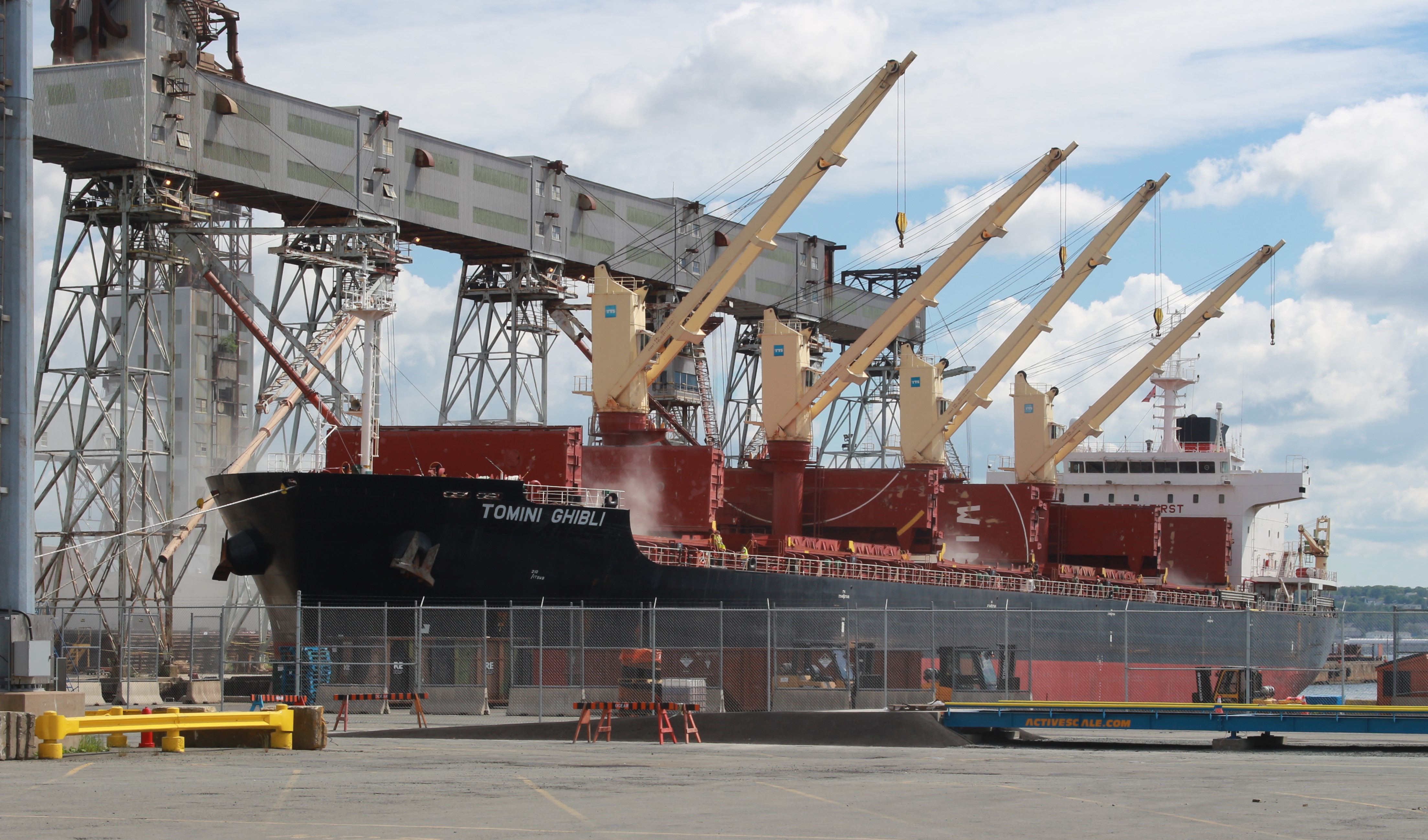
 In yesterday's post I mentioned the grain loadout gallery at pier 28, and today the facility was in use loading the bulk carrier Tomini Ghibli.

A series of conveyors from the grain elevator silos transfers cargo to the ship loading gallery where a series of spouts direct the cargo into the ship's holds. The facility replaced older structures at Pier 23, which could not load large ships, and Pier 26. 

Today's visitor, the Tomini Ghibli, is a typical bulk carrier, built in 2016 by AVIC Weihai, Weihai, China. Measuring 23,741 gt, 37,896 dwt, it carries four 35 tonne capacity cranes.

Built as Sea Angel it was renamed as recently as June 1 by Tomini Shipping. The Tomini family, founded the company in their native Pakistan, but later moved to London, then to their current headquarters in Dubai. They named this ship after a "hot, sand bearing wind of North Africa". Its last port was Grande Anse, QC and Trois-Rivières QC where it offloaded bauxite. 

The old loading facility at Pier 23 had only 3 or 4 spouts, and could not accommodate large ships. It was little used by 1970 when I took this photo:

The USSR water tanker Alitus was in port to load fresh water for the fishing fleet. They used Halifax tap water to freeze the fish at sea. (The Halifax skyline has only one high-rise - the Park Victoria apartments, where I lived.)

The ill-fated Eastcliffe Hall (it sank July 14, 1970 with loss of nine lives only a few days after I took these photos) was at Pier 25-26. The conveyor system extended out to the end of Pier 26 and had loading spouts the full length. In the centre was the grain leg, which was used to offload ships that did not have their own unloading equipment. There were two conveyor sytems - one in each direction, to and from the grain elevators.

 Now the conveyor gallery ends at Pier 25, and is no longer used to load ships. The grain leg has also not been used for many years, since all incoming grain now comes on self-unloading ships, which discharge directly into a hopper and into the "inbound" conveyor. To my recollection the grain leg was last used to unload grain from a ship that arrived for repairs, and the cargo had to be removed and dried before being re-loaded after the ship was repaired.

The St.Lawrence Navigator had a cargo of grain from the Lakes in 1975, and the grain leg was was the means of unloading. The ship had to be repositioned several times as the grain was unloaded, although they did have payloaders in the hold to assist with the last dregs.(Note the Pier 26 portion was gone by 1975.)

 As the Port's plans for the area will see the camber at Pier 27-28 filled in, they will have to rebuild the grain gallery at pier 25-26 for ship loading, and perhaps extend it out to the end of the pier again to accomodate larger ships. It appears that the "two storey" structure still has room for two conveyor systems, but it is not long enough for large ships.

The Independant Pioneer at Pier 25, preparing to load grain in 1970. Note the maze of conveyor systems in the background connecting the "export" conveyors to the grain elevator.

Smaller ships like the Ernst Schröder, also in 1970, often loaded relatively small quantities of grain after discharging general cargo to the shed at Pier 26. However the pier could accommodate large ships for loading.

 Nowadays the few grain loaders we do see are seldom smaller than today's Tomini Ghibli.


Friday, April 3, 2020

Spring is here

As one of the east coast "winter ports", along with Saint John, NB, Halifax always had mixed feelings about the arrival of spring. Ships that would not dare to chance an encounter with ice and had been calling in the winter ports would now be shifting to the St.Lawrence River and even the Great Lakes. This meant a huge reduction in shipping activity in Halifax, with very little offset.

One ray of light was the arrival of the first grain loads from the Lakes. Until 1959 only small ships could reach the Great Lakes, and then only seasonally and grain export ports such as Montreal, Sorel, Trois-Rivieres and Quebec City were also cut off by winter ice. The federal government subsidized railway shipping rates to Halifax so that grain farmers could get their grain to international markets more effectively. Called the "Crow Rate" it meant that the cost to transport grain by rail from the prairies was the same to Vancouver or Halifax. A huge grain elevator was built in Halifax to store grain during the summer and ship it out during the winter.

Once spring arrived, so did grain by ship, from ports as far away as the Lakehead.


Before the St.Lawrence Seaway was built, the size of ships that were able to reach the Great Lakes was limited by the size of the St.Lawrence canals. The earliest canals were minuscule, but by the time of Confederation in 1867 plans were afoot to enlarge the locks to allow ships of roughly 260 feet x 43 ft with a 14 ft draft. Work was mostly completed in 1901.  A series of locks bypassing Niagara Falls, had been built to the same size, and this permitted ships to carry grain (and all sorts of other cargo) from the Great Lakes to salt water.

A special breed of ships, called canallers were built to the maximum dimensions of the locks but with scantlings to permit 16'-6" draft when not "canalling". The ships were also built to Home Trade Class I (trade to the West Indies) or II (Gulf of St.Lawrence and eastern seaboard to New York.) They were thus able to reach Halifax with grain cargoes, but most of the grain arrived by rail because the ships were so small, and the Crow Rate favoured rail.

In the early 1950s shipping companies were experiencing a boom with the post-war expansion of the Canadian economy. Ancient steam powered canallers were not able to meet the demand for ships and despite the looming arrival of the Seaway, they were forced to build new ships but to the old canal dimensions. Knowing that the Seaway would be opening in 1959 they designed the new ships to be lengthened, and even deepened in some cases.

Most of the old steam canallers were scrapped when the Seaway opened. A very few, like the Charles R. Huntley, built in 1926, found new work. Converted to a trailing suction hopper dredge, it worked on construction of the south-end container terminal in Halifax.

It was easy to see why the old ships were no longer profitable. Two of them could fit into the new Seaway locks with room to spare. Shipowners began to build ships to suit the 730 ft x 75 feet dimensions and with smaller crews.

This scene, one of my earliest photos, shows the Canada Steamship lines Elgin, a steam canaller in the foreground and another steamer in the background (identity not recorded).
 In the middle is one of the new diesel canallers, Sarniadoc.

For the first several years after the opening of the St.Lawrence Seaway in 1959 the grain ships coming to Halifax ships were former canal sized ships that had been lengthened. The Hall Corporation of Canada was the company with the most of these ships, all very similar in description.

Rockcliffe Hall

Built in 1958 by Davie Shipbuilding + Repair in Lauzon, QC, as a twin screw motor canaller, the ship was lengthened and deepened in 1961 by Canadian Vickers in Montreal. At 342.8 ft long it now had a tonnage of 3543, up from 2262. It was a regular in Halifax bringing in grain.

In 1972 it went back to Canadian Vickers and was converted to a tanker. Its forward cabins were moved aft and it was renamed Island Transport.

When owners Hall Corporation of Canada Ltd went out of business the ship was sold in 1986 to EnerChem Ship Management and renamed Enerchem Laker. It did not call in Halifax under that name, but it did return in 1990 under the name Recovery VIII after it had been sold to Panama owners.


On Christmas Day 1990 it left Halifax under its own power, but in tow of the Boston tug Russel Jr. Once in protected US waters it carried on to Panama un-aided where it was renamed Morgan Trader in 1998 and Anna II (Honduras flag) in 1998. Its fate since then is uncertain and has likely been out of service for some time.


Hutchcliffe Hall

Another twin screw motor canaller, Hutchcliffe Hall was built by Canadian Vickers in Montreal in 1954. In the reverse of its fleet mate it was lengthened and deepened by Davie Lauzon in 1959, going to 343.8 ft long and increasing from 2143 to 3476 gt. Dwt increased from 2143 to 3376 tonnes.

In 1972 the ship was converted to a spoils carrier for the North Traverse dredging project on the St.Lawrence River. It was renamed Ile aux Coudres. In 1982 it was towed to British Columbia and in 1984 renamed Canadian Challenger in 1986 and was eventually scrapped in 2002.

Eastcliffe Hall


Another product of Canadian Vickers in Montreal in 1954, Eastcliffe Hall went back to the same yard in 1959 to increase gt from 2140 to 3335 after lengthening from 259 to 343.3 ft. and deepening from 19.0 to 22.8 ft.

After unloading grain in Halifax in early July 1970 (see photos above) the ship sailed in ballast to Sorel, QC where it loaded pig iron for Saginaw, MI. After transiting the US locks in the St.Lawrence Seaway July 14 the ship wandered off course, grounded, then struck a submerged pier and sank very quickly near Morristown, NY. Nine lives were lost including the captain and his teenage son, the chief engineer his wife and their small daughter.

The ship's cargo was recovered, and the wreck cut down to deck level. Its hull was filled with stone and left in place.


Other shipping lines also has modern canallers that brought grain to Halifax. Among them was N.M.Paterson + Sons Ltd.

Lachinedoc 


Built in 1956 by Atlantic Shipbuilding Co in Newport, Wales, it was a 2193 gt ship equipped with a pair of deck cranes for handling general cargo. It was never enlarged and continued to operate until 1975 when it was sold overseas.


Reamed Emerald by United Arab Emirates owners, it was lost in the Arabian Gulf November 8,  1981.


In January I also covered another pair of canallers in the same trade.


In the early 1970s shipowners began to invest in larger ships and the days of the old canallers were numbered. For several years re-purposed cargo and bulk carriers brought the grain, but eventually it became self-unloaders only.  

In 1983 the first grain arrived on Frankcliffe Hall, on March 29. Even though it was a self-unloader the Halifax grain gallery did not have a hopper system, and still had to use the time consuming grain leg. Eventually the hopper was installed and Frankcliffe Hall was renamed Halifax, but that will be the subject of another post.

The Crow Rate was eliminated, and little grain is exported from Halifax now. Most of the incoming grains (including corn) are for local consumption.

This year, in a bit of a turnaround, the first ship to use the St.Lawrence Seaway on opening day was CSL's Baie St.Paul from Halifax with a load of gypsum for Hamilton, ON. 

Regrettably fuzzy shot of Baie St.Paul loading gypsum for the Lakes on March 27. 

It is possible it will also be the first caller in Halifax from the Great Lakes too since P+H Milling owns the flour mill in Halifax and has a grain storage facility in Hamilton.

.

Thursday, October 12, 2017

Grain from the Lakes

Another load from the Lakes arrived yesterday on the Algoma Mariner. The amount of grain (could be feed grain, corn or wheat) coming from the Lakes is much reduced from days gone by, when there was an almost monthly arrival. Now it is only a few times a year. Grain continues to arrive by rail however.


The ship looks a bit like a shark lunging out of the water. 
Its hull paint has eroded at the bow wave line.

Ships now unload directly to a hopper that leads to the conveyor system running to the storage elevator. Before self-unloaders were common in the grain trades, ships used a system of buckets on an endless belt that was lowered into the ship. The ship had to move back and forth along the pier so that the "grain leg" could reach all the holds.


The Eastcliffe Hall under the grain leg in July 1970.

On its return to the Lakes Eastcliffe Hall loaded a cargo of pig iron in Sorel, QC and on July 14, 1970 struck a shoal and sank near Cornwall, ON. Nine persons were lost and twelve survived.
The ship was built in 1954 by Canadian Vickers in Montreal to the maximum size of the old St.Lawrence Canals, 253.4' x 43.8' x 17.0'. When the St.Lawrence Seaway opened it was lengthed 92' and deepened 3'-9". 

The grain leg is still there, housed in the tower, but has not been used in many years, since all grain ships that call here are now self-unloaders.

.