Showing posts with label Tomini Ghibli. Show all posts

Wednesday, July 6, 2022

IJzerborg for Nirint and other things

 Nirint Shipping, based in Barendrecht, Netherlands, operates a regular general cargo and container service between Rotterdam, Netherlands, Bilbao, Spain and the Dutch Caribbean islands of Aruba and Curacao and Cuba and returning to Europe via Halifax. The primary cargo for Halifax is nickel sulfides from Cuba. They use up to seven different ships to maintain the service, not all of which call in Halifax on every trip.

Today's arrival (July 6) has not been one of the regulars, and I believe it is making its first call in Halifax. The IJzerborg is a multi-purpose general cargo ship of the open hatch, moveable tween decks, box shaped hold type. With a hull built in 2010 by Damen Yichang, and completed in Gorinchem, it is a 8999 gt, 12,080 dwt vessel fitted with a pair of 80 tonne capacity cranes. It is also strengthened for heavy cargoes, and containers in all holds and on all hatches. The container capacity is 686 TEU and includes 80 reefer plugs. To add to the ship's utility it can carry grain, is fitted for Great Lakes trade, has hold ventilation, dehumidification and CO2, and is Ice Class 1A Swedish/Finnish. Its tween decks are removable and can be installed as temporary bulkheads. (Sister ship IJsselborg has called in Halifax numeorus times in 2016, 2018, 2020 and 2021.)


Despite today's heavy rain, the ship was seen working cargo, which I appears to be nickel sulfides in bulk bags, which protect it from weather. The doors to the Pier 27 shed were open, so I expect the bags were forklifted to the shed for storage. They will eventually be loaded on open gondola rail cars for Sherritt International's refinery in Fort Saskatchewan, AB. 

Recent work at Pier 29 (in the foreground of the photos) has involved installation of a weigh scale for dump trucks to deliver pyritic slate to be used to infill the pier A-1 / Pier B  basin. That means, at least for now, a much clearer view of proceedings at Pier 27 and 28, although there are new fences in between.

In the misty background MSC Manzanillo is in number one anchorage. After working cargo at PSA Halifax Atlantic Hub, the ship returned to anchor. (See yesterday's post.)

 The previous occupant of Pier 27-28 Tomini Ghibli (see July 1 post) completed loading and sailed last evening (July 5) for Ghent, Belgium.

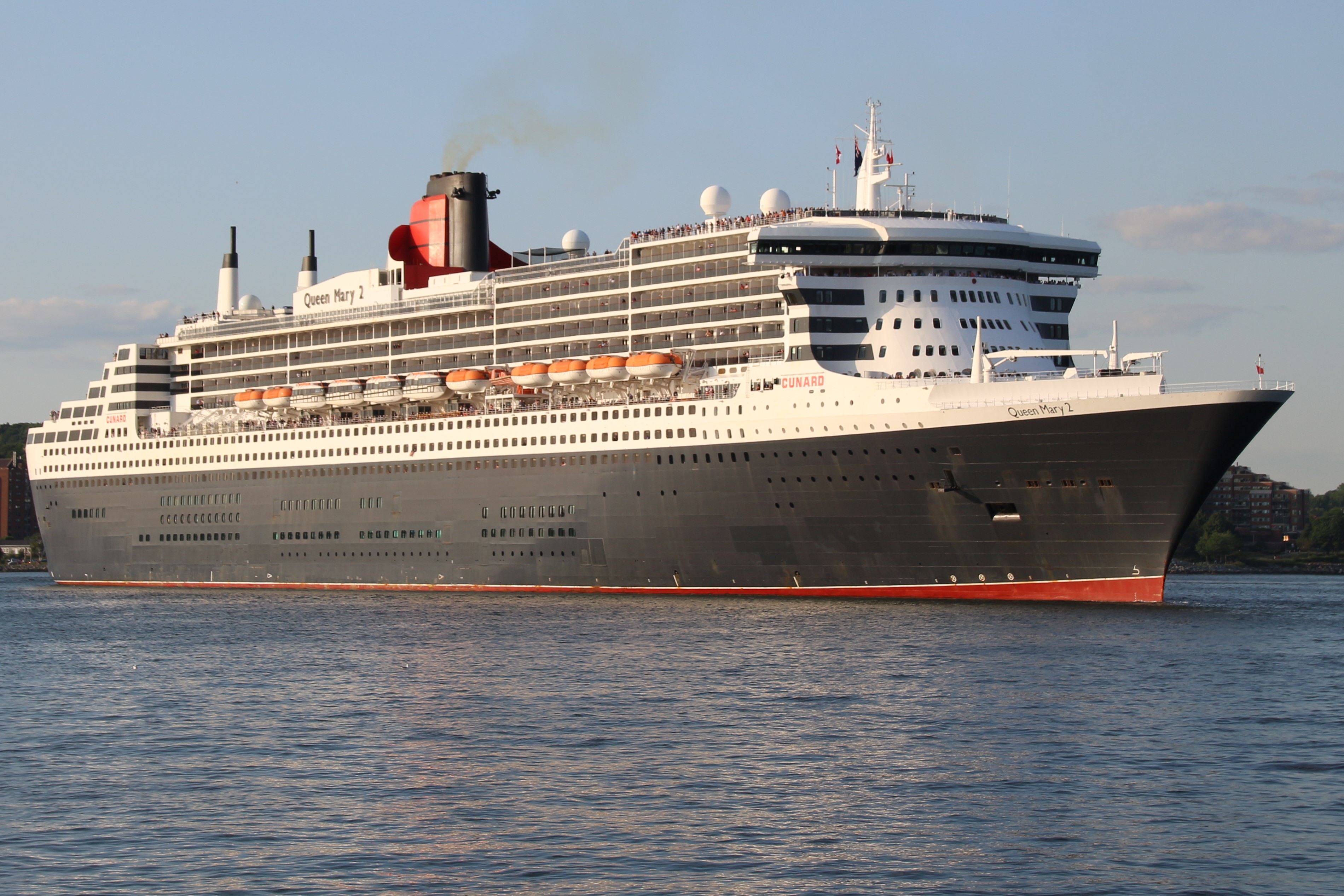
Another visitor in Halifax today is the always popular Queen Mary 2. The ship's arrival and departure drew the usual crowds, despite the weather. I did not make an effort to take a photo this time because I have many pictures already, and taken in good conditions, such as:

 .


Friday, July 1, 2022

Break Bulk and Bulk

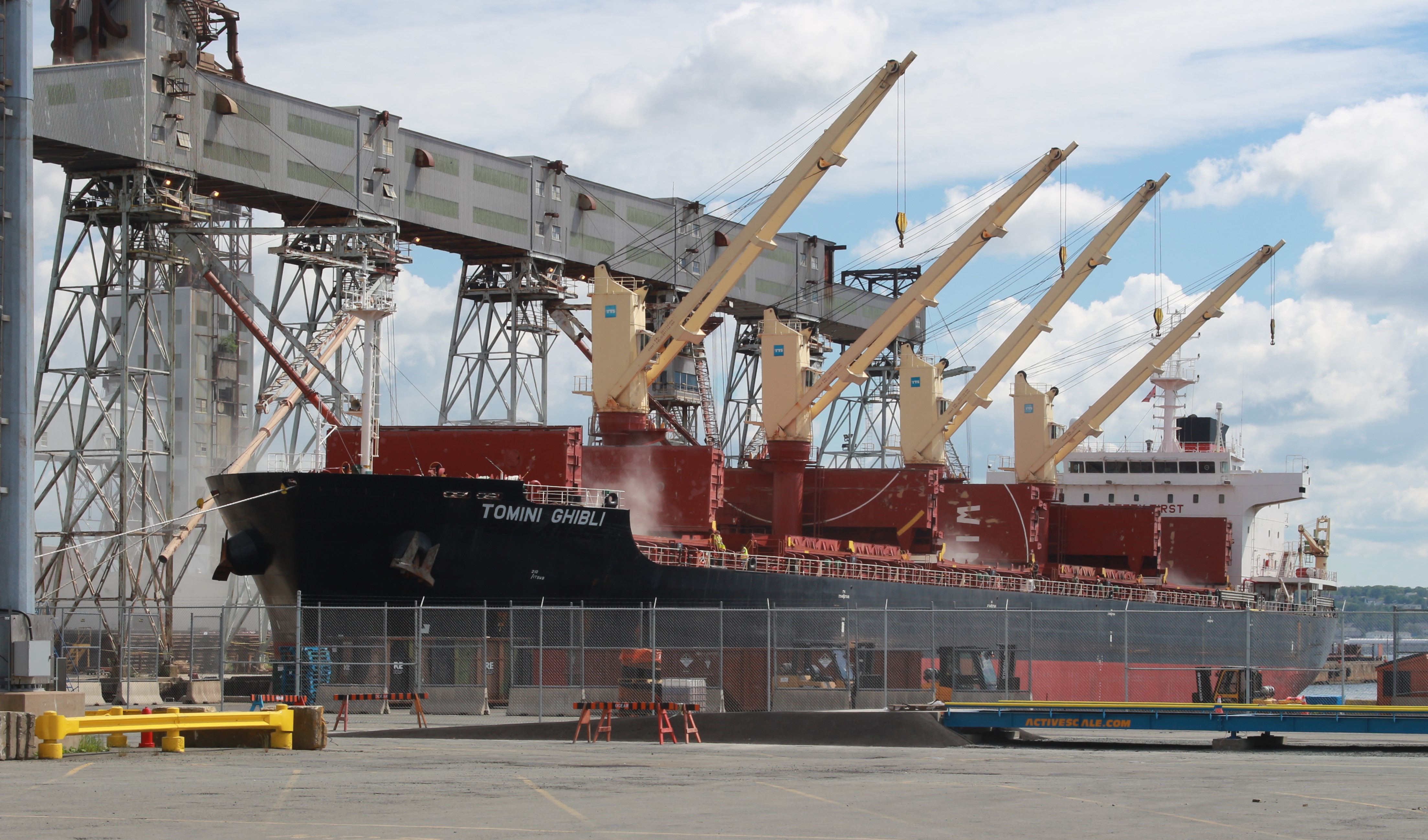
 In yesterday's post I mentioned the grain loadout gallery at pier 28, and today the facility was in use loading the bulk carrier Tomini Ghibli.

A series of conveyors from the grain elevator silos transfers cargo to the ship loading gallery where a series of spouts direct the cargo into the ship's holds. The facility replaced older structures at Pier 23, which could not load large ships, and Pier 26. 

Today's visitor, the Tomini Ghibli, is a typical bulk carrier, built in 2016 by AVIC Weihai, Weihai, China. Measuring 23,741 gt, 37,896 dwt, it carries four 35 tonne capacity cranes.

Built as Sea Angel it was renamed as recently as June 1 by Tomini Shipping. The Tomini family, founded the company in their native Pakistan, but later moved to London, then to their current headquarters in Dubai. They named this ship after a "hot, sand bearing wind of North Africa". Its last port was Grande Anse, QC and Trois-Rivières QC where it offloaded bauxite. 

The old loading facility at Pier 23 had only 3 or 4 spouts, and could not accommodate large ships. It was little used by 1970 when I took this photo:

The USSR water tanker Alitus was in port to load fresh water for the fishing fleet. They used Halifax tap water to freeze the fish at sea. (The Halifax skyline has only one high-rise - the Park Victoria apartments, where I lived.)

The ill-fated Eastcliffe Hall (it sank July 14, 1970 with loss of nine lives only a few days after I took these photos) was at Pier 25-26. The conveyor system extended out to the end of Pier 26 and had loading spouts the full length. In the centre was the grain leg, which was used to offload ships that did not have their own unloading equipment. There were two conveyor sytems - one in each direction, to and from the grain elevators.

 Now the conveyor gallery ends at Pier 25, and is no longer used to load ships. The grain leg has also not been used for many years, since all incoming grain now comes on self-unloading ships, which discharge directly into a hopper and into the "inbound" conveyor. To my recollection the grain leg was last used to unload grain from a ship that arrived for repairs, and the cargo had to be removed and dried before being re-loaded after the ship was repaired.

The St.Lawrence Navigator had a cargo of grain from the Lakes in 1975, and the grain leg was was the means of unloading. The ship had to be repositioned several times as the grain was unloaded, although they did have payloaders in the hold to assist with the last dregs.(Note the Pier 26 portion was gone by 1975.)

 As the Port's plans for the area will see the camber at Pier 27-28 filled in, they will have to rebuild the grain gallery at pier 25-26 for ship loading, and perhaps extend it out to the end of the pier again to accomodate larger ships. It appears that the "two storey" structure still has room for two conveyor systems, but it is not long enough for large ships.

The Independant Pioneer at Pier 25, preparing to load grain in 1970. Note the maze of conveyor systems in the background connecting the "export" conveyors to the grain elevator.

Smaller ships like the Ernst Schröder, also in 1970, often loaded relatively small quantities of grain after discharging general cargo to the shed at Pier 26. However the pier could accommodate large ships for loading.

 Nowadays the few grain loaders we do see are seldom smaller than today's Tomini Ghibli.