Showing posts with label Acadia. Show all posts

Monday, January 1, 2024

Waiting

New Year's Day is a holiday, and there is usually no work in the port and January 1, 2024 was no exception, with only two commercial vessels in  the harbour, and both idle.

At Pier 42 the Tropical Lissette was patiently waiting for the end of the holiday period to resume work.

 At Pier 9C it was the Nolhan Ava laying over for the holidays, before returning to its usual weekly trips to St-Pierre et Miqueon and Argentia. (December 30 photo)

Meanwhile offshore two ships could be seen at the anchorages with Devil's Island partially blocking the view.

The larger ship is the ONE Wren a 14,026 TEU container ship. It is expected to move in to PSA Halifax Atlantic Gateway tomorrow.

Astern of it is the Panamax bulker Athina III also due tomorrow at Pier 28 to take a top-up load of grain or soyabeans. The ship loaded in Quebec City, but due to draft restrictions on the St.Lawrence River it could not take a full cargo. (Some sources have identified the ship as the crude oil tanker Athina, but this was an error on someone's part.)

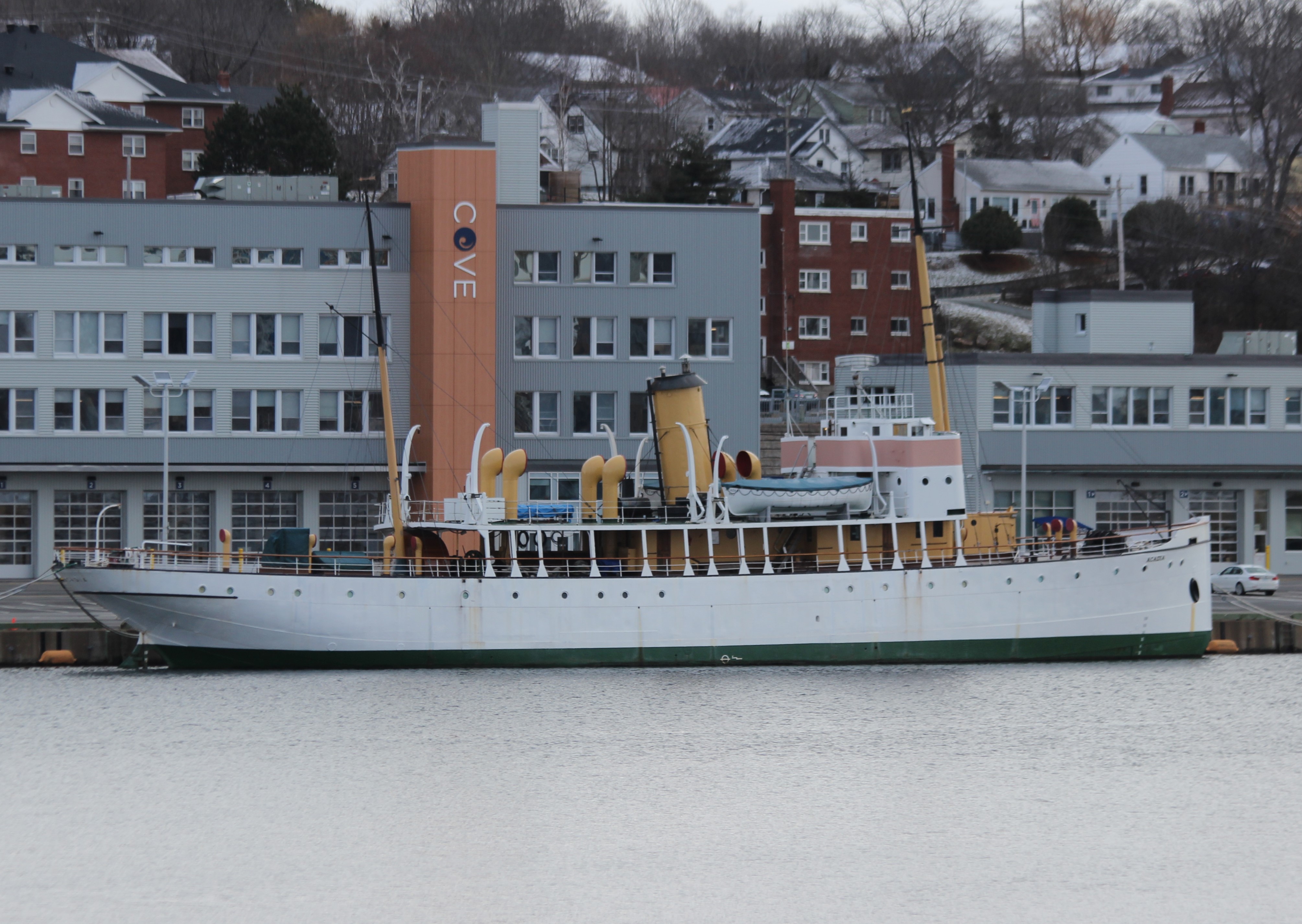
Otherwise the port was very quiet with ships settled in for the winter. Among them is the museum ship Acadia at an unusual berth. Due to planned construction activity at the Maritime Museum of the Atlantic on the Halifax side of the harbour, the ship was moved to the forner Coast Guard base in Dartmouth. Now the home base for COVE - the Centre for Ocean Ventures and Entrepreneurship - It is also the base for several active research ships.

.

Tuesday, November 1, 2022

Are You Still Here

 Since my arrival in Halifax in 1966 I have kept a record of ship arrivals and departures in various formats, usually small note books. I also take a closer look at what is in the harbour each New Year's Day, and make a list of everything I can see. I thus have a quite unique record that would be difficult to replicate from any other source. (Of course it is [mostly] cross referenced on file cards too.) 

On October 31, 1982, as  I neared the end of one record book, I decided to do a tally of everything in port on October 31, 1982- November 1, 1982  (it was a Sunday / Monday). Not surprisingly there are very few ships in that list that can be found in a comparable list compiled yesterday, October 31, 2022 (a Monday) and today November 1, 2022.

 There was still an operable refinery in Eastern Passage in those days, operated by Texaco Canada and the Canadian coastal tanker Gulf Gatineau and the Greek crude oil tanker Kristina were both tied up there.

Imperial Oil's refinery was in full operation and their coastal tanker Imperial St.Clair was in port as was their bunkering tanker Imperial Dartnouth.

 Irving Oil's Woodside terminal was taking on product from the Aimé Gaudreau.

On the container front - it was the Nurnberg Express arriving at Halterm. Atlantic Container Line had recently returned to Halifax after a short stint running to Montreal in combination with HAPAG-Lloyd, and was due to shift to the new Fairview Cove terminal starting in January 1983. ZIM was about to drop the New England feeder service using ZIM Northland but HAPAG was still operating the similar Yankee Clipper as their New England feeder.


Pilot boat operations were carried out from Queen's Wharf by A.P.A.No.1 and A.P.A.No.18. Both boats are still operating for the Atlantic Pilotage Authority, but not presently in Halifax.


Dartmouth Marine Slips was in full swing doing small ship repairs, with CCGS Alert and Thomas Carleton alongside.


There were also fishing vessels in for repairs including the wooden hulled draggers Ross R and Harry N, the steel hulled Cape Wrath and Lumaaq and the offshore suppliers Maersk Rider and Heather Sea.

The Marine Slip's own work boats were also on duty - the World War II built Slipway II 


 and the 1960 Halmar.


The Halmar is one of the two boats in my 1982 list that is still operational in Halifax today. After a major rebuilding by Dominion Diving it still sees nearly daily service shuttling pilots in the harbour and other workboat duties.

The Halmar in its present incarnation does not look a bit of its 62 years.

 Taken a few days after my 1982 tally, a view of the Marine Slips and the Coast Guard base shows many of the noted vessels, plus the St-Pierre RoRo Langlade (which had arrived in tow of the Point Valiant) on the slip

The Canadian Coast Guard Base in Dartmouth was also nearly full up with CCGS Alexander Mackenzie, Labrador, Edward Cornwallis [i], Provo Wallis, John A. Macdonald and Louis S. St-Laurent [the latter of course still operational and presently in the high arctic].

Ferry service between Halifax and Dartmouth was being provided by the relatively new (1979) Dartmouth III and Halifax III both since replaced, but still in existance. A plan to use them in Toronto has apparently stalled out.


HMC Dockyard also had guests on October 31, 1982. I have no reports of any Coasties overdoing Hallowe'en after an arctic deployment on USCGC Westwind.

 There were also USN ships in port: the minesweepers USS Affray MSO-511 and USS Exultant AM-441 sailed November 1.

HMCS Iroquois was in the Graving Dock at Halifax Shipyard on October 31, and the Floating Drydock had the ferry Vacationland. [The latter still exists as a hulk in Quebec City. Sister Holiday Island is now due to be broken up after a serious engine room fire July 22.]

The Shipyard was still operating the veteran Halcrane, although its steam crane was no longer certified for lifting, its coal fired boiler provided steam to ships under repair such as steam powered crude oil tankers still in service well into the 1980s.

The Halcrane's "Woodbine" chimney is matched by the chimney of the former sugar refinery in Dartmouth.

Eastern Canada Towing Ltd were the exclusive harbour tug providers in those days and had nine tugs of various sizes alongside their dock. [not necessarily those shown in the older photo below]

The duty tugs Point Vibert (of 1961), Point Vim, Point Viking and Point Vigour (all of 1962) are all still existing (under different owners) but the outside tugs such as Point Valiant and Point Carroll have been scrapped. Point Spencer and Point Tupper returned to the UK.

At the Bedford Institute of Oceanography there were some familiar names. Sigma T was a small workboat (a newer vessel of the same name is now in service there), and the fisheries research trawler Alfred Needler.  It was still quite new (it was built by Ferguson Industries, Pictou in 1981.)


Still operating, but now out of Newfoundland, the Alfred Needler was in Halifax as recently as this past summer., but has long been painted in Canadian Coast Guard red.

The new fsheries patrol vessel Cygnus was operational (as it still is today, but in Newfoundland). The Department of Fisheries operated from Queen's Wharf. The previous vessel of the same name had been decommissioned and was laid up under the name 81-3


The previous Cygnus was the second of the name, and worked out of Queen's Wharf.
 
Stern trawlers had displaced traditional side trawlers and there were four of the older vessels laid up at Pier 30. No buyers were found and I believe Cape Fortune, Cape Hood, Cape Sable and Cape Blomidon were all "expended" as naval targets.
 

The Forty Fathom fish plant at Pier 29 and the mammoth National Harbours Board cold store across the street were soon demolished too.
 
The Halifax Port Authority operated the Port Authority to maintain fenders at the piers. 
 

A fixture on the waterfront was Atlantic Salvage, which had a ragtag fleet of craft used for "bum boat" service in the harbour, but also available for actual salvage work. One of these was the S.S.Shatford - one of the last wooden hulled cargo vessels to be used in Halifax harbour.

Built for Imperial Oil during World War II to deliver lube oil in barrels and other stores to ships at anchor, it was named for Sydney Smith Shatford, who was responsible for the construction of Imperial's refinery in Dartmouth. [See more in my October 18, 2014 post.] 

Atlantic Salvage had only recently vacated thier long time base at the Western Union pier, adjacent to the Halifax ferry terminal.
 
Preservation of older craft was still far from certain for some vessels such as HMCS Sackville which had  become the Canadian Naval Auxiliary Vessel Sackville and was still in active use for various types of research.
 

However CSS Acadia had been handed over to the Maritime Museum of the Atlantic. It is still preserved there, and is one of only two craft in my 1982 log that is still afloat in Halifax harbour today.


Numerous other ships and craft, totalling 85 names were included in my 1982 list. (Not including the fishing boats of Eastern Passage, and pleasure craft.)

Today's 2022 list (of comparable length) has to include the eight NATO ships sailing this morning with the aircraft carrier USS Gerald R. Ford, but due to drizzle and rain I was only able to catch USS Ramage DDG-61. (Arleigh Burke class).
 

 .
 

Friday, November 5, 2021

Acadia Returns [ Post#1 of 3 for November 5 ]

 The 1913-built Acadia returned to its berth at the Maritime Museum of the Atlantic this morning. 


The veteran of two World Wars and decades of hydrographic survey work has been a static display fixture at the Museum since 1982, but was retired many years before (in 1969) and declared a National Historic Site in 1976. It does require periodic hull maintenance, and that used to be done in Halifax, but there is a shortage of drydocking capability here now, so in August the ship was towed to Shelburne, NS where Irving Shipbuilding Inc has appropriate facilities to effect some much needed repairs to its aged hull.

See previous post:http://shipfax.blogspot.com/2021/08/acadia-to-sea.html

 The ship was towed back in today by the tug Irving Elm which has only recently returned from a summer's work with a barge ferrying cargo into Rankin Inlet from the mouth of Chesterfield Inlet on the west coast of Hudson Bay.


The pair were met off Maugher's Beach by the harbour tug Atlantic Fir suitably draped with white sheets to prevent scuff marks on the newly painted hull.

.


Thursday, August 26, 2021

Acadia to sea

 The legendary Canadian Survey Ship Acadia put to sea today in tow for Shelburne, NS. This is the first time the ship has left the confines of Halifax Harbour since it became the centrepiece of the Maritime Museum of the Atlantic in 1982.

The tug Atlantic Larch backs Acadia out of her berth at the Maritime Museum of the Atlantic, as fog rolls in from the sea. That is Canada's naval memorial, the corvette Sackville in the background. Where else can you take a picture of two World War II veterans?

There are no available drydocking facilities available in Halifax to carry out the needed "shave and haircut" to the ship's hull and quite probably some repairs before a new anti-fouling coating can be applied to the underwater parts of the hull.

Built in 1913 by Swan Hunter, Newcastle on Tyne, the ship was a hydrographic and oceanographic survey vessel before it was retired in 1969. It was commissioned into the Royal Canadian Navy in World Wars I and II and conducted important survey work in Hudson Bay and elsewhere in Atlantic Canada. A more detailed history can be found in the Wikipedia entry: CSS Acadia


.


Thursday, January 5, 2017

Acadia and Acadian, day and night

The "flagship" of the Maritime Museum of the Atlantic is the veteran survey ship Acadia. A veteran of two world wars and a pioneer in charting Hudson's Bay among many other achievements, the ship is now enjoying retirement at the museum wharf.


This morning while walking by I noticed that the Irving Oil tanker Acadian was anchored in an interesting juxtaposition with an orange surveyor's dory in between. I had to act quickly however - no time to carefully frame a photo- because a wall of snow soon enveloped the area and brought visibility down to near zero.

Bow in the snow, stern in the sun, Acadian awaits a turn at the Irving Oil Woodside depot.

Three minutes later it was dark as night. The Halifax Tugger works with divers and a containment boom at Queen's Wharf where the latest waterfront development is under way.


It was just a snow shower however, and in a few minutes the sun was blazing again.

.

Thursday, February 12, 2015

Acadia takes bunkers

A ship called Acadia arrived today to take bunkers. This is not Irving Oil's Acadia, although that ship is also a frequent caller, but a crude oil tanker built in 2008 and originally named Overseas Acadia.
It came out of the New Times Shipbuilding Co of Jingjiang, China and measures 62,775 grt, 1113,005 dwt. It flies the Marshall Islands flag.


As its first name implied it was operated by OSG, Overseas Shipholding Group, but in 2014 it was transferred to Groton Pacific Carriers Inc of Stamford, CT and became simply Acadia.
The publicly traded OSG entered Chapter 11 bankruptcy protection in 2012 and was reorganized in by August 2014, the same month in which the ship was renamed.

.

Monday, November 8, 2010

Acadia cocooning for the winter


CSS Acadia the former survey ship and pride of the Maritime Museum of the Atlantic is preparing for winter. Every year the ship receives a partial cocoon, which protects the wooden decks and contains heat to allow for winter work.

The 1913 era former survey ship is the only existing vessel to have served the Canadian navy in both World War I and World War II. It has many more distinctions, which you can read about here:

Saturday, January 23, 2010

CSS Acadia


Acadia, pride of the Maritime Museum of the Atlantic, will be leaving her customary berth for a spell in drydock. The vintage former survey vessel was last in drydock in November 2003. She is scheduled to return to the Scotiadock floating drydock at Halifax Shipyard on Monday January 25 for hull work, which will keep her safely afloat for some years to come.

Built in 1913 at Swan Hunter & Wigham Richardson at Newcastle-upon-Tyne (hull number 912), she first arrived in Canada July 8, 1913 and on the 29th of the same month sailed for Hudson Bay. She did survey work for the Port of York factory (which was eventually abandoned) and Churchill (which was built). She served in both world wars (the only surviving Canadian ship do do so) and had a distinguished career as hydrographic survey vessel (hence the initials CSS=Canadian Survey Ship) until November 28, 1969, when she was retired.

Acadia was reprieved from the scrapyard when ownership was transferred to the Maritime Museum of the Atlantic, and was opened to the public in 1982.

Originally based in Pictou, Nova Scotia, she was transferred to Halifax when the Bedford Institute of Oceanography opened in the 1950s. However she spent most of the survey season elsewhere on Canada's coasts, particularly in the north and off Newfoundland

There is a lot more to be learned about the Acadia by visiting her at the museum during the summer, when she is open to the public, and at the museum's website.