The current unpredictability in the Canadian economy thanks to unwarranted tariffs applied by the President of the United States against Canada will certainly show up in the shipping in Halifax harbour. Both imports and exports will be effected, due to the closely integrated economies of the two countries. Not only the amount of cargo, but the number of ship visits and the related truck and rail traffic and spin offs, will take a hit. For example:
Gold Bond Gypsum
The largest open pit gypsum mine in the world is located in East Milford, Nova Scotia and is operated by Gold Bond Canada (formerly National Gypsum.) The mine was developed by the Buffalo, NY based company to export raw gypsum to the United States in bulk. Fom the mine, the raw ore is sent by rail to Gold Bond's storage and shipping facility in Wright's Cove in Bedford Basin.

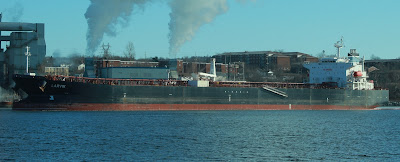
The storage stockpile appeared to be at a very low level as of yesterday when the CSL Tacoma was alongside loading.
Gypsum from the Nova Scotia mine is primarily used for the production of wall board in the United States. It is a major component in building construction due to its fire resistant qualities. The amount of gypsum leaving the Halifax harbour dock has always been a reliable barometer of the United States' economy. When the US construction industry is booming gypsum export quantities are high. Only a small percentage of the US wall board production comes back to the much smaller Canadian construction industry, but due to the economies of scale, wallboard pricing in Canada has been favourable. If tarifs are applied to raw gypsum arriving in the US from Canada, the cost of finished board coming back to Canada, will certainly be higher - especially if Canada imposes retaliatory tarifs. Gypsum companies in the United States may find other sources of raw material. (See the previous post February 28 where CSL Metis sailed without loading gypsum. CSL Trantau did load last week, see March 1 .
Due to drop in the resultant demand there will likley be fewer ships loading here.

The CSL Tacoma at the shiploader, with a thin skim of ice in Wright's Cove in the foreground.
One of Gold Bond's competitors, US Gypsum has a Canadian subsidiary Canadian Gyspum Corp Inc (CGC) with two mines in Nova Scotia. One has been shut down permanently and one was on track to re-open in a few years, but that is now doubtful.
Nova Scotia Power Corp
As noted in my previous post, electricity for the Halifax area is generated at the Tufts Cove generating station. The plant uses natural gas that arrives by pipeline from the United States. The gas comes from a variety of sources mostly the result of fracking. Electricity is fed back and forth onto the grid to supplement power generated at coal fired stations in Northern Nova Scotia and Cape Breton. (That coal comes from the United States.)
If there is an interruption in gas supply Tufts Cove can burn oil, and the recent delivery to its heavy oil storage stockpile came from Houston.

The tanker Larvik unloaded a cargo of black oil at Tuft's Cove. The ship's head lines and stern lines lead out to mooring buoys. A containment boom has also been deployed around the ship by Connors Diving's handsome work boat Eastcom.

If there are obstacles to importing US gas, oil and coal, Nova Scotia Power will need to source fuel from overseas sources, which will almost certainly result in increased power rates. Even that situation will do little to spur NSP's lethargic development of alternate sources such as wind, hydrogen, etc., if they can pass on costs to consumers while still rewarding their shareholders with profits.
Gasoline, Diesel, Avgas, etc.,
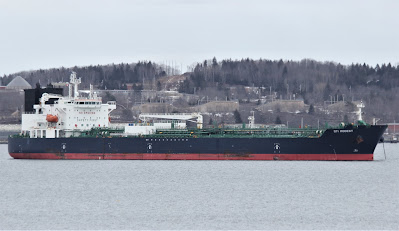
Petroleum fuel for heating, cars, trucks, planes and ships arrives in Halifax by ship and is offloaded at two facilities.
Irving Oil has its terminal in South Woodside, on the Dartmouth side of the harbour. That facility is supplied by ships and by rail and is backed up by a large storage and distribution facility. Irving Oil's refinery in Saint John, NB - the largest refiney in Canada, is the source for most of the product. Irving's two Canadian flag tanker ships (on long term charter) transport the fuel to Halifax, Charlottetown, Saint John's, and sometimes to Quebec. The current tankers are about to be replaced by new ships (the first is en route from Korea) and the Canadian tanker Sarah Desgagnés has been short term chartered to bring product from Saint John to Woodside.
Irving Oil also has a refiney in Ireland and a storage terminal in
Amsterdam and has the capability to bring in product from those
facilities. The majority of the product coming out of the Saint John refinery goes to the northeastern United States. The future of that arrangement is in the air due threatened counter measures.

Sarah Desgagnés sails for Saint John March 4.
Imperial Oil brings in product for its storage and distribution facility in South Woodside, next door to Irving Oil, (its tanks show up in the picture above) also by ship and rail. Algoma Tankers distribute the product to ports such as Sydney, Corner Brook and Sept-Iles. Resupply comes from Antwerp, Belgium or parent company (Exxon Mobil) refineries in the United States and Canada.
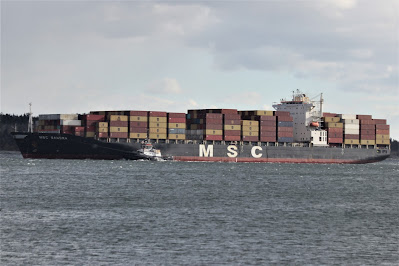
Container Traffic is the big question. Although fourth quarter statistics for the Port of Halifax have not been released yet, I expect TEUs for the year 2024 will be down about 10% from 2023. Add that to the expected decline in bulk and other cargoes in 2025 the Port may expect a dreary year ahead.

This afternoon's (March 5) misty arrival of the 14,052 TEU ONE Aquila may not be a sign of things to come. The ship is eastbound from New York for Europe and appears fully loaded, at least by volume if not by weight. The proposed tarifs would certainly not have had much effect when the ship loaded at its last ports.
(It was in Halifax February 1 to 2, westbound, and has since been in New York, Norfolk, Savannah, Charleston, and New York again.) Much of the import cargo on the ship was for the US and some the cargo unloaded in Halifax on its westbound leg would have been sent to the US mid-west by train through Canada.
What sort of disruption will result if that arrangement is disturbed and how it will add to existing congestion in US ports and rail lines can only be imagined at this point.
Autoport is eastern Canada's automobile import facility. An estimated 185,000 import vehicles arrive by ship every year and are prepped and dispatched by rail and truck on an as needed basis. These cars are exclusively for the Canadian market as far as I know, but the disturbance in domestic car production due to US tarifs will likely increase demand for foreign cars. While that may satisfy car buyers, it will add to the grief in Canadian car making if they cannot meet demand. Or worse, a crippled Canadian economy will reduce the demand for cars of any sort.

On February 27 the Emden brought in the latest consignment of Volkswagen products. The ship went on to US ports. The ship has a capacity of 7,000 CEU (Car Equivalant Units) and is usually loaded to capacity. Frequency of calls and quantity of cars could well change with the new tarifs.
Cruise Ships are a major interest of Halifax Port Authority, which recently announced the 2025 schedule (See previous post: February 14 ) with an anticipated 188 calls and 328,000 visitors. A large percentage of the latter will be US residents, whose US dollars will go a lot farther in Canada. I am sure they will still receive the friendly welcome that Halifax is known for, but I do wonder how many will be willing to come to Canada under the circumstances.

The last cruise ship of the 2024 season was the Insignia sailing on November 3.
Conclusion
I do not normally stray too far from the topic of shipping in these blogs and will try to refrain from getting off topic in future. But I do have to declare deep ancestral roots in the United States, both paternal and maternal. Without going into detail I do wish to proclaim my own allegiance to Canada while acknowledging my affinity for the United States and its peoples several of whom are blood relatives! (My mother was born on this day in 1915 in Collamer, Ohio.)
The current situation is so personally disturbing that I cannot bear to dwell on it in this blog in an objective manner, so will have to avoid discussing it except as it may apply peripherally to ships and shipping.
As usual I do not publish comments submitted to this blog. It is, and will remain, my personal ship watching diary - not a discussion forum.
.