Tuesday, July 5, 2022

Scrubbers on duty

 There can be little doubt that exhaust gas scrubbers have been a boon to the shipping industry. The devices have been fitted to many ships that otherwise would not be able to operate under new emissions regulations. Those ships have engines that could not be converted to use lighter low sulphur fuels. With scrubbbers they can continue to use heavy fuel oil and the scrubber washes out sulphur and nitrous oxides and particulate matter. Of course they are delaying the inevitable need to replace the ships with more environmentally sustainable systems, but such systems are not generally available yet, and even such alternatives as LNG still involve hydrocarbons. The shipping industry has recently set a carbon neutral target date of 2050, pinning their hopes on hydrogen fuel, but also using wind and other alternative technologies.

In the meantime ships with scrubbers arrive in Halifax daily. Today's arrivals allowed for a close up view of how the systems were fitted to existing ships that had no thought given to scrubbers when built.

MSC Manzanillo arrived this morning on MSC's new Turkey and Greece route, with a stop at MSC's Sines, Portugal hub. It anchored at first for CFIA inspection for LDA moth larva. Once given clearance it moved into PSA Halifax Atlantic Hub, South End Terminal.

The pilot boat Scotia Pilot embarks a pilot to move the ship from number one anchorage. The boat is water jet propelled and makes quite a fuss in close quarter maneuvering.

 The MSC Manzanillo dates from 2005 when it was built by Hanjin Heavy Industry and Construction  - the forepart in Pusan and the stern and assembly in Ulsan. It is a 54,758 gt, 68,168 dwt ship with a capacity of 5060 TEU including 454 reefers.

Delivered as Juliette Rickmers, it was immediately renamed Maersk Davao until 2012, then Juliette Rickmers again. In 2017 it was renamed MP The Gronk when acquired by Mangrove Partners. All Mangrove ships were named after New England Patriots football players - this one after the tight end Ron Gronkowski. As with other Mangrove ships it was bought for US$ 7.5mn then sold to MSC in 2021 for more than US$60 mn. (See also Shipfax June 29 for fleet mate MSC Cancun, the former Mangrove ship MP The Brown.) 

Once alongside Pier 42, the positioning of the scrubber tower became clearer.

Some sacrifice of container stowage space appears to have been necessary to accommodate the large scrubber structure.

Early this afternoon another ship arrived with a scrubber. This time it was the Danish tanker Torm Thor arriving from China and Japan via the Panama Canal.


The MidRange tanker was built in 2015 by Sungdong Shipyard in Tongyeong, South Korea. The 29,609 gt, 49,667 dwt ship is one of more than 80 tankers owned and operated by Torm, and painted in their unique colour scheme.

The ship's scrubber has been integrated into the funnel and appears as one structure.

Unlike the Irving Oil tankers, the Torm Thor's scrubber has been painted in with the funnel colours. Irving's Acadian (in port June 26) for comparison: (you be the judge)

On sailing later this afternoon, Torm Thor gave its destination as Saglek Bay, a small port, very far north on the Labrador coast, at the head of a long inlet. It is likely it had CFIA clearance inspection while in Halifax.

 
I can't imagine what the ship will be doing there, although it may be a "jumping off point" for Greenland, which still has strong Danish connections. The ship appears to be loaded so it may be delivering fuel or even transhipping it, but it is hard to know where the cargo was loaded.

.


Mysteries - partly solved

 The arrival (June 29) and departure (July 4) of the ship River Mas remains only a partial mystery. As previously reported the ship unloaded some huge shrink wrapped fabrications (not boats!) and fifty or so containers at Pier 9C.


When unloading seemed complete, the ship reloaded all the cargo- using its own cranes.

 It may be that the cargo had to be re-stowed for stablity, or possibly for logistics and ease of unloading at its destination port, which turns out to be Gaspé. Fortunately Shipfax has antennae in Gaspé and reliable sources there have filled in some of the blanks.

The large fabrications are moulds for the construction of wind turbine blades. And the containers are carrying equipment and machinery for the (General Electric subsidiary) LM Wind Power Canada Inc factory. The moulds and machinery will be used to form a new line of colossal 103m blades.The factory already produces smaller blades.

 It is still not completely clear as to why the cargo had to be unloaded and reloaded in Halifax.

 On sailing at dusk last evening (July 4) the ship looked quite neatly squared away.

Another ship that was in Halifax June 29, Nomadic Milde, also went to Gaspé where it is loading 45 smaller size wind turbine blades.

Nomadic Milde at anchor in Halifax June 29.

.


Monday, July 4, 2022

Oceanex - bumper to bumper

 A shortage of cars in Newfoundland, particularly rental cars, may be alleviated somewhat by a mid-week call by the Oceanex Sanderling today, July 4. The ship arrived and sailed from Autoport, taking no containers or truck trailers - just cars (although the deck seemed to be bumper to bumper mostly with pickup trucks). 

It is unusual to see the ship sailing with its deck loaded with cars instead of being piled high with containers.

For the last six months while Oceanex Sanderling was in Amsterdam for refit Oceanex was only able to provide alternate week RoRo service from Halifax and from Montreal. This may be one reason for the dearth of cars in Newfoundland, but the entire Atlantic region is short of rental cars too, so Oceanex cannot be entirely to blame.

The Oceanex Sanderling only returned from the Netherlands last week, see Shipfax June 29, but now that it has been "reconditioned", it will be able to make two trips a week between Halifax and StJohn's if necessary to make up a backlog. It has done so in the past, and in fact it also used to serve CornerBrook on its weekly service.

.

Sunday, July 3, 2022

Chebucto Head

 One of the best ship viewing spots in Halifax is Chebucto Head, which is actually not within the harbour itself, but at the traditional entrance point well out on the coast.

It is marked by a lighthouse, a Vessel Traffic Services radar installation and several abandoned coastal defence gun emplacements. The 45 foot high lighthouse is located near the edge of the rocky headland, 162 ft above sea level. The only drawback to the location is that it is not directly accessible by car and involves a longish walk over a gated service road.The view of ships is ideal however.

This morning July 3 there were two outbound ships, and fortunately the fog retreated somewhat before they came into view.

MSC Sandra had dropped its pilot and was picking up speed en route for Barcelona on MSC's CANEX 2 service. The ship arrived in Halifax yesterday, July 2, from Montreal to top up its cargo to sea-going draft.

The ship was built in 2000 by Hanjin Heavy Industies + Construction Co Ltd in Busan. It is a 43,575 gt, 61,468 dwt vessel with a capacity of 4340 TEU including 150 reefers.

The second ship was CSL Tacoma with a cargo of raw gypsum ore loaded at Gold Bond's dock in Wright's Cove, lower Burnside, in Bedford Basin.

 Built by Chengxi Shipyard, Jiangyin in 2013 it is a 43,691 gt, 71,552 dwt self-unloader. It was not loaded to maximum draft because there is limited water depth alongside the Gold Bond dock. The ship arrived yesterday morning in ballast from Baltimore. Its destination on this trip was not updated on AIS.

While Chebucto Head is a great shipspotting location, it is a long way from town, and involves a long walk, so it is not a place I go very often. The excuse for today's visit was actually an outing for the Halifax Urban Sketchers Group, and I chose to draw the lighthouse and radar tower as one of my sketches. The structure on the right is the dangerously loud fog signal, which was not operating when I was there.

.


STI Battery

 Another short term visitor to number one anchorage on Saturday July 2 was the tanker STI Battery

Built in 2014 by Hyundai Mipo in Ulsan, it is a 29,899 gt, 49,990 dwt tanker operated by the Monaco based Scorpio Tankers Inc. The scrubber equipped ship is one of 73 MidRange tankers in the Scorpio fleet of 124 tankers of various sizes. Many Scorpio ships are named for neighbourhoods in London and New York. In this case it is the latter, an area at the very south end of the Manhattan peninsula.

Its last port was Amsterdam. After a few hours in port, likely for Canadian Food Inspection Agency examinaton for LDA moth, it sailed but did immediately update its AIS destination It was later determined to be headed for the Beauport area of the port of Quebec City.

 .

Saturday, July 2, 2022

HMS Protector sails (updated)

 The Royal Navy's icebreaker research ship HMS Protector sailed this afternoon (July 2) after is multi-city visit to Canada, apparently headed home to HMNB Devonport, but in any event not northward. later reported to be heading for Puerto Rico.

See my previous post "Navy News" from June 28, describing the ship and some of its features and equipment.

Although the civilian tugs Atlantic Beaver and Atlantic Oak  Fir stood by, the ship backed off its pier unaided (all five thrusters weren't needed either). 

On the ship's port side amidship it carries a 10m (34 ft.) survey motor launch named James Caird IV after Shckleton's small boat used in his legendary voyage to South Georgia. Further aft under an A-frame davit is one of two RHIBs the ship carries. They are named Terra Nova and Aurora, also named for legendary polar ships. The other RHIB is mounted on the starboard side just aft of the impressive 50 tonne capacity knuckle boom crane.

The ship also has a helicopter landing platform aft. It was mounted forward when the ship was built as Polarbjørn for G.C.Rieber Shipping of Norway, but relocated by the RN.

Speaking of Rieber, as I mentioned in the previous post, their ships were well known in Halifax at one time. Their Canadian operation, known as Carino Ltd, operated a number of ships over the years in the seal hunt, various fisheries and for research.

 Photo above at Dartmouth Marine Slip, February 22, 1970. It was rigged for herring seining, but was being prepared for the seal hunt.

Their first Canadian ship was Kvitfjell, a vessel with a storied history. Built in 1940 by Goole Shipbuilding as HMS Morris Dance T117, an armed anti-submarine trawler, it served as a convoy escort during World War II, working in West Africa. It was sold off in 1947, likely for service as a trawler. In 1951 Norwegian owners P/R Tottan converted it to a reefer cargo/sealer and renamed it Tottan. It was also converted from steam to diesel propulsion at that time, using a 6 cylinder Krupp engine built in1942. 

In 1952 it was chartered by the British government to carry the British North Greenland Expedition team members from Deptford to Young Sund, Greenland. Queen (regnant) Elizabeth II came aboard for the send-off. (She had assumed the crown on the death of her father but the coronation had not yet taken place).

In 1960 Riebers acquired the ship, renaming it Kvitfjell (white mountain). In 1967 they sent it to their Canadian subsidiary Carino Ltd. It was mainly used as a seal hunter and was available for research. It was also rigged for herring seining during a short lived herring "boom".  (GC Rieber Skinn established Carino Ltd in Newfoundland in 1957 to process seal pelts.)

In 1972 Plymouth, UK based Interfish took ownership. On September 24, 1972 it caught fire in the Skagerak and was towed to Gothenburg by a Russian tug. It was declared a total loss, but Swedish owners rebuilt and renamed it Seiko in 1973. In 1976 it had become a deep sea salvage and recovery ship named Deep Diver, under Swedish flag. By 1985 it had returned to being a fishing vessel and was renamed Sjøvik, still Swedish. It was still active in 1988 for Nordic Fishing Management Inc under Panama flag, but I don't know what happened to it after that.  

In the early 1970s A/S Rieber commissioned construction of two ships that were to be multi-purpose vessels reinforced for service in ice. They were to be capable of working the seal hunt, fishing, but predominantly in oil-related surveys and research.

The first, built in 1970 by Smedvik MV in Tjøvaag, was the 436 gt Carino The red hulled vessel was based in Halifax and was usually tied up on the north side of the Western Union Cable pier, with Kvitfjell.

Photo above in 1971 with Kvitfjell at the Cable Wharf.

The ship was lengthened in 1973, increasing its gt to 564.


 Photo above on the slip at Steel and Engine Products in Liverpool, NS in 1976. Note the standing room only enclosed crow's nest.

In 1979 Carino sold the ship to Newfoundland owners, Miller Shipping Ltd, who renamed it Fogo Isle. They found work for the ship doing seismic surveys and other work until late 1996 when it was sold to European owners.

 Its history after 1996 remains murkey. It was seized in 1997 for drug running off the Netherlands, then "converted" in 1999 to a diving support vessel. In 2007 it went to the UK, then in 2008 to Nigeria. It was reported in Lagos in 2011 but I have no information after that.

Photos above at Purdy's Wharf in Halifax.

 The second of the 1970s ships was the 991gt Arctic Explorer, built in 1974 by P Høivolds M/V in Kristiansand, Norway, and classed as an ice strengthened sealer / researcher. From 1975 on, it was under long term charter to Geophysical Service Inc (GSI) [a subsidiary of Texas Insturments Inc of Dallas, TX] and based in St.John's, NL. It was engaged in seismic data collection but was given "time off" for seal hunting and sometimes called in Halifax, usually tying up at Karlsen's wharf.

The Arctic Explorer in Halifax.

The ship's tragic sinking with nine lives lost, coincidentally, took place on July 3, 1981 shortly after it sailed from St.Anthony, NL on a seismic survey trip. The ship quickly developed a list and capsized. It carried 32 persons - eight ship's crew and 24 survey workers. Survivors reached a raft but were not rescued for two days. There is a full summary on Wikipedia under Arctic Explorer. It was assumed at the time that the ship struck a growler, but no cause for the list and sinking has ever been determined. Another account, published in Maclean's magazine July 20, 1981 has also been preserved on line at Maclean's. There are several other accounts on line, including a lengthy summary as part of legal proceedings under  Complaint of GSI.

G.C.Rieber still has a presence in Canada with Carino Ltd operating the seal processing plant in South Dildo, NL. Among its products are Omega 3 seal oil capsules and seal fur. It is no longer a vessel owner.

.


Friday, July 1, 2022

Break Bulk and Bulk

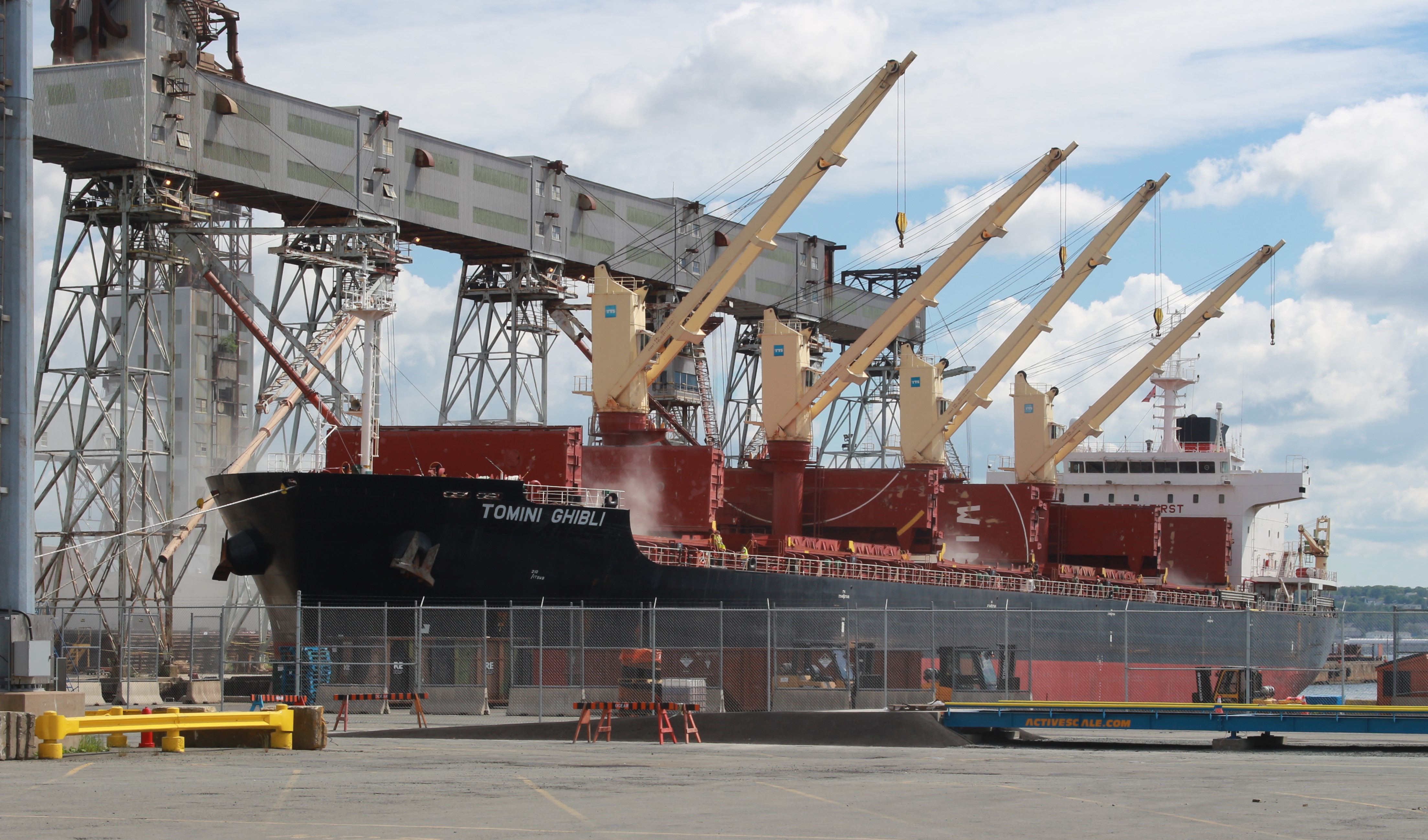
 In yesterday's post I mentioned the grain loadout gallery at pier 28, and today the facility was in use loading the bulk carrier Tomini Ghibli.

A series of conveyors from the grain elevator silos transfers cargo to the ship loading gallery where a series of spouts direct the cargo into the ship's holds. The facility replaced older structures at Pier 23, which could not load large ships, and Pier 26. 

Today's visitor, the Tomini Ghibli, is a typical bulk carrier, built in 2016 by AVIC Weihai, Weihai, China. Measuring 23,741 gt, 37,896 dwt, it carries four 35 tonne capacity cranes.

Built as Sea Angel it was renamed as recently as June 1 by Tomini Shipping. The Tomini family, founded the company in their native Pakistan, but later moved to London, then to their current headquarters in Dubai. They named this ship after a "hot, sand bearing wind of North Africa". Its last port was Grande Anse, QC and Trois-Rivières QC where it offloaded bauxite. 

The old loading facility at Pier 23 had only 3 or 4 spouts, and could not accommodate large ships. It was little used by 1970 when I took this photo:

The USSR water tanker Alitus was in port to load fresh water for the fishing fleet. They used Halifax tap water to freeze the fish at sea. (The Halifax skyline has only one high-rise - the Park Victoria apartments, where I lived.)

The ill-fated Eastcliffe Hall (it sank July 14, 1970 with loss of nine lives only a few days after I took these photos) was at Pier 25-26. The conveyor system extended out to the end of Pier 26 and had loading spouts the full length. In the centre was the grain leg, which was used to offload ships that did not have their own unloading equipment. There were two conveyor sytems - one in each direction, to and from the grain elevators.

 Now the conveyor gallery ends at Pier 25, and is no longer used to load ships. The grain leg has also not been used for many years, since all incoming grain now comes on self-unloading ships, which discharge directly into a hopper and into the "inbound" conveyor. To my recollection the grain leg was last used to unload grain from a ship that arrived for repairs, and the cargo had to be removed and dried before being re-loaded after the ship was repaired.

The St.Lawrence Navigator had a cargo of grain from the Lakes in 1975, and the grain leg was was the means of unloading. The ship had to be repositioned several times as the grain was unloaded, although they did have payloaders in the hold to assist with the last dregs.(Note the Pier 26 portion was gone by 1975.)

 As the Port's plans for the area will see the camber at Pier 27-28 filled in, they will have to rebuild the grain gallery at pier 25-26 for ship loading, and perhaps extend it out to the end of the pier again to accomodate larger ships. It appears that the "two storey" structure still has room for two conveyor systems, but it is not long enough for large ships.

The Independant Pioneer at Pier 25, preparing to load grain in 1970. Note the maze of conveyor systems in the background connecting the "export" conveyors to the grain elevator.

Smaller ships like the Ernst Schröder, also in 1970, often loaded relatively small quantities of grain after discharging general cargo to the shed at Pier 26. However the pier could accommodate large ships for loading.

 Nowadays the few grain loaders we do see are seldom smaller than today's Tomini Ghibli.