Showing posts with label Radcliffe R. Latimer. Show all posts

Thursday, May 1, 2025

Grain from the Lakehead

 The first shipment of western Canada grain arrived today, May 1, on the Radcliffe R. Latimer. The ship wasted no time, and using its own self-unloading gear, began to discharge at Pier 25-26. A shoreside hopper leads to a conveyor system that transfers the grain to the Port's grain elevator.

Soon after the St.Lawrence Seaway opens for the season each year there is usually a cargo of grain, and in recent years it has been delivered by the Algoma Central Corp's Radcliffe R. Latimer. This year the ship looks a little different. In February it went for its five year survey to Veracruz, Mexico where it also received a refresh of its hull paint.

This is what the ship looked like late last year:

Ships get lots of wear and tear using the St.Lawrence Seaway locks, and so are given some extra rubbbing strakes, but still suffer from "lock rash". The lower portion of the hull is covered with "bottom paint" that is an antifouling coating that prevents the build up of marine life. Since they release copper or biocides as they wear, they tend to look ratty even though they are still functional. Most hull paint, including botom paint is expected to last five years, and aside from possible patch touchups, is only repainted in drycock.

Since leaving Mexico the Latimer has called in Belledune, NB, March 28 and 29; Port Cartier, QC, April 6 to 8; Montreal April 11, then up through the Seaway and Great Lakes to Thunder Bay, ON where it loaded April 20 to 22. It then repeated the process non-stop to Halifax. 

The Radcliffe R. Latimer began life with the name Algobay when it was built by Collingwood Shipbuilding in 1978. It was built to near maximum Seaway size as a self-unloder but could make extended voyages beyond the Great Lakes region. Initially constructed to "Nova Scotia" class standards, it was upgraded to "Caribbean class" in 1987-88. After operating overseas under foreign flag from1994-97 on charter to CSL and with the name Atlantic Trader, it returned to its original name and Canadian flag. 

In 2008 it was towed to China where a new forebody, built by Chengxi, was insalled. At the same time the ship was re-powered with new Cat engines that can operate on heavy fuel or marine diesel. Its new tonnage figures beame 24,102 gt, 37,257 dwt.

In 2012 the ship was renamed in recognition of the former Chairman of Algoma Central Corporation.  After delivering grain it has often loaded gypsum as a backhaul. 

.


Thursday, November 21, 2024

Algoma Growing

 The Algoma Central Corporation is on another growth spurt, with new bulk carriers ordered for its international operations and new tankers for charter.

The company's ships are often seen in Halifax, and this week was no expception with three of its ships in port, each representing a different area of operations. By this evening, November 21, all had sailed on their ways to wisdespread destinations.

In the international bulk shipping realm, Algoma is a partner in CSL's self-unloader pool, with nine ships including the Algoma Integrity which loaded at Gold Bond Gypsum and sailed November 19 for Tampa. In this file photo taken in January 2024 the ship is transitting the Narrows in Halifax headed for the loading dock at Wright's Cove in Bedford Basin.

The former Gypsum Integrity built in 2009 by EISA-Ilha in Rio di Janeiro, was built to service US Gypsum's Canadian operations in Little Narrows and Hantsport. When those operations shut down the ship was reassigned and Algoma purchasd it in 2015. The 33.047 gt, 46,293 dwt ship has a self-unloading rate of 3,000 tonnes per hour.

In January 2023 Algoma and CSL each ordered two Kamsarmax self-unloaders from Jiangsu Yangzi-Mitsui Shipbuilding Co Ltd. The 72, 250 dwt ships will unload at 5,000 tonnes per hour. The first ship is due for delivery in July 25 and subsequent ships in three month intervals thereafter. They will replace older ships in the CSL pool. (Kamsar is an important bauxite port in the Republic of Guinea. Ships that can load there are considered to be the most versatile.)

In the domestic area, Algoma operates ten self-unloaders and eight gearless bulkers under Canadian flag and took delivery of another new Equinox class ship this year - Algoma Bear. It will likely be restricted to the Great Lakes / Gulf of St. Lawrence iron ore / grain trade.  Some of the self-unloaders can make extended trips to Halifax such as the Radcliffe R.Latimer which delivered a load of grain from the Great Lakes, sailing from Thunder Bay November 9 and arriving here November 19.


 The ship will sail this evening for Auld's Cove on the Strait of Canso to load aggregate. I have recounted the ship's history here before, but briefly again: built in Collingwood in 1978 as Algobay, upgraded to Caribbean class in 1987-88, chartered to CSL as Atlantic Trader 1994 to 1997. Towed to China where new forebody and engine were installed - redelivered in 2009 and renamed in 2012. Now a 26,102 gt, 37,257 dwt Seawaymax ship, can unload at up to 5440 tph; "Coastal Class" with restricted sea voyages.

Algoma Tankers Ltd has also been busy increasing and renewing its fleet, with several additions added this year. In the last week three of its fleet have called in Halifax: Algoscotia, Algoberta, and Algonova. The last of which (see yesterday's post) sailed today for the Esso refinery in Nanticoke. Algoma Tankers was formed with the takeover of the Imperial Oil (Esso Canada) fleet and has been Imperial's dedicated carrier. 

However in 2023 Algoma Tankers announced that they had ordered two Ice class, 37,000 dwt  Mid Range 2 tankers from Hyundai Mipo for delivery in 2025. The ships will be chartered exclusively to Irving Oil and will sail under Canadian flag. They will replace two older ships, the Acadian, and the Esst Coast [see yesterday's post], both built in 2005 and chartered from Iver Ships BV, the tanker operating arm of the Dutch Vroon Group. 

The new ships have not been assigned official names yet, but are listed by builder's hull numbers as Hyundai Mipo 2900 and Hyundai Mipo 2901. The first delivery is due in January so an announcement can be expected soon. The second ship is due in March.

.


Friday, July 1, 2022

Break Bulk and Bulk

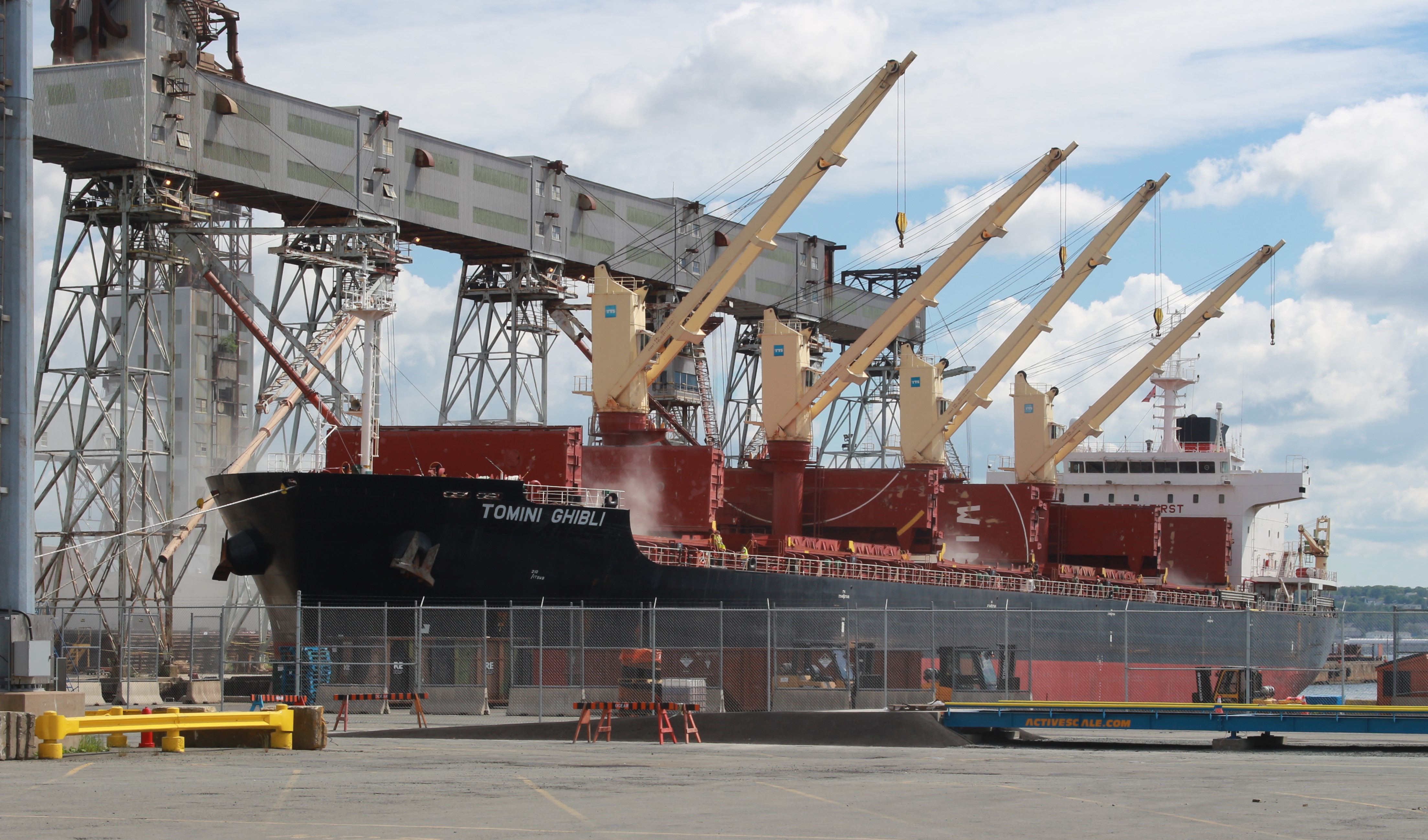
 In yesterday's post I mentioned the grain loadout gallery at pier 28, and today the facility was in use loading the bulk carrier Tomini Ghibli.

A series of conveyors from the grain elevator silos transfers cargo to the ship loading gallery where a series of spouts direct the cargo into the ship's holds. The facility replaced older structures at Pier 23, which could not load large ships, and Pier 26. 

Today's visitor, the Tomini Ghibli, is a typical bulk carrier, built in 2016 by AVIC Weihai, Weihai, China. Measuring 23,741 gt, 37,896 dwt, it carries four 35 tonne capacity cranes.

Built as Sea Angel it was renamed as recently as June 1 by Tomini Shipping. The Tomini family, founded the company in their native Pakistan, but later moved to London, then to their current headquarters in Dubai. They named this ship after a "hot, sand bearing wind of North Africa". Its last port was Grande Anse, QC and Trois-Rivières QC where it offloaded bauxite. 

The old loading facility at Pier 23 had only 3 or 4 spouts, and could not accommodate large ships. It was little used by 1970 when I took this photo:

The USSR water tanker Alitus was in port to load fresh water for the fishing fleet. They used Halifax tap water to freeze the fish at sea. (The Halifax skyline has only one high-rise - the Park Victoria apartments, where I lived.)

The ill-fated Eastcliffe Hall (it sank July 14, 1970 with loss of nine lives only a few days after I took these photos) was at Pier 25-26. The conveyor system extended out to the end of Pier 26 and had loading spouts the full length. In the centre was the grain leg, which was used to offload ships that did not have their own unloading equipment. There were two conveyor sytems - one in each direction, to and from the grain elevators.

 Now the conveyor gallery ends at Pier 25, and is no longer used to load ships. The grain leg has also not been used for many years, since all incoming grain now comes on self-unloading ships, which discharge directly into a hopper and into the "inbound" conveyor. To my recollection the grain leg was last used to unload grain from a ship that arrived for repairs, and the cargo had to be removed and dried before being re-loaded after the ship was repaired.

The St.Lawrence Navigator had a cargo of grain from the Lakes in 1975, and the grain leg was was the means of unloading. The ship had to be repositioned several times as the grain was unloaded, although they did have payloaders in the hold to assist with the last dregs.(Note the Pier 26 portion was gone by 1975.)

 As the Port's plans for the area will see the camber at Pier 27-28 filled in, they will have to rebuild the grain gallery at pier 25-26 for ship loading, and perhaps extend it out to the end of the pier again to accomodate larger ships. It appears that the "two storey" structure still has room for two conveyor systems, but it is not long enough for large ships.

The Independant Pioneer at Pier 25, preparing to load grain in 1970. Note the maze of conveyor systems in the background connecting the "export" conveyors to the grain elevator.

Smaller ships like the Ernst Schröder, also in 1970, often loaded relatively small quantities of grain after discharging general cargo to the shed at Pier 26. However the pier could accommodate large ships for loading.

 Nowadays the few grain loaders we do see are seldom smaller than today's Tomini Ghibli.


Wednesday, December 1, 2021

Beans Out - Grain In

It has been an unusually busy time at the grain piers in Halifax. Unfortunately the weather was not cooperating for several days, causing delays for two ships.  

The  bulk carrier St.Sophia arrived November 23 from Quebec City to top up its cargo with soy beans. That cargo is handled by the Halifax Grain Elevator Ltd and uses the grain conveyor system running from the storage silos through six grain spouts at Pier 28.

St.Sophhia was built in 2018 by Mitsui Tomano and is a 34,094 gt, 60,424 dwt vessel with four cargo handling cranes of unknown tonnage rating. Due to the moisture sensitive nature of the cargo, the ship could not load in the rainy weather over the past few days.

However it did manage to complete loading this afternoon (December 1) and sailed just at sunset for the Port of El Dekheila, in a suburb of Alexandria, Egypt.

Meanwhile the  Canadian bulker Radcliffe R. Latimer arrived November 25 from Thunder Bay with a cargo of wheat consigned to P+H Milling. The Halifax grain elevator provides storage space for the flour mill, and delievers the wheat as needed via a grain pipeline. Again, due to the moisture sensitive cargo, the Latimer could not unload in heavy rain. It was finally able to begin unloading today and will sail over night. With only a few weeks left in the St.Lawrence Seaway season, the ship will be heading back to the Great Lakes (via Lower Cove, Newfoundland).

The Port of Halifax owns the grain elevator structures, and leases the facility to Halifax Grain Elevator Ltd. The silos were built as a grain export facility when the government of Canada subsidized rail freight rates to facilitate grain exports.


The following is an exerpt from a previous post:

"The elevator, consisting of 365 silos, with a total capacity of 5,152,000 bushels was built in four stages: 1925, 1929, 1958 and 1963. The first stage was but to replace the previous elevator destroyed in the Halifax explosion. Later stages were prompted by amendments to the Crow’s Nest Pass Agreement. That 1897 deal, between the Canadian government and the Canadian Pacific Railway gave the railroad access to valuable mineral properties in exchange for reduced rates to haul grain and flour eastbound - in perpetuity. Well perpetuity for governments is not for ever! The rate was suspended during World War I, and was revised in 1927 (after the government had formed the Canadian National Railroad) and then applied to grain only and to all rail lines. The CPR deal had favoured the Port of Saint John, but with the new CNR serving Halifax, a bigger grain elevator was warranted.

From the 1930s through the 1960s Halifax was a major grain exporting hub. In those days the entire St.Lawrence River closed for the winter and Halifax stockpiled grain and shipped it from January to April in huge quantities. Often the elevator was full. The port of Halifax owns the grain elevator and leases it to operators Halifax Grain Elevator Ltd.

As I said perpetuity does not mean forever with governments and the rate was adjusted in 1984 by the Western Grain Transportation Act, but it was capped. In 1993 it was eliminated completely and the grain trade for Halifax fell away dramatically. Traffic had been eroding anyway with the opening of the St.Lawrence Seaway, winter navigation on the St.Lawrence and better connections to the Mississippi and the west coast."

With the virtual elimination of grain exports through Halifax, the grain silos are used for storing quantities of grain for local consumption, such as P+H Milling. They are also used to store wood pellets for export to Europe as hog fuel, and more recently for soy beans, which are exported. The soy beans arrive in Halifax by truck or rail.

The Port of Halifax provides an excellent aerial photo on its web site showing the entire facility:

Halifax Grain Facility

.


Saturday, November 27, 2021

Algoma Days - Part 2

 Another day, another Algoma. After yesterday's two Algoma ships, there were again two today,  November 27, with Algoma Integrity arriving for another load of Gold Bond gypsum.


 Purpose built to serve CGC (Canadian Gypsum Corp) the Canadian branch of US Gypsum, in 2009 by EISA-Ilha, Rio de Janeiro, the ship was originally called Gypsum Integrity and was owned by the shipping subsidiary Fundy Transportation. When USG closed its operations in Hantsport and Grand Narrows, NS, the ship 's managers, Beltships Ltd, found work for the ship and its sister Gypsum Centennial in Africa, shuttling iron ore to larger bulk carriers in Sierra Leone.

Algoma Central Corp acquired and renamed the ship Gypsum Integrity in 2015 and operated it under Canadian flag for two years until new ships were completed. It was then registered in the Bahamas and placed in the CSL Americas pool of self-unloaders. It continues to carry gypsum, but also carries coal and aggregates. It has become a regular caller in Halifax for Gold Bond (formerly National Gypsum) the direct competitors of its first owners.

The tugs Spitfire III (aft) and  Atlantic Willow (forward) make up to the ship as it passes Pier 9 in the Narrows bound for the Gold Bond dock in Bedford Basin.

The 33.047 gt, 47,761 dwt ship can unload gypsum, coal and aggregates at an average rate of 2,500 tonnes per hour, and ore at 3,000 tonnes per hour. (CSL Americas quotes the ship's capacity at 46,293 dwt.)  Its 76.50 meters long telescoping unloading boom has an outreach of 60.40 meters.

When I checked up on the other Algoma ship, the Radcliffe R. Latimer at Pier 26 this morning, it was not unloading its grain cargo - possibly due to off and on rain showers. 

(See yesterday's post for a photo of the ship with its boom swung out for unloading.)


.

Wednesday, December 4, 2019

All Canada Day

There was no foreign flag shipping in Halifax harbour today. All shipping was Canadian - surely a very rare occurrence.

The Royal Canadian Navy's chartered supply ship Asterix returned to port yesterday after a maintenance session at parent shipyard Davie in Lévis, QC. It refueled at the Irving Oil dock in Dartmouth and this morning moved to jetty Juliet in HMC Dockyard. (Its place at Irving was taken by HMCS Fredericton which sailed later.)


During a brief snow shower, the coastal ConRo Oceanex Sanderling arrived from St.John's.


Nolhanva slipped into port around noon time and tied up at pier 27 - not its usual berth at Cerescorp, Fairview Cove.


And late this afternoon Radcliffe R. Latimer sailed after unloading its part load of grain. The ship is bound for Lower Cove, NL in ballast.


.

Monday, December 2, 2019

Some grain for Halifax

Normally when grain arrives in Halifax from Thunder Bay by ship, it is in full loads. However today's arrival of Radcliffe R. Latimer marks a departure from the norm.


It was quite apparent as the ship approached pier 25-26 that it was carrying less than a full cargo. A little digging revealed that the ship took a full cargo at Superior Elevators in Thunder Bay on about November 21, but on its way down through the Great Lakes it was diverted to P&H's facility in Hamilton, ON where it appears to have left about half its cargo.  P&H Milling [Parrish and Heimbecker] also operate the flour  mill in Halifax (the former Dover Mills) and so perhaps the cargo was kept "in house" so to speak. Nevertheless it is an unusual event.


P+H in Halifax brings in most of its grain by rail, so does not depend on ships to keep up its supply. However the recent rail strike may have been a factor in all this. Almost all the grain moving through the port of Halifax is for local consumption either for milling or for animal feed. Some small quantities are sometimes exported for food aid.

Radcliffe R. Latimer is the former Algobay of 1978, extensively rebuilt in China in 2009 and renamed in 2012. It is likely to load gypsum after unloading its grain.

.

Monday, December 24, 2018

Christmas Eve

The day before Christmas can be a busy one in the port, since Christmas Day and Boxing Day are 'no work' days for longshoremen. Ships do not wish to sit idle in port for two days, so they try to get their work done and get away to sea.

There are several ships working to get away today. The sister ships Asian Moon and Asian Sun are in port - but for different lines. Asian Moon is busy unloading its nickel concentrate cargo at pier 31 (regrettably no longer photographable due to Halterm expansion) for Nirint Lines. It will sail late morning.

And arriving appropriately at sunrise this morning was Asian Sun for Tropical Shipping.
 

There is no posted sailing time for it, so it may be here over Christmas.

Meanwhile the CMA CGM Orfeo anchored offshore early this morning. The 11,249 gt, 120,986 dwt ship was originally due yesterday, and is now slated to arrive in port tomorrow. Linehandlers (members of the Longshoremen's union) will get a hefty paycheck to tie the ship up if in fact it does berth on Christmas Day.


Built in 2008 by Hyundai Heavy Industries, Ulsan, the ship has a capacity of 9658 TEU, including 700 reefers. Normally these CMA CGM ships called on Saturdays, but for the last month they have been in port on Tuesdays or Wednesdays.

Also due at Halterm tomorrow, Oceanex Sanderling will berth at pier 36. It often takes time off over Christmas.

ACL's Atlantic Sail departed late morning. At first it was into a dead calm and gloomy Bedford Basin.


By the time the ship cleared the Narrows there was bright sun as the ship passed west of George's Island bound for Liverpool.


Also sailing this morning was Atlantic Huron. The CSLer has a load of gypsum for Cote-Ste-Catherine, QC.

With the St.Lawrence Seaway set to close December 31, it is expected that the ship will just manage to unload then move to Montreal for winter layup. Last year it laid up there from January 14 to March 17.

Last winter Radcliffe R. Latimer laid up in Halifax from January 6 to March 18. This year it sailed from Halifax December 14 with a load of gypsum.

It reached Goderich, ON on Lake Huron, loaded salt and sailed yesterday for Johnstown, ON, just above the Iroquois lock. It is also likely to leave the Lakes before the close of the season.

The oil docks normally work on Christmas, as their shore workers are not members of the ILA. Irving Oil's Acadian is due this evening, so may be in port Christmas Day. So far there are no scheduled arrivals at Imperial Oil.

Also arriving today, Troms Sirius from Bay Bulls, NL. It accompanied the oil rig West Aquarius when it completed work on BP's (unsuccessful) exploration well on the Scotian Slope.

 
It likely has equipment to land from the rig, and then will probably layup as it has no other scheduled work. Fleetmate Lundstrom Tide is already laid up at The Cove. Both vessels, on charter from Tidewater to Horizon, will likely be unemployed for a time.


.

Wednesday, December 12, 2018

Business Developments

Shipfax is normally more interested in ships than the shipping business, but a few recent developments have come to our attention.

HORIZON


Horizon Star is the first owned ship in the Horizon fleet.

Horizon Maritime based in Halifax, had been hopeful of a takeover of Nordic American Offshore. NAO, publicly listed on the NYSE, is an offshoot of Nordic American Tankers and operates 10 supply vessels, mostly in the North Sea. The deal was on again, off again recently, and this week it was announced that NAO has left Horizon at the altar and eloped with Scorpio, an Italian tanker company owned by Emanuele Lauro.  Lauro adds NAO to Scorpio's small offshore startup that has two PSVs and some crew boats.

Nordic American has a "historic" connection with Nova Scotia's offshore. Its tanker Nordic Apollo was for several years the storage vessel at Nova Scotia's offshore oil field - the short-lived Panuke / Cohasset. Their shuttle tanker Nordic Challenger took the oil to refineries.

Nordic American's tanker Nordic Challenger sailing from Halifax June 30, 1992 for Panuke / Cohasset to load the first cargo of commercially produced offshore oil in Canada.


The takoever would have given Horizon an entree into North Sea work and access to more modern vessels, but  there are many more fish in the pond. As the offshore market is showing signs of recovering from a major slump, prices are likely to go up however. The more important aspect I think would have been access to capital and a potential NYSE listing for Horizon/NAO.


 The recentkly acquired Horizon Enababler is the former Tidewater Enabler.

Horizon operates two ships of its own and charters two from Tidewater. The latter two however will soon be out of work in Nova Scotia as BP's drilling program has ended, save for capping the one exploration test hole.

The deal would have given Horizon better footing against competitors such as Siem's Canadian business, operating as Secunda Canada LP which operates a small fleet with four OSVs operating out of Halifax and two out of St.John's.

 Despite the Irving Oil sign in the background, Siem Hanne is at the Mobil dock in Dartmouth this morning taking on material for its work in offshore de-construction. It carries a dominion Diving container on deck to support ROV work.

Siem Offshore is part of the Siem Industries group of autonomous subsidiaries including shipping and industrial concerns, based in the Cayman Islands, but essentially Norwegian. Maersk Canada - another competitor is Danish and is owned by the Moller family, also owners of one of the largest shipping companies in the world.

Atlantic Towing Ltd, part of the J.D.Irving group of companies is an independent, based in Canada.


HHL

  HHL Mississippi

Hansa Heavy Lift (HHL), based in Hamburg, Germany filed for insolvency December 10. The company was backed by funds under Oaktree Capital Management which has now thrown in the towel. HHL is down to five ships, one of which has been detained in France. It has 18 ships earlier this year according to reliable sources.

HHL was originally formed using some ships from the short lived Beluga Shipping, founded in Bremen in 1995 and wound up in 2011, with Oaktree as its principal shareholder. Beluga built up a fleet of 70 heavy lift ships and was held out as an innovative and public spirited company, however its collapse was also tainted by allegations of fraud against its managers. 

Beluga Efficiency

Transport Desgagnés had a working relationship with Beluga and then HHL and operates several ships built under Beluga's building program. This past summer Desgagnés hired HHL New York to fill in when one of its own ships was late returning from a charter. HHL New York carried a project cargo consisting of a 110 tonne generator and several heavy plant modules from Becancour, QC to Rankin Inlet. The ship is fitted with a pair of 400 tonne cranes.
Desgagnés has more recently seen its dry cargo ships working off season with Briese's BBC Chartering.

Maersk Supply Service Canada


After shedding a pair of older suppliers earlier this year, the St.John's based company has now added a new monster supplier from parent company Maersk Supply AS of Denmark. Maersk Mobiliser was delivered by Kleven Werft AS, Ulsteinvik at the end of October, and was registered in St.John's, NL on December 11. The huge vessel measures 10,181 grt, 4,900 dwt and has a 260 tonne bollard pull, and is equipped to operate an ROV in harsh environments. It is the fifth in a class of six Starfish vessels built for Maersk. It is reported that the ship has been contracted for drilling support and ice management by a major Canadian oil company. It is suspected that the sixth vessel, to be delivered mid next year will also follow to Canada.


K+S and Belships
The handysize / supramax bulk carrier Belnor arrived in Halifax last night and tied up at pier 9C, loaded with salt. Built in 2010 by Yangzhou Dayang, it carries four cranes and grabs. Its last port was Caleta Patillos, Chile, which barely qualifies as a port. It consists of a giant conveyor system projecting out over the sea, where ships are secured by a spread of seven or more anchors and must winch themselves back and forth to load. However it is the loading port for a huge salt mine owned by K+S AG of Germany, one of the major players in the salt and phosphate business. K+S acquired Morton Salt in 2009 and Potash One in Saskatchewan in 2011. Its history goes back to the 1890s when potash came into use as a fertilizer. It later acquired salt mines, becoming Kali und Salz.


The ship is owned by another legendary company, Belships, founded by the Norwegian former naval officer Christian Smith in 1918. An early pioneer in heavy lifts, it specialized in transporting complete railroad locomotives, something never done before. The company has been saved and re-formed more than once during depressions, recessions and wars (both international and internecine) , to survive as Belships. It got out of heavy lifting in the 1970s and now has a fleet of five bulkers and two on order, chartered to Canpotex (the Saskatchewan potash marketing arm) and Cargill.
Belnor is time chartered to Canpotex until mid-2020, but as we can see it does back hauls that are not potash, to make for profitable use.


Grain Trade
Continuing from yesterday's post about Algoma's newest tanker Algonorth,  the company is still very much in the bulk trades, and its Radcliffe R. Latimer arrived last evening with a cargo from the Great Lakes. likely Thunder Bay. This is probably the last grain cargo for this year from that destination as the St.Lawrence Seaway will be closing December 31. (While Algoma is heavily involved in the domestic grain trade, its international fleet of self-unloaders, pooled with CSL, carry only minerals such as sand, aggregates, coal, and gypsum. )

Radcliffe R. Latimer self-unloads its cargo at pier 25-26 while McNally Construction sets up at pier 24 for Phase 1 dredging at pier 42 Halterm.

Halifax is a very minor of player in the grain trade, with most of the inbound cargo consisting of feed stock for local consumption. Grain also arrives by rail and yesterday's sailing of the Nirint ship Augusta Sun with a load for Rotterdam indicates that the grain elevator facility still has some utility for export.
Phase 2 of the Port's Halterm expansion, which will fill in the space between the finger piers, will mean that the current grain export galleries will no longer be accessible to ships. It may be possible to somehow rebuild the import facilities at pier 25-26 to export grain too, but that would be a major investment for a minor amount of business. 


As I understand the port redevelopment proposal, filling in the space between the finger piers would create more land for the Halterm container terminal, but would effectively cut off the the grain export trade.


.


Saturday, April 21, 2018

Back Again and Shine A Light on Halterm

The Algoma Central Corp self-unloader Radcliffe R. Latimer arrived back in Halifax on Friday. This time it was with a load of grain from Thunder Bay.The ship spent the winter at the same pier undergoing routine maintenance.
It had arrived January 7 and on March 17 it sailed light ship for Port-Cartier and loaded iron ore for Contrecoeur, QC. It subsequently made two more shuttle trips between Port-Cartier and Contrecoeur, sailing April 3 for Thunder Bay. It loaded there April 9 and was on its way back to Halifax. It anchored for a time off Grande-Entrée, Magdalen Is April 16 due to weather, but was underway again the next day. Sailing via the Cabot Strait for Halifax.

This afternoon after completing its grain work the ship moved to National Gypsum.

Arriving at Autoport the autocarrier Sunshine Ace brought out some welcome sunshine. (Another autocarrier named Sunlight Ace also called here March 27).

As Atlantic Fir and Atlantic Oak move in to position a survey boat (see below) works off Halterm.


Sunshine Ace dates from 2009 when it was built by Minami-Nippon in Marugame. The 58,917 grt, 18,858 dwt ship has a capacity of 5,200 cars. It flies the Bahamas flag for MOL Ship Management (Singapore).
Connors Diving Services Ltd operates this nameless Stanley workboat. Powered by a pair of 150 horse Yamahas it has a bow ramp  qualifying it as a landing craft.
No registration number could be seen on the hull.

The boat has been surveying off Halterm for the past several weeks. No doubt its activity is related to a recent tender notice from the Port of Halifax for rock anchor installation for a 200 tonne bollard. My expectation is that a dolphin / crib will be constructed off Pier 42 to take the headlines for large ships. Since the cranes on the pier can run right out to the end,  there is a lot of unused length to the pier taken up by ships' headlines. A bollard off the end of the pier would increase the effective length of the pier by 100 feet or more.

I only hope that the new installation will not deprive ship watchers of a favourite vantage point. 

The same boat has also been assisting Connor's work barge with a core drilling rig off pier 31-37 which is where the port is expected to infill the camber to expand Halterm's land area.

This is my interpretation - not announced by the port - of what I think will be happening:

Note the two cranes shown on pier 37 have been demolished. There are five cranes shown on Pier C. This includes the one crane now at pier 36, which was built with specail bogies that allowed it to move to Pier C..
.

Saturday, March 17, 2018

More signs of spring

With light snow on the ground and a few snow showers in the air, perhaps it was good to be reminded that spring is on the way.

One sure sign is the opening of Asian Gypsy Moth season. As of March 15, all ships entering Canadian waters that have been in the far east must provide a declaration that the ship is clear of the pests that threaten North American forests. Ships that have visited China north of Shanghai, Japan, Korea and the far east of Russia may be carrying egg masses of the invasive insect.

If they do not have a certificate they  must undergo an inspection by the Canadian Food Inspection Agency. It takes a few hours to do this, and it is usually done at Halifax, Sydney or the Strait of Canso, before the ships get near any forested areas.

The regulations make no exceptions for ships such as autocarriers that are going no deeper into Canada than Halifax.Such is the case for Miraculous Ace and the reason that the rare sight of an autocarrier anchored in Bedford Basin.


Operated by Mitsui OSK Lines of Japan, the ship was built in 2006 by Imabari Zosen, Marugame, and measures 59,422 grt, 19,281 dwt. It has a capacity of 6,141 cars.

The ship will remain anchored in the Basin until Monday.

At pier 27 the Radcliffe R. Latimer was doing some hold cleaning after winter layup. They had swung the self-unloading boom out over the dock, and with an elephant's trunk extension were preparing to unload sweepings into trucks.


The ship is preparing to sail tomorrow, which will give it time to pick up cargo en route to the opening of the St.Lawrence Seaway at the end of the month.


.