Showing posts with label CCGS Terry Fox. Show all posts

Tuesday, March 11, 2025

Big price tag for the Louie's replacement


The CCGS Louis S. St-Laurent will be kept in service until replacements are delivered in 2030.

 On March 7 and March 9 the federal government announced contract signings to build the long-planned Polar Icebreakers for the Canadian Coast Guard. The much needed replacement for the aged CCGS Louis S. St-Laurent has been "in the works" for decades but with little progress until the National Shipbuilding Strategy was announced. Even then the needed replenishment ships for the Royal Canadian Navy and other research and survey vessels created a huge backlog at Seaspan's Vancouver Shipyard (VSY), and the RCN ships were given priority.

As previously announced, one ship, to be named the CCGS Arpatuuq, will be built by Seaspan Vancouver Shipyard (VSY). It will be a Polar Class 2 diesel-electric ship of 63,000 total horsepower delivered to one shaft and prop and two ABB azipods. The announced contract cost is $3.15 billion (exclusive of tax) with a delivery date of 2030. The ship was originally to be named the John Diefenbaker, but a change in policy (and political parties) resulted in a culturally significant name for northern populations. Arpatuuq refers to Akpatok Island, in Ungava Bay, Nunavut. The Canadian government commissioned STX to design the ship. That company, formerly associated with Wartsila, has Finnish icebreaker experience.

The government re-assessed its need for year round capability in the arctic and decided to include CDC in the National Shipbuilding Stratetgy and add a second  Polar icebreaker in the plan, while eastablishing the Lévis yard as a centre of excellence for icebreaker technology.

The second ship, to be named CCGS Imnaryuaq is to be built to a totally different design prepared by Chantier Davie Canada Inc (CDC) in association with their wholly owned Helsinki Shipyard. The ship will be built entirely in Canada at CDC's Lévis, QC shipyard but with icebreaker expertise from Finland. The PolarMax design is "off the shelf" from CDC/Helsinki, and will be a slightly smaller ship. Price tag for this one is $3.25 billion, also for delivery in 2030.

Its name comes from a 300 meter high cliff at the southern end of Banks Isand in the Amundsen Gulf, and was once named Nelson Head.

The CCGS Louis S. St-Laurent (affectionately called "The Louie") was launched by Canadian Vickers (now defunct) in Montreal in 1966 and commissioned in 1969. It has been endlessly refitted, rebuilt and repowered over the years, and will presumably require even more TLC to keep it going for another five years. 

Its fleet mate, the smaller CCGS Terry Fox will also be replaced by the new Polar ships, and is in a $135.56 million Vessel Life Extension now at Heddle Shipyard in St.Catharines, Ontario.

 CCGS Terry Fox

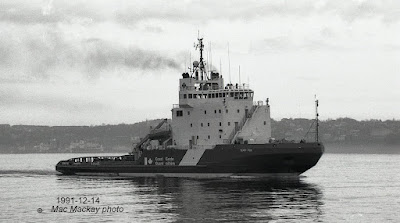
CCGS Terry Fox built in 1983 for private industry. It was leased by the CCG in 1991, then purchased in 1993 as a temporary measure until new icebreakers could be delivered.

.


Thursday, March 10, 2022

MSC Kim - end of chapter one

 The container ship MSC Kim sailed from Halifax in the late evening of March 5, bound for Montreal. It had been at PSA Halifax for a few hours to decant some cargo to reduce the ship's draft to meet St.Lawrence River restrictions. It is regular practice of Mediterranean Shipping Company (MSC) ships to call in Halifax en route to or from Montreal to off load from or top up to ocean draft. This visit was no different, see Shipfax March 5

The ship was making its way across the Gulf of St.Lawrence in the early hours of March 7 when it had a main engine breakdown 40 nautical miles south of Anticosti Island and 66 nautical miles east of Percé. The ship began to drift in high winds and by today (March 10) it was reported to be 50 nautical miles off Port au Port, NL, still without the use of its main engine.

In the meantime, the ship's owners scrambled to develop a salvage plan. Details have not been released as the whether this was a Lloyd's Open Form (No Cure No Pay) salvage contract, or a more basic towing contract. However in view of the potential of the situation, the Canadian Coast Guard would have the responsibility to oversee and grant approval for any operation.

The CCGS Terry Fox icebreaker was the nearest large CCG asset and it was dispatched to Stephenville, NL where Atlantic Towing Ltd had some powerful tugs laid up. ATL rounded up a crew and quickly mobilized the 16,000 hp anchor handling tug/supplier Atlantic Kingfisher from cold layup. According to reports the Terry Fox provided fuel to the tug then broke out the ice in the bay to allow the tug to sail. It was able to reach the ship and rig a tow in matter of a few hours.

Latest reports on the evening of March 10 have tug and tow due in Sydney harbour in the early afternoon of March 11. CCGS Terry Fox will likely be escorting the pair. The tug Atlantic Spruce out of Saint John, which had just towed the CCGS Kopit Hopson 1752 from Shelburne to Halifax, was also sent on to Sydney to assist.

The tug Atlantic Kingfisher was built by Halifax Shipyard in 2002 and was named for the avian emblem of the old City of Halifax which also appears in the middle of the coat of arms and flag of the Halifax Regional Municipality (formed in 1996). (It is apparently a symbol of industry.)

 Ironically, at 23,200 bhp, the Terry Fox is one of the most powerful tugs ever built in Canada, but as a CCG ship it is not equipped or mandated to tow except in dire emergency. Civilian craft are expected to make commercial arrangments for towing. Canada operates no Emergency Towing Vessels (ETVs) on Canada's east coast. A sister ship of Atlantic Kingfisher, the Atlantic Eagle and a similar vessel Atlantic Raven, are contracted as ETVs on the west coast. That controversial contract has been extended but expires in Novemeber of this year (2022.)

CCGS Terry Fox, one of Canada's two big icebreakers, was built as a tug supplier.


Sunday, December 5, 2021

Some call it nostalgia...

 Having been around for a while I do recollect things that happened long ago. I realize however that my definition of long ago has changed and now must include events in years that seem fairly recent. Those events are now part of "history" and might be included in a trivia contest. It was therefore somewhat startling when I realized the subject of today's post happened no less than thirty years ago.

The Canadian Coast Guard acquired its "newest" arctic icebreaker in 1991, and decommissioned one of its best known ships.

The acquistion was the Terry Fox, an eight year old ship, leased from private industry, which began trials December 2, in advance of going into service in January of 1992. The ship it was to replace was CCGS John A. Macdonald which had reached the advanced age of 31. It was to make a paying off trip around Halifax harbour December 2 in advance of formal decommissioning on December 4, 1991. 

I have to wonder if the CCG knew then that thirty years later they still would not have a new polar icebreaker that they might have kept the John A. Macdonald going for a while longer, or acquired the Kalvik a twin sister of the Terry Fox. [see footnote below.]

 The Terry Fox on a trials trip in Halifax in December 1991.

The Terry Fox was built by Burrard-Yarrows Corp of Vancouver to support Gulf Canada Resources arctic oil projects. Gulf's Beaufort Sea work was carried out by its subsidiary Beaudrill, which needed icebreaking tug/ suppliers to work year round. The two 23,000 bhp ships were the most powerful privately owned icebreakers in the world when delivered in 1983. 


In 1991, with the CCGS Louis S. St-Laurent in a major five year long conversion from steam to diesel electric, the CCG leased the Terry Fox from Beaudrill, with an option to purchase which was taken up in 1993.

On December 1, 1991 the Canadian Coast Guard hosted a public open house at the Dartmouth base, with tours of the Terry Fox and the John A. Macdonald.

 Getting ready to pay off, the John A. Macdonald still looked spendid.

During its thirty year career the John A. Macdonald acquired near legendary status. Built by Davie Shipbuilding in Lauzon, the 13,000 shp diesel electric vessel was perhaps best known for its role in the Manhattan's arctic trip, but the ship set many records, and made numerous voyages in the arctic (which was much more "arctic" than it is now) and the Gulf of St.Lawrence (ditto for winter).


 A quick survey of the Wikipedia entry for the ship is a good refresher: John A. Macdonald


Footnote:

Back in 1991 Shipfax was an eight page newlsetter (printed on a dot matrix printer) and my account of the visit to the Terry Fox and John A. Macdonald included the following:

"The contrast between the two ships is remarkable. Terry Fox is in every way a modern ship, which is conned from a comfortable padded seat where the QM is surrounded by all the controls and instruments within easy reach...[John A.] Macdonald is very much old school with engine room telegraphs of gleaming brass and ...requiring several persons on the bridge and a fully manned engine room."


The John A. Macdonald was laid up in Dartmouth, and finally left Halifax November 22, 1993 in tow of the Dutch tug Elizabeth for India where it was eventually broken up sometime in 1995. Presumably some of the artefacts pictured above have been kept for posterity.

.

Saturday, March 28, 2015

Saturday roundup - avant le déluge

The early bird was rewarded today as another heavy snow fall began late morning blotting out the view.
CCGS Cape Roger arrived last evening and anchored until this morning when it moved to Imperial Oil to refuel. The ship is on Search and Rescue standby along the South Shore of Nova Scotia.


Also in this week is CCGS Alfred Needler at BIO. Both ship are based in Newfoundland, but are often displaced in winter and spring by ice, and exchange places with Halifax based ships.
 
One visitor this week that I failed to post was CCGS Terry Fox, in for refueling March 25. We have now seen the entire east coast icebreaker fleet this spring - so much for the wisdom of moving them to Newfoundland.


Bow doors open, ramp being lowered on hydraulic pistons.

Bow ramp in lowered position appears very narrow and of a very low weight capacity compared to the stern ramp.     [ Say  AAAAH!]

At pier 9A work on the ferry Canada 2014 is, if you will pardon the expression, "ramping up". This morning workers had both the bow and stern doors open for work.

The stern ramp, with a red painted pedestrian pathway. A temporary partition has been built inside the car deck to retain heat during the refit process. After this photo a mobile crane came along to take the weight of the ramp for work on the bearing.

The ship is expected to enter service between Digby, NS and Saint John, NB, sometime this summer.


See Tugfax for the tug Lois M and barge Nunavut Spirit at pier 9B.


At pier 9C Harefield is still tied up for repairs.


Work continues on the rudder using a raft and various tackles to take the weight off the pintle.


In Bedford Basin the Torm Rosetta lies at anchor until it is time to go alongside Imperial Oil Another handysize tanker product tanker, it was built in 2003 by Onomichi Dockyard in Japan as Rosetta for OMI. It was acquired by Torm A/S in 2008. The ship measures 28,567 grt, 47,038 dwt and is enrolled under the Danish International register. (Denmark and Norway, among others have offshore registers which have different regulations from their national registers, as to foreign crewing, taxes, etc.,)


At anchor the tanker Sloman Hermes will be sailing this afternoon for the St.Lawrence. It has been awaiting the opening of the St.Lawrence Seaway, which has been postponed from March 25  27 to April 5 2 due to ice. Rather than anchoring in ice off the Escoumins pilot station or farther upriver, the ship opted for the comforts of Halifax harbour. An ice adviser boarded the ship late in the morning from the launch Halmar.


Autoport is still struggling with frozen in cars - thousands are still in ice up to their hubcaps, but it appears that more recent arrivals are still being processed, as the trains keep rolling out every days with a dozen or more autoracks full of imports. [In the photo of Terry Fox above, there is a string of autorack cars waiting in a siding.] Recent arrivals are leapfrogging ahead of the January and February arrivals which are waiting for natural melting to free them.


Today Mermaid Ace made a morning visit. It was built in 2010 by Minami- Nippon in Usuki, Japan, measuring 58,939 grt, 18,828 dwt, with a capacity of 5,219 cars. It is owned by Masumoto Shipping Co Ltd under the Panama flag, on charter to MOL (Mitsui OSK Lines).

.

Wednesday, March 26, 2014

Icebreaker parking lot

Halifax has become something of an icebreaker parking lot in the last two days. The combination of an approaching severe winter storm, with hurricane force winds and the monthly crew change date, saw CCGS Henry Larsen arrive yesterday morning and CCGS Terry Fox yesterday evening.
Larsen went to the fuel dock first (see excellent photo on Halifax Shipping News ) then moved to the old Dartmouth Coast Guard base yesterday afternoon.
Terry Fox arrived and tied up at BIO adjacent to the idle CCGS Louis S. St-Laurent.

At 8:15 this morning, just before the storm arrived, Canada's two most powerful icebreakers lie quietly alongside the pier at the Bedford Institute.

In view of the storm conditions, I expect the ships to remain in port until tomorrow at the earliest. Both of the new arrivals were once common sights in Halifax, but have been rare in recent years, as all are now based in Newfoundland.
Gulf ice conditions remain severe, so their services will be needed again as soon as they are able to leave port.

.