Wednesday, January 12, 2022

Aurviken

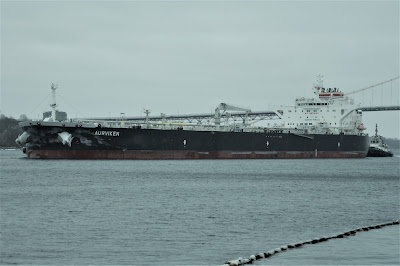
 It is unusual to see a crude oil tanker in Halifax these days, since there is no refinery here to process the commodity.  Therefore today's arrival (January 12) of the Liberian flag Aurviken is notable.

On a gloomy day, threatening snow, the Aurviken makes its way in the Narrows toward Pier 9C. The ship has quantities of frozen spray on its anchors.

The ship dates from 2019 when it was built by Samsung, Koje. At 62,372 gt and 112,802 dwt it is considered to be "Aframax" size, although at the small end of that type (upward limit is 160,000 dwt). Owners Viken Shipping AS of Bergen, Norway operate about 20 ships of various sizes. Formerly bulk shipping operators, and frequent visitors to the Great Lakes, Viken has now shifted entirely to tankers with about a dozen Aframax, one Suezmax and five product tankers. All its ships are placed under the technical management of Wallem Ship Management of Singapore.

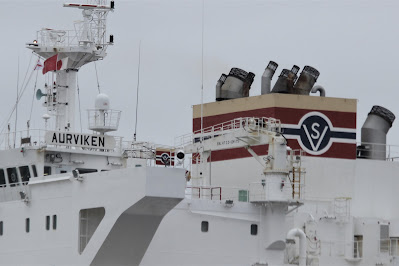
The ship is equipped with an exhaust gas scrubber system, with a large stack just aft of its funnel structure.

The ship appears to be loaded, and it is carrying the red hazard flag on its signal mast above the bridge. Its last port seems to be Es Sider, Libya. Canada has some trade sanctions with Libya, but whether that would apply to this ship's cargo is not known to me, nor is its ultimate destination. I see a large backlog of tankers off Saint John, NB, so it is possible the ship is headed there eventually.

.


Tuesday, January 11, 2022

Horizon Thetis

 The Liberian flag tanker Horizon Thetis arrived this morning, January 11, with cargo for Imperial Oil. An air temperature near minus 15 C (5F) is the coldest temperature recorded in Halifax in two years, so it was not surprising to see some frozen spray on the ship.

Built in 2009 by SPP Shipbuilding Co in Tongyeong, South Korea, Horizon Thetis is a 29,828 gt, 50,326 dwt ship with pure epoxy coated cargo tanks. The ship's last port is reported as Cartaret, NJ, located on the Arthur Kill, between Staten Island and the New Jersey mainland. Several refineries and chemical plants operate in the area leading to it being referred to as the "chemical coast".

The Horizon Thetis is operated by Horizon Tankers Ltd SA of Piraeus, Greece, a company with about a dozen tankers of which four are Suezmax (just under 160,000 dwt) and the rest MRII (45,000 to 54,999 dwt) size.

.

Monday, January 10, 2022

Crimson Queen

 The bulk carrier Crimson Queen anchored in Halifax today (January 10). The ship arrived from Saint John, NB where it loaded potash at the Barrack Point terminal.


The ship is an unusual caller - the first I can recall - to stop in Halifax with such a cargo. Potash is mined in Saskatchewan and sent by train to terminals on the west coast (for export to Asia) and the east coast (for Central and South America, Africa and Europe). Potash is essentially potassium rich salt. Potassium, along with nitrogen and phosphorus is an essential component of soil fertilizer, but has many other industrial uses.

The Saint John export facility, which is served by CN Rail on the land side, can store 210,000 tonnes of potash in two large sheds. It loads up to 2700 tonnes per hour via quadrant loader to ships alongside its dolphin type jetty. The two Canadian potash producers Mosaic Canada Crop Nutrition LP and Nutrien Ltd operate a 50/50 joint venture called Canpotex Ltd which manages potash export terminals. Quebec Stevedores Ltd operates the terminal on their behalf.

 Crimson Queen is owned by MMSL Private Ltd, a Singapore branch of the giant Japanese conglomerate Marubeni Corp. Oddly the ship is operated by Fleet Ship Management Pte Ltd, a Carnival Group company. It was built in 2014 by Tsuneishi Cebu, the Philippine shipyard owned by the Japanese shipbuilder. Coming in at 32,309 gt and 58,140 dwt, it is what is termed a "Supramax" sized bulker. It carries four 30 tonne capacity cranes fitted for clamshell buckets, but I do not see any buckets on the ship. Unloading terminals frequently provide their own buckets and crane operators.

As for the ship's name I am quite certain it does not relate to the University of Alabama's football team, the Crimson Tide. The colour red, and all its tones, have cultural significance in Japan. I will not begin to guess what the importance of crimson in particular may be, but can be fairly certain it has more meaning than meets the eye.

The purpose of the ship's visit is not clear, but likely involves some maintenance. Halifax no longer provides bunker fuel by barge and there would not seem to be any government requirement to stop here unless it is an operating deficiency or health issue. It could also be for a crew change as Halifax has international airport facilities with COVID isolation.

.


Sunday, January 9, 2022

Gypsum outbound

 There has been a slight lull in harbour traffic over the Chrisitmas / New Year week, and a few days of bad weather slowed traffic down, and discouraged ship watching, so there has not been much to report of late. 

This morning's (January 9) sailing of Algoma Integrity would otherwise have attracted little notice but for the fact that it occurred in daylight.

The former Gypsum Integrity until 2015 - no surprise -  loaded Gold Bond gypsum for Baltimore. It was of note however that the ship was not down to its marks, that is to say it was not fully loaded. Drawing 10.1m  according to AIS, but according to my observation it appeared closer to 10m.

As ships earn their keep by carrying tonnage, a slight difference in draft can be converted fairly directly to dollars. Draft may be restricted at the loading dock (as it is at the Gold Bond dock in Bedford Basin) or at the unloading facility (unknown to me) or by the amount of cargo the customer can take at one time, but can also be dictated by the classification society in the interests of safety. The latter does not seem to be the case this time, since the plimsoll mark shows more than a meter of additional draft beyond the 11.1m allowed for winter, but perhpas there is an additional margin for safety.

The ship sails for the CSL Americas self-unloader pool, and CSL's website has highly detailed specifications for all its ships: Integrity specs

The data sheet for the Algoma Integrity shows a  deadweight of 39,500 tonnes at 10.1m versus a 46,293 deadweight at  just over 11.4 m summer draft. That reduction of cargo would only be in the interests of safety or requirements of the customer.

One interesting data column on the spec sheet is "TPC". That stands for "tonnage per centimeter" . For more on that topic see: https://marineinbox.com/marine-exams/tonnes-per-centimetre-immersion-tpc/

As there was no wind to speak of on departure, the ship only required one tug to get away from the dock and turn outbound for sea. That duty fell to the Atlantic Willow, which still carried a bit of snow around the edges from the January 7-8 storm. 

Atlantic Willow is a 4,000 bhp ASD (Azimuthing Stern Drive) tug with 50 tonnes of bollard pull, and firefighting capability. It was built in 1998 for service at the Strait of Canso, based on the NuStar oil storage facility, and is registered in Port Hawksbury. The joint-venture arrangement between Svitzer Canada and Atlantic Towing Ltd formed in 2010 has Svitzer providing tug service on the Strait and Atlantic working in Halifax, so Atlantic Willow is one of four Atlantic Towing Ltd tugs normally based in Halifax. The other tugs range from 5,000 to 5,500 bhp and 66 to 70 tonne bllard pull.

.


Saturday, January 8, 2022

Old Ships

In a pre-Christmas post while commenting on the refit for the ConRo ship Oceanex Sanderling I noted that it is a very old ship by current standards (it was built in 1977). On delivery of the Oceanex Connaigra in 2013 the chairman of Oceanex said that the new ship was expected to be in service for 40 years. This is understandable as the added cost of RoRo capability makes for a longer "payback" for the investment. ConRo ships are also much rarer these days as owners concentrate on containers or RoRo but seldom both.

The current economic climate and demand for container ships means that many older container ships are being kept in service beyond the usual 25 to 30 years, since they are demanding and getting huge prices for charters. Bulkers and tankers however rarely last longer than the 25 to 30 years due in part to wear and tear from cargo handling.

Because Canada has a large fleet of ships that serve almost exclusively in the fresh or brackish (semi-salty) water of the Great Lakes/St.Lawrence, and also operate only seasonally there are dozens of old inland ships sailing under the maple leaf flag. Some date from the 1940s and a good many from the 1950s and 1960s. 

Government ships also tend to last longer, largely because politicians find it difficult to commit to new construction but are willing to spend fortunes on refits or extensive rebuilds instead. [CCGS Louis S. St-Laurent and CCGS Hudson are living examples].


Another long lasting breed can be ferries, some of which operate only seasonally and therefore experience less wear and tear, particularly on machinery. Holiday Island of 1971 is one of the veterans in this class.

Back in the pre-Confederation Bridge days the Holiday Island and sister Vacationland provided seasonal Northumberland Strait service for Marine Atlantic.Once the bridge was built the Holiday Island transferred from Borden / Tormentine to Caribou / Wood Island and still runs from May to December.
 

Another veteran is the Trans St-Laurent of 1963.  

Trans-St-Laurent operates seasonally between Rivière-du-Loup and St-Siméon, QC. It does not work in ice, but its route across the St.Lawrence River is in near ocean levels of salinity.

However the current champion seems to be the much rebuilt Radisson of 1956.

Currently in another rebuild, the Radisson is expected to return to service in 2022 for the Société des Traversiers du Québec. It usually runs in the summer on the St-Joseph-de-la-Rive to Ile-aux-Coudres route in brackish waters. However it does fill in on the Quebec City / Lévis run in winter if either of the two regular boats is out of service. (Although operating in fresh water, they do battle ice and are getting on in years too, dating from 1971 and are soon due for replacement.)

The railcar and train ferry Georges Georges Alexandre Lebel which runs year round between Matane and Baie-Comeau, QC and Sept-Iles, QC is another veteran. Built in 1975, it is still going strong, even though it sometimes has to battle drifting ice.

Tour boats and passenger ships, while not ferries in the traditional sense also tend to last longer in the fresh / brackish territory. The Louis-Joliet of 1938 is the champion in this category. It runs short tours out of Quebec City seasonally, in virtually fresh water.

It was originally a Quebec City - Lévis summer ferry, but has been much modified and converted from steam to diesel (the forward funnel is now a dummy). My first ever 35mm ship photo shows the ship in its original configuration.

In the passenger / cruise sector a runner up is the cruise/ferry CTMA Vacancier built in 1973:

It still runs weekly (seasonally) from Montreal to the Magdalen Islands, but is also pressed into winter service in ice, running from Cap-aux-Meules (Grindstone) to Souris, PE.

There are still a half dozen or more true "Lakers" built before 1975 - several with wheelhouse forward - trading on the Lakes and the St.Lawrence River and Gulf as far east as Sept-Iles. Most have been rebuilt over the years, which has extended their service lives by decades.

John D. Leitch dating from 1967 is one of the veteran Lakers. A self-unloader, it was rebuilt with a new mid-body in 2001-2002. It was originally named Canadian Century and renamed when rebuilt. It still carries grain, salt and iron ore, but much less coal than it orginally did.

Excluding all those lakes and river ships, it is rare to find an older commercial ship, operating in salt water, year round. Oceanex Sanderling is therefore almost unique. Adding to its longevity is that it does not carry destructive cargoes, like salt in bulk.

.


Wednesday, January 5, 2022

Old Cruise Ships

 The pandemic has done a great deal of damage to the cruise ship industry. Entire cruise seasons have been cancelled for two years in a row and despite a gradual re-start health authorities are still issuing cautions against taking cruises.  A recently published list of cruise ships sent to the scrap yard in 2021 is staggering (nine ships altogether) and includes several favourites - mostly from years long gone by.

Last seen in Halifax under the name Marco Polo the former Aleksandr Pushkin was built in 1965 as a Transatlantic liner under the USSR flag. It was a familiar sight on the St.Lawrence River even after its conversion to a cruise ship and renaming in 1993.


Not even a cargo crane at the North Sydney pier could spoil the looks of the Aleksandr Pushkin.

Built by the Mathias-Thesen shipyard in Wismar, East Germany, the 19,860gt ship was a stylish looking vessel from the end of the liner era.

As the Marco Polo, the ship arrived at Alang, India January 9, 2021 and demolition began on January 14.

Another stylish ship, built as a cruise ship, but before the "block of flats" era was the Royal Viking Sea. Along with sister Royal Viking Sky they set an aesthetic standard that few other ships could match. Both ships were scrapped in 2021.

Built in 1973 by Wartsila, Helsinki, the ship was lengthened from 169.7m to 205.5m in 1983 increasing gt from 21,897 to 28,018. (It looked better lengthened),

Royal Viking Sea was renamed 91: Royal Odyssey, 97: Norwegian Star, 01: Norwegian Star I, 02: Crown, 04: Albatros. It suffered the indignity of being renamed Tros for delivery to Alang where it arrived July 25, 2021 and was broken up starting July 27. One of its last visits to Halifax was October 11, 2015

Sister Royal Viking Sky suffered a similar fate. Carrying the subsequent names 90: Sunward, 92: Birka Queen, 92: Sunward, 93: Golden Princess, 96: Superstar Capricorn, 98: Hyundai Kumgang, 01:Superstar Capricorn, 05: Boudicca and renamed Edi in 2021 as it made its way to Aliaga, arriving May 17, 2021.

Although not a Halifax caller, another trend setting ship was broken up in Alang starting January 1, 2021. Tropicale was Carnival Cruise Lines' first purpose built new ship, when it emerged from Alborg Verft, Aalborg, Denmark in 1981. It was also the first with the winged funnel that became a Carnival trade mark.

The other trade mark of Carnival was the stylized "C" on the funnel, which was a left over from Canadian Pacific's "Pac Man" funnel mark from the Empress of Canada, Carnival's first ship which they renamed Mardi Gras in 1972. It was scrapped in Alang starting in Decmeber 2003.

A partial recovery of the cruise ship business is predicted in 2022 but nothing is certain, and several well known, and newer, ships may yet be headed for the breakers.

.


Monday, January 3, 2022

Colour Choices - Part Two

 Due to the length of the previous post I decided make two posts on the subject of colours. This post might well have been titled Part O.N.E. for it includes the arrival of another one of the Ocean Network Express ships painted in their unique magenta hull colour.


ONE Hangzhou Bay has called here before, but still draws attention - which was surely part of the reason for the colour choice. Its first visit with its current name and hull colour was on June 28, 2021. Working for The Alliance on the EC5 service, the 9120 TEU ship is among the largest ships to transit the Narrows and berth at Fairview Cove.

With three escort ugs, Atlantic Cedar (starboard side) Atlantic Oak (port side) and Atlantic Fir (on a stern line) the ship glided under the MacKay bridge with ease. It is worth noting how clean the hull looks. Despite just more than a year in servce, the paint is remarkably free of scuffs and streaks.

Meanwhile at the other end of the harbour Grande Baltimora was sailing from Autoport, showing somewhat more wear and tear..

The ship carries the bright yellow hull paint of Grimaldi Lines - in this case looking a bit seedy compared to newer ships. Built in 2007 by Jinling Shipyard in Nanjing, China, the Pure Truck and Car Carrier is a 62,134 gt, 18,447 dwt ship with a capacity of 6700 cars. 

Grimaldi's yellow ships are familiar sights in the Mediterranaean and various African ports where the bright sun makes them really shine. The Grimaldi Group also owns the Atlantic Container Line, which uses a more sombre dark blue hull colour, perhaps a more practical choice.

Viewed from Shearwater, the ship passes PSA Halifax outbound for sea.


.