Showing posts with label Atlantic Willow. Show all posts

Monday, May 20, 2024

It was a dark, dank and drizzly May 20 morning for hellos and goodbyes for visitors to the Port of Halifax.
 

Hello

 An inaugural call from the Swan Hellenic vessel SH Diana was the first notable arrival.
Delivered by Helsinki Shipyard in March of 2023, the SH Diana is a "pocket cruiser" of 12,255 gt with beds for 192 passengers in 96 staterooms and a crew of 140. It is a Polar Class 6 ship with many amenities to make it suitable for arctic and Antarctic cruising.
 
 
After the ship's inaugural cruise to the Mediterranean last year it made its way to Ushuaia, Argentina, its base for Antarctic cruises. In March of this year it cruised northward up the South American west coast and in April called in Acapulco. After transiting the Panama Canal it stopped in Santa Marta, Santo Domingo, New York (May 15) and Boston (May 18-19).
 
 
As a smaller ship, it berthed at Pier 23. I noted the docking platform at the bow with several crew members set to send heaving lines to the pier. Also the steel plating at the anchor pockets, to protect the hull during the ship's frequent periods at anchor.
 
The SH Diana is now headed for Greenland, then Norway and eventually the Mediterranean again.


Good bye

Two German naval vessels that had been in Halifax since Friday, May 17 put out to sea mid-morning. (See Friday's post for details on the ships.)
The ships were tied up side by side at Pier 20, so the outside ship, FGS Baden-Würtemburg was first to go.


The civilian tigs Atlantic Willow and Atlantic Bear pulled the ship away from its companion and it was soon underway. It was then the turn of the Canadian Naval Auxiliary tug Listerville to move in and retrieve three "Yokohama" type inflated fenders from the inside ship FGS Frankfurt am Main.
Once the Listerville was clear, the same two tugs moved in to unberth the larger ship.


At some point it was decided to call for a third tug and the Atlantic Beaver "stormed in" from its berth across the harbour at Dartmouth Cove. Its job was the push against the ship at midships, to keep it alongside and reduce strain on the mooring lines until they could be let go. (A contingent of Canadian navy ratings was on the pier to let the lines go.)
 
 
FGS Frankfurt am Main carries two helicopters which were in view Saturday, but today they were tucked away safely in their hangars. (The ship can land larger helicopters of the Sea King class.)
 

.
 

Saturday, December 9, 2023

Launch Day - AOPV 434 Frédérick Rolette

 Time was when launch day at a shipyard was a festive occasion. Dignitaries gathered on a special elevated stand - sometimes with a band in attendance. The sponsor - also known as the godmother - "christened" the vessel with champagne and a religious blessing. Employees not directly involved with the launch operation gathered, often with their families. The ship itself was usually festooned with bunting and streamers.

The CCGS Ann Harvey was built at Halifax Shipyard and launched stern first on a sloping launch way.

 Workers with heavy mallets knocked out the blocks that kept the ship in place and it began to slide down heavily greased rails, gradually picking up speed until it splashed into the water. (A later version had the ship mounted on a sled.) The crowd cheered as the ship floated free, and was taken in charge by tugs. Most ships were launched stern first, and some were launched sideways (but not inHalifax). When the ship was fully afloat, if its bow turned seaward, that was thought to be a very good omen. (Turning shoreward meant that the ship might someday run aground.)


 The future HMSC Summerside MM 711, the last of twelve Maritime Coastal Defence Vessels built at Halifax Shipyard, was launched stern first and with traditional fanfare September 26, 1998. It was mounted on a sled (yellow crib work) that had to be removed in drydock after the launch.

 Halifax Shipyard launched the Atlantic Eagle August 14, 1999, bow first in order to protect the azimuthing stern drives from impact damage.

These celebrations and traditional launches still do occur at some shipyards, but the practice of launching a ship down sloped launchways is a dangerous one for the workers and could also lead to damage to the ship. Many modern shipyards now "float off" the ship either by filling a drydock or using a launch barge. Halifax Shipyard now uses the latter method. [See also yesterday's post].

In a day long operation today (December 9) the barge Boabarge 37, with the AOPV5, the future HMCS Frédérick Rolette on board, moved from the Shipyard to Bedford Basin where it was gradually submerged until the ship had buoyancy. The attending tugs then eased the ship away from the barge and back to the shipyard, floating on its own for the first time.

Pilots were called for 0700 hrs AST, and the tugs Atlantic Fir, Atlantic Willow, and Atlantic Larch (the latter brought in from Saint John) arrived alongside.

 0807 hrs: In the glare of early morning sun, tugs move the barge off the dock ad turn it toward Bedford Basin. Parts of the ship then became visible in close up.


0819 hrs: the heavy ice knives will protect the ship's rudders and props when backing in ice.

0816 hrs: With the barge's bow heading for Bedford Basin, the ship's icebreaking bow faces seaward for the first time.

The tug Atlantic Fir is at the barge's bow pulling, Atlantic Willow is alongside for additional power and direction control and Atlantic Larch is on the stern for braking and turning.
 

0826 hrs the tow passes beneath the A.Murray MacKay bridge. Two Connor's Diving workboats have been launched at the Africville boat ramp, and will be working on the float off along with several other small craft.
 

1026 hrs: in position in Bedford Basin ballasting operations are underway as the barge's tanks are flooded. The Tuft's Cove power plant in the background was running only two turbines today, and burning natural gas.The chimneys were venting mostly water vapour.

1336 hrs: the barge's tanks are flooded progressively from the stern, (ship's bow).


1421 hrs: the ship is nearly afloat, and the barge's (red) hull is completely submerged.


 1446 hrs: viewed from Africville Park the ship is nearly afloat. The tug Atlantic Fir has a line up to the ship's bow ready to pull. The other tugs will stand by on each side to keep the ship in line.(The support cradles remain on the barge's deck, and could damage the ship's hull if not kept clear.)

1546 hrs: well clear of the barge, the ship is now passing the Africville park enroute to the Shipyard.


1602 hrs: the ship is off Pier 9 as the Shipyard's 4pm whistle sounded.

.
 

Tuesday, March 28, 2023

Quiet Day

 Today, March 28, will be a quiet day in the harbour. The only scheduled arrivals are the Atlantic Sail at 1500 hrs and the CSL Tacoma at 2300 hrs. Therefore I have looked backward a few hours to a departure from last evening.With Daylight Saving Time now in effect, and with the days growing longer, it is still light enough in the early evening for some photography.

Last evening's departure was the general cargo ship Fairwind Legion from Pier 9C. (The pilot was called for 1900 hrs ADT).

 Deckhands rig the pilot ladder as the ship clears Pier 9C.

The ship arrived in Halifax March 11 (see Shipfax of that date) and was fitted with fibreoptic cable storage racks (called tanks). With that work completed, the ship sailed for Portsmouth, NH to load the cable.

As a relatively small ship, it was able to turn directly off the pier without having to go to Bedford Basin to turn. It did use two tugs however: Atlantic Beaver and Atlantic Willow.


.


Friday, September 23, 2022

Battening down the hatches

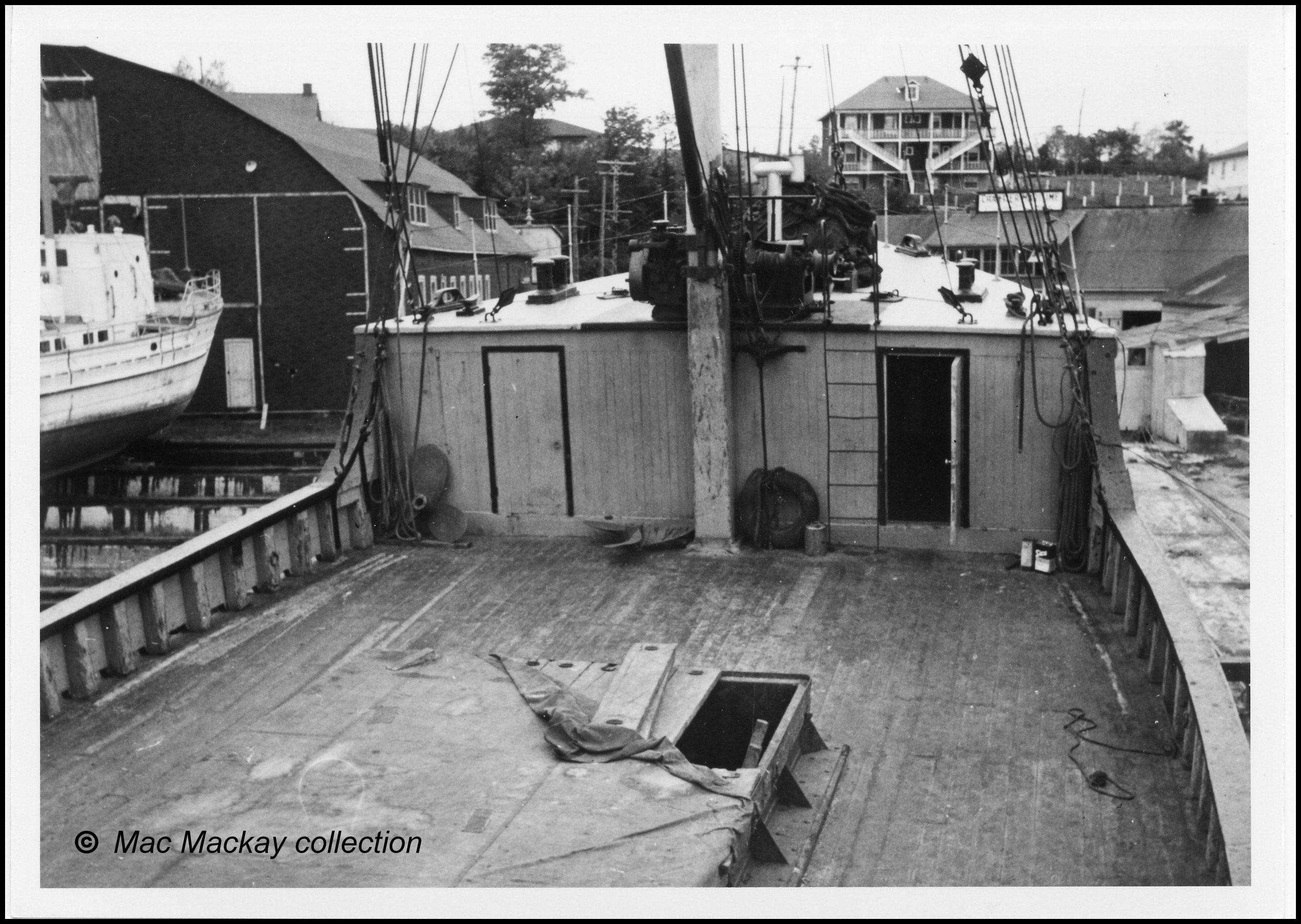
 Now mostly just a figure of speech, "battening down the hatches" no longer describes the process of making hatch openings ready for sea. At one time it was necessary to seal a ship's hatches with boards, and canvas tarps held in place by laths (battens) and wedges. Modern day ships have all sorts of steel hatch covers and seals that generally keep the cargo safe and prevent the hull from filling with water. Some ships are even designed to be "hatchless", such as the Oceanex Avalon (see many previous Shipfax references.)

Battens removed, tarps rolled back and hatch boards lifted to gain access to the hold.

(The goélette Rivière-Verte at St-Laurent, Ile d'Orleans, in 1959.)

 Nowadays "battening down the hatches" means preparing for a tempest (either a real weather event or some other kind of crisis). So today September 23, in Halifax, there was evidence of such preparations in advance of the arrival tonight of Fiona. Currently a hurricane, it may be down graded to a post tropical storm (but still a dangerous northern hemisphere cyclone) when it makes landfall in our area, then tracks across the province and Gulf of St.Lawrence to the west coast of Newfoundland.

Workers from Develop Nova Scotia, the government agency responsible for waterfront amenities, were busy moving floating docks to safe storage at the Centre for Ocean Ventures and Entrepreneurship (C.O.V.E.) dock in Dartmouth (the former Coast Guard base). High winds and a predicted storm surge would certainly damage these structures and potentially cast them adrift. Develop Nova Scotia closed off most of  the waterfront boardwalk to pedestrian access too.

The visiting Irish Navy patrol vessel LÉ James Joyce P62  was tied up at the Tall Ships Quay, a timber pile wharf adjacent to Pier 20. It was decided to move the ship to HMC Dockyard where it will be safer during the storm, and would not risk damage to the dock.


The Samuel Beckett class vessel was built by Babcock Marine in Appledore, England and commissioned September 1, 2015. It carries a compliment of 55, which includes 10 trainees. 

The James Joyce arrived on September 21 and was open to public tours for a time. The tugs Atlantic Willow and Listerville stood by while the ship let go from the pier, which it did by "springing off" - a bit of seamanship rarely seen in these days of bow thrusters and twin screws.

As Listerville makes its way to the Tall Ships Quay, Develop Nova Scotia's work boat moves some floats and the supplier Atlantic Condor is visible in the background at the C.O.V..E dock.

 The number of commercial ships in port was at a minimum (see yesterday's post). The last container ship to sail, Conti Crystal got under way around noon time. That left the Oceanex Sanderling and Nolhan Ava anchored in Bedford Basin as the only sizeable commercial vessels remaining in port. The Canadian Coast Guard deployed CCGS Sir William Alexander to the Shelburne area of the south coast and CCGS Jean Goodwill to Sydney in Cape Breton, where they are on standby for Search and Rescue.

CCGS Sir William Alexander, September 13, 2022.

That left two ships tied up at piers, namely Atlantic Condor at C.O.V.E and the CCGS Kopit Hopson 1752 at the IEL dock. The latter is the former CCGS Edward Cornwallis currently rebuilding by Irving Shipbuilding Inc.  I assume that extra lines have been run to secure these craft during the storm. The barge Scotia Tide is alongside Pier 9  (despite the Harbour Master's requirement that all barges were to be removed moved from Halifax Port Authority berths by noon September 23.)

The yacht clubs and others with waterfront facilities such as the Atlantic Pilotage Authority and Dominion Diving have also "battened down the hatches" in various ways.

Halifax Harbour has experienced several hurricanes during my time, the most severe being Hurricane Juan September 29, 2003 which was a Category 2 when it tracked through the harbour with 150 kph winds (and a gust of 176 kph). Lessons learned by that event, and subsequent ones such as Dorian in 2019, have no doubt guided the preparations for this event.

There were two container ships that remained in port during Juan, and  one of the them, the Albert Oldendorff (ex Hoegh Dyke) parted its lines and ran down on the Saudi Tabuk causing damage to both ships and their cargoes. Numerous other vessels sank or were blown aground, at least partly due to inadequate preparations or the impossibility of emergency response during the storm.

 Albert Oldendorff ripped into containers on the adjacent Saudi Tabuk and dropped at least one of its own containers on the other ship's deck. Adding to the confusion - both ships were carrying National Shipping Company of Saudi Arabia (NSCSA) containers.

Let's hope that this time around Fiona will not be as brutal as its predecessors. However, Shipfax may not be able to publish due to power outages for the next few days. A summary of events will be provided when posssible.

.


Sunday, January 9, 2022

Gypsum outbound

 There has been a slight lull in harbour traffic over the Chrisitmas / New Year week, and a few days of bad weather slowed traffic down, and discouraged ship watching, so there has not been much to report of late. 

This morning's (January 9) sailing of Algoma Integrity would otherwise have attracted little notice but for the fact that it occurred in daylight.

The former Gypsum Integrity until 2015 - no surprise -  loaded Gold Bond gypsum for Baltimore. It was of note however that the ship was not down to its marks, that is to say it was not fully loaded. Drawing 10.1m  according to AIS, but according to my observation it appeared closer to 10m.

As ships earn their keep by carrying tonnage, a slight difference in draft can be converted fairly directly to dollars. Draft may be restricted at the loading dock (as it is at the Gold Bond dock in Bedford Basin) or at the unloading facility (unknown to me) or by the amount of cargo the customer can take at one time, but can also be dictated by the classification society in the interests of safety. The latter does not seem to be the case this time, since the plimsoll mark shows more than a meter of additional draft beyond the 11.1m allowed for winter, but perhpas there is an additional margin for safety.

The ship sails for the CSL Americas self-unloader pool, and CSL's website has highly detailed specifications for all its ships: Integrity specs

The data sheet for the Algoma Integrity shows a  deadweight of 39,500 tonnes at 10.1m versus a 46,293 deadweight at  just over 11.4 m summer draft. That reduction of cargo would only be in the interests of safety or requirements of the customer.

One interesting data column on the spec sheet is "TPC". That stands for "tonnage per centimeter" . For more on that topic see: https://marineinbox.com/marine-exams/tonnes-per-centimetre-immersion-tpc/

As there was no wind to speak of on departure, the ship only required one tug to get away from the dock and turn outbound for sea. That duty fell to the Atlantic Willow, which still carried a bit of snow around the edges from the January 7-8 storm. 

Atlantic Willow is a 4,000 bhp ASD (Azimuthing Stern Drive) tug with 50 tonnes of bollard pull, and firefighting capability. It was built in 1998 for service at the Strait of Canso, based on the NuStar oil storage facility, and is registered in Port Hawksbury. The joint-venture arrangement between Svitzer Canada and Atlantic Towing Ltd formed in 2010 has Svitzer providing tug service on the Strait and Atlantic working in Halifax, so Atlantic Willow is one of four Atlantic Towing Ltd tugs normally based in Halifax. The other tugs range from 5,000 to 5,500 bhp and 66 to 70 tonne bllard pull.

.


Tuesday, April 12, 2016

Allise P in daylight

Although the ship has been a regular caller for Hapag-Lloyd since February 2015 I never seem to catch it during daylight hours. Most ships like to arrive in the early morning and sail in the late afternoon or evening and winter lighting conditions make it hard to get good photos.

Today Allise P arrived at the pilot station at 1500 hrs, and transited the Narrows just at 1600.

 Atlantic Willlow paces the ship through the Narrows and is about to come alongside near the bow.

Once into the Basin the Atlantic Fir, the stern escort tug, swung the ship around with Atlantic Willow assisting on the bow.

 The Atlantic Fir is new to Halifax and at 5,000 bhp can handle stern tethered escort work, as can sister Atlantic Oak.

Allise P was built in 2007 by Hyundai, Ulsan for Stefan Patjens Reederei, GmbH as Maersk Dubrovnik. It operated in the China, Korea, India, Asia loop known as the Chennai Express.
The 5041 TEU ship took its present name in 2014 on completion of the charter to Maersk. It measures 53,481 grt, 53,900 dwt.

.

Saturday, March 21, 2015

Saturday Roundup and further updates

As usual for a Saturday, there was lots of activity in the harbour - some to do with catching up after many delays due to heavy snow, some in advance of another weather system (this time mostly rain, to herald the arrival of spring) and some just normal activity.

Sloman Hermes arrived for bunkers. The ship was here December 13 at pier 31, apparently for repair.  A small chemical tanker of 11,298 grt, 16,418 dwt it was built in 2012 by  Jiangzhou Union in Rui Chang, China, and operates in the Navig8group tanker pool.

Sloman Hermes waits for bunkers.

Federal Tweed did eventually move to pier 27, but there was some problem after she weighed anchor in the Basin and Dominion Diving's Halmar came out to assist. It appears that a heaving line may have become fouled in the bow thruster. In any event the Narrows was busy with arrivals and departures - see below - and  she eventually was free to move. Whatever her problem (likely a bent prop blade), it is supposed to be fixed by this evening allowing her to sail.

Federal Tweed had weighed anchor, but was holding in the Basin for arrival of the Halmar.

Federal Tweed is owned by Fednav, one of more than 100 owned and chartered ship in the Canada's largest shipping company. At 31,590 grt, 55,317 dwt, with ice class 1C, it has four 30 tonne cranes (and clamshell buckets on deck) and is considered a supramax bulker, i.e. between 50,000 and 60,000 dwt
 -smaller than (old) Panamax and thus handysize. If all these terminologies are confusing, there is a good reference available http://maritime-connector.com/wiki/ship-sizes/

Halmar under the bow, with a number of extra hands on the foredeck peering over the rail. A heaving line is barely discernible from the centre lead down towards the bow thruster.

The ship was built in Oshima, Japan in 2013 and has a new hull design with fuller bow and almost plumb stem, with smaller bulbous bow.

The Narrows was a busy spot for time this morning with the arrival of Atlantic Cartier on its regular visit. First though was Atlantic Willow, putting on a little extra speed to get ahead of the Cartier.

It is unusual to see a tug running at speed thought he Narrows.

Atlantic Cartier with Atlantic Oak tethered astern.

Its berth at Fairview Cove was occupied by NYK Daedalus which departed after the Cartier was in the Basin. Interestingly, the tug Atlantic Oak was tethered escort on both the inbound Cartier and the outbound Daedalus, with the tug Atlantic Willow, unberthing the Daedalus first then going out to the Cartier to free up Atlantic Oak..


NYK Daedalus has cleared the MacKay bridge, and is southbound in the Narrows. Escort tug Atlantic Oak is not visible, but is tethered to astern.

NYK Daedalus first called here July 21, 2014. It was built in 2007 by Hyundai, Ulsan, measures 55,534 grt, 65867 dwt, and has a capacity of 4922 TEU.  
 
Meanwhile Yantian Express was still working cargo today, with trucks lined up on several streets leading toward the Fairview Cove terminal. There have been delays of inbound rail cargo due to the heavy snow and clearing the rail yards to move cars - those same cars must be emptied to load outbound cargo.
It is indicative of the problems with these larger ships however. They have so many containers to move that they place big demands on the terminals. Expect this situation to get worse as bigger and bigger ships arrive, even in good weather. Yantian Express arrived Tuesday March 17, the day of a fierce winter storm, with 70cm of snow and there was likely no work that day or most of the following day.


Yantian Express partially surrounded by snow dumped from clearing operations in the terminal.

Yantian Express, which sailed as Shanghai Express until 2012, was built in 2002 by Hyundai, Ulsan and measures 88,493 grt, 100,003 dwt, with a capacity of 7,506 TEU (700 reefer). It has just been displaced on the Asia-Western Europe service by even larger ships as Hapag-Lloyd rationalizes its fleet. It has announced that it will sell or scrap 16 ships - all of smaller size.

Updates:


At pier 9c Harefield was receiving the ministrations of Connors Diving under its stern, thanks to ice damage.
 
At Autoport: Tosca finally sailed and Opal Ace took its place.   
At Imperial Oil: Seavictory sailed in ballast for Saint John and Prisco Irina took its berth.

And in partial answer to the burning question How Much Snow Was There? I offer this photo of a gang of workers on the roof of the New Halifax Shipyard Assembly Hall, removing snow from the lowest roof,  - by hand (they also had a snow blower). The size of the drift against the higher wall is in excess of 10 feet, and is packed hard because it faces south and is exposed to sun all day.

The accumulation of snow and ice, melting and refreezing and fresh drifted snow on top has resulted in many roofs now loaded in excess of their design capacity. Tonight's rain, will result in untold additional stress, particularly when drains are blocked. 

According to most sources there has been 100cm in March, with 70 cm on March 21 alone..

.


Monday, May 19, 2014

Foggy-part 2

Later in the morning the wind came up and blew most of the fog away, but there was misty rain from time to and some unusual moisture.

Atlantic Cartier arrived and held off the Fairview Cove terminal until Atlantic Concert was ready to leave. It gave time to study the many small differences between the two fleetmates.


Although both ships were of the same general design,  they were built to the order of the various partner companies in the Atlantic Container Line. Atlantic Concert was built by Kockums of Malmo, Sweden for Wallenius Lines.
Atlantic Cartier was built by Chantier du Nord, Dunkerque for Cie Générale Maritime. The enclosed forepeak was added some years later, but its accommodation was built on quite a different arrangement-note the different pattern of windows.

At the time these G3 ships were built, the other partners in ACL were Cunard (Atlantic Conveyor built by Swan Hunter) and A/B Transatlantic, of the Brostrom Group (Atlantic Companion and Atlantic Compass built by Kockums). Since then the ownership of the line has been consolidated, with Grimaldi Group owning 100%. All ships are now registered in Sweden.

Things were almost brightening up when Barkald sailed from National Gypsum for Baltimore. (See yesterday's post for more on this odd ship.)

The pilot aboard was intending to head the ship west of George's Island for sea, but came to find out that he had to go east. No Notice to Shipping was posted, and Halifax Traffic seemed totally unaware of an exclusion zone around pier 20 (right next to the Port Authority's office!) where two tugs were carrying out a water display.

Atlantic Willow and Atlantic Oak do pinwheels, while hurling gobs of water and creating their own drizzle and fog off pier 20. [See also Tugfax]

Halifax Regional Municipality Police boat Garrett Cotter patrols an exclusion zone.


Visiting cruise passengers from the Veendam may have thought the demo was for them, and customers at the Seaport Market may have had similar thoughts. My own opinion is that it was arranged for the visiting royal personage by marriage, the Duchess of Cornwall. She and her spouse, Prince Charles were in Halifax for the day on a short tour of the Maritimes. The Duchess was at the Seaport market at the time of the display, while Prince Charles was visiting veterans.
Royal security apparently precludes broadcast notification for mariners.

Breaking off the display, the two tugs headed for Fairview Cove for the scheduled 1630 departure of Virginia (see previous post). That event was delayed until 1800 as tugs and pilot cooled their heels until the last boxes were put aboard.

Unlike her arrival, conditions were clear for Virginia's departure this evening.

 .