Sunday, January 30, 2022

Weather

 A major nor'easter winter storm working its way across Atlantic Canada from New England brought the usual accumulations of heavy wet snow, sleet and freezing rain. More concerning to shipping however were the very high winds with extreme gusts. By mid-morning Sunday January 30 wind speeds in the harbour were beginning to taper off from 60 kph (37 mph). Gusts in excess of 80 kph (50 mph) were recorded around 0600 hrs.

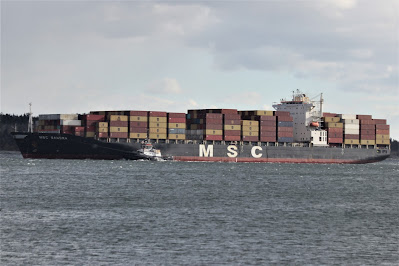
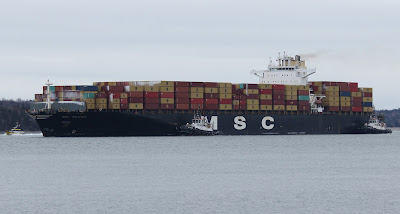
It was around 0600 that the MSC Sandra, which was docked at Pier 41 PSA Halifax, apparently began to come off the pier. From the ship's recorded AIS track it apppears that some lines must have parted.When that happens there is more stress on the remaining lines and it is not long before they part also. The ship called for tugs and a pilot was dispatched to assist in bringing the ship back alongside and running new lines. Presumably there was also a call for line handlers, as the ship's own crew would not be able to make the ship fast by themselves.


 MSC Sandra arriving in Halifax on an earlier visit in calm conditions.

(December 17, 2021 photo)

As of mid-morning the tugs Atlantic Oak and Atlantic Willow were being kept alongside the ship, as there were still occassional bursts of high wind.

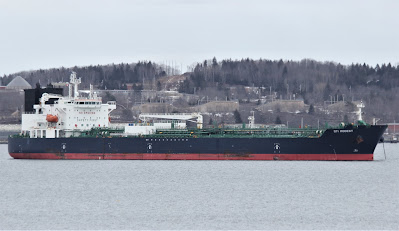
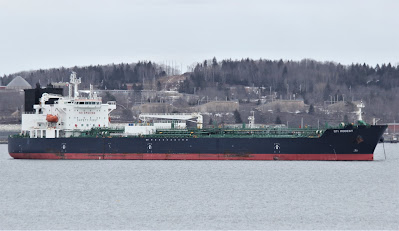
Also wandering about was the tanker STI Modest which was waiting out the storm at anchor in Bedford Basin. From its AIS track it appears to have been dragging its anchor quite a bit, but as there was no other shipping nearby there was no cause for panic, however I am sure a close watch was being maintained. Nobody wants to see a loaded tanker adrift. I am not aware that a pilot was called, but I assume the ship was steaming up on its anchor line to control drift.

STI Modest in its original anchorage position as pictured Friday January 28. It will dock at Irving Oil when calmer conditions prevail.


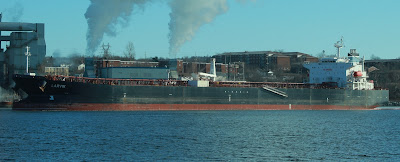
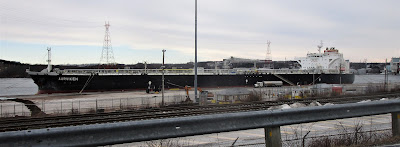
Another tanker, the Larvik which was discharging heavy fuel at Nova Scotia Power, Tufts Cove, left off unloading and put out to sea. At first it was in the outer anchorages but that is not a good holding ground, so the ship is just steaming about until conditions are right to return to port.

Also pictured January 28, the Larvik has only a light jetty to secure to at Tuft's Cove, and it would not be safe in high winds.

Several ships which are expected in Halifax are holding off until condiitons improve.

The bulker Efficiency OL which has some technical problems on the St.Lawrence River and was detained for thirteen days in Quebec City by Ship Safety is sheltering in Chedabucto Bay.

The tanker Minerva Xanthe from Port Neches, TX and bound for Imperial Oil was due yesterday but is still at sea somewhere off the east coast.

Some container ships that were due have held off for a day or two. These include Tropic Hope and MSC Tianjin. Maersk / CMA CGM's weekly caller from Montreal, Maersk Patras which would normally arrive on Saturday, is now due Monday January 31.

.

Friday, January 28, 2022

Scorpio in the Basin

 The Scorpio Tankers fleet of about 130 tankers is active world wide, and so it is not unusual to see one of its ships in Halifax.

 STI Modest, one of many MidRange tankers in the fleet, arrived early Friday morning January 28 from Amsterdam and anchored in Bedford Basin. I am assuming it will wait out some nasty weather over the next few days before delivering cargo to Irving Oil.

The scrubber fitted ship was built by Hyundai Vinashin Shipyard Co in Ninh Hoa, Vietnam in 2019. It is a 29,991 gt, 47,499 dwt product tanker.

In an unintended pun, owners Scorpio Tankers recently announced the sale of 16 of its tankers to Singapore based Hafnia Tankers to "increase liquidity". Certainly the half billion US dollar price tag will return a lot of cash to Scorpio, but Scorpio's capacity to carry liquid cargo is reduced by 10% - a reduction in liquidity ?

For more detail on the complicated deal see Hafnia's press release

Scorpio is publicly traded in the NYSE. Chairman and CEO is Emanuele A. Lauro. Hafnia is the world's largest product tanker owner and is listed on the Oslo stock exchange.

.

Thursday, January 27, 2022

Oil Heat

 The Nova Scotia Power Corp is taking a cargo of oil at its Tuft's Cove generating plant in Halifax today January 27. Delivering the load of heavy oil is the Bahamas flag crude oil tanker Larvik coming from Freeport, Bahamas (January 20-21) and Saint Rose, Louisiana (January 14-16).

 The current very cold weather places extra demand on power generation, and Tuft's Cove appeared to be going full tilt today with billows of steam emitted from its burners.

The Tuft's Cove facility, located on the Narrows, usually burns natural gas, but has the capability to store and burn heavy oil. Built originally to burn oil or coal, it was modified to use gas when Nova Scotia's offshore gas fields came on line. Once those fields were exhausted, Nova Scotia Power continued to access gas from their partly owned Maritimes and Northeast pipeline, which is connected to the North American network in Massachusetts. 

Since a major oil spill at Tuft's Cove in 2018, the NSPC has upgraded some of the oil storage and pipeline at the site, but has not notably used much if any heavy oil.

By coincidence NSP has acknowledged the delayed retirement of its coal fired generating stations in Trenton, NS and Point Aconi, Cape Breton because the new hydroelectric power transmission line from Newfoundland has not proven reliable. The Muskrat Falls hydro electric project in Labrador sends some of its power by undersea cable across the Strait of Belle Isle and the Cabot Strait to Nova Scotia, but this has not yet lived up to expectations.

The tanker Larvik, despite its Norwegian sounding name, is owned by Polys Haji-Ioannu family of Greece. Technical management is entrusted to their Singapore based World Tankers Management, and commercial management is done by Polyar Tankers of Oslo. The ship is apparently time chartered to the Heidemar pool.

Built by Sumitomo, Yokosuka, Japan in 2006, the Larvik measures 35,711 gt and 61,213 dwt which is very small for a crude tanker, but more common for the DPP "dirty petroleum products" or black oil trade. It is an (old) Panamax size.

Emissions from Tuft's Cove are fairly clean when it is burning gas, but is not quite so white when burning oil. It appeared to be running only two of three generators today.
 

.

Wednesday, January 26, 2022

CCGS at 60 - my slant on it - and update

Preface

  I am prepared to take some flack on the following, which is my own take on the events of sixty years ago. I certainly have nothing against the Coast Guard. I am only trying to put the events in perspective.

Anniversary

On January 26, 1962 the Canadian Coast Guard came into existance. At first it was a change of name and paint scheme for the Department of Transport's then fleet of 241 vessels. The serviceable black hull, white superstructure and tan funnel with black cap was replaced with a bright red hull, complete with stylish white slash, and a white superstructure and funnel with bright red maple leaf (well in advance of Canada's maple leaf flag, which was adopted officially in 1965). The selection of red as a hull colour signified that the ships were to be present in winter where red was highly visible againt the white of ice. Merchant ships working in northern waters were often painted red too, so it was a functional as well as a policy choice.

Canada's then largest icebreaker, delivered in 1959, was the John A. Macdonald. Naming it after Canada's first prime minister, and a Tory, left little doubt that part of its mission would be political.

 Differing from its US counterpart, the Canadian Coast Guard was not a quasi military organization although its members did have uniforms and badges. Like the Canadian Marine Service, its immediate predecessor, it remained civilian. It also remained responsible for aids to navigation such as buoys and lighthouses, (from numerous bases in ports from coast to coast), arctic supply, lifesaving and icebreaking.

The Coast Guard had a large marine base in Halifax harbour, in Dartmouth, where they based the ships and serviced the navigation aids for the area.

The Canadian government of the day, lead by the Progressive Conservative John G. Diefenbaker, had been elected by a landslide majority in 1957. In no small part the victory was thanks to widespread support in Quebec. Diefenbaker's Quebec lieutenant, and deputy leader of the PC party was Léon Balçer, a lawyer from Trois-Rivières. Balçer was appointed as Minister of Transport in 1960.

The icebreaker Labrador was originally assigned to the Royal Canadian Navy, but transferred to the Department of Transport in 1957 for politcal reasons. It became a CCG ship in 1962.

 With the opening of the St.Lawrence Seaway in 1959 ports on the St.Lawrence River and Great Lakes were on the ascendency to the detriment of coastal ports like Halifax and Saint John. The latter two had become primarily "winter ports" and saw their busiest times from December to April when the St.Lawrence was closed due to ice. However there was pressure to provide for longer shipping seasons on the St.Lawrence in ports such as Quebec City, Trois-Rivières, Sorel and Montreal.

The icebreaker N.B.McLean built at Halifax Shipyard in 1930, was used in Hudson's Bay in summer, but was based in Quebec City and worked the St.Lawrence in winter. It never looked comfortable in red.

 The Department of Transport icebreakers were kept busy in the winter but in spring some were dispatched to break ice to prevent flooding on the upper reaches of the St.Lawrence. However ports in that area wanted more icebreaking to assist navigation earlier in the year. At the same time there was political pressure from Halifax and Saint John to preserve the status quo. It was feared that with winter navigation on the St.Lawrence, Halifax and Saint John would be "dead". (Container shipping was still in the future. In 1963 CNR spokes people said the railroad was preparing for containers but they would not be coming 'over night'.)


 The first CCGS Sir William Alexander was delivered by Halifax Shipyard Ltd in 1959 and was a capable buoy tender with good icebereaking capability. (In the photo it is still working after being renamed William to free up the name for its successor, which had post-delivery issues and could not enter service right away.)

Each year after 1960 ships began to arrive in Montreal earlier and earlier in the year, and the Atlantic ports continued to cry foul as icebreakers began to assist the ships ostensibly for safety. Of course the way to assist the ships for safety was by maintaining navigation lanes in ice. Flood control was still claimed to be the primary mission of the ships but that also assisted navigation.

By the time the PCs left office in 1963 winter navigation on the St.Lawrence although still in its infancy, had become a fact and the succeeding Liberal governments expanded the Coast Guard's capability by building more icebreakers, including the CCGS Louis S. St-Laurent. Primarlily for the arctic, but also working in the Gulf of St.Lawrence and Saguenay River, the ship is also named for a Quebec politico.

A 1975 view of "the Louie"with its original bow, and still a steamer along with several of its fleet mates.
 
Named for the Liberal Prime Minister immediately before Diefenbaker, the Louie's name also sent a policitical message, as does the oft promised but not yet delivered CCGS John G. Diefenbaker. If it is delivered during the tenure of a Liberal government, odds are that it will be renamed. I don't know the current betting line but I believe Pierre Eliot Trudeau is a nose ahead of Lester B. Pearson. The former will not be a big hit in Alberta, but that province doesn't need much icebreaker assistance.

Present day Coast Guard, with 119 vessels, is multi-tasked, for navaids,  pollution control, icebreaking, search and rescue and research work.
 
In 1995 the Canadian Coast Guard was transferred from the the Minister of Transport to the Minister of Fisheries and Oceans, making it also responsible for all the research and enforcement vessels in the department. In 2006 the CCG became a "special operating agency" under the Minister, with its own commissioner. It also co-operates with other departments for the operation of border security vessels.
 
New ships are planned for the CCG, but many of its older vessels will be expected to serve longer until replacements arrive. Some will not make it, and interim vessels may be needed.
 
CCGS Jean Goodwill, based in Halifax, is one of three former Swedish icebreaking supply vessels acquired by the CCG as interim ships until purpose built icebreakers can be constructed.

The Coast Guard's history since 1962 has been a distinguished one, working as it often has with tired equipment and under brutal conditions both in the south and the north. Its people are to be admired and its ships are to be well remembered.


Update

It may be a coincidence, but the next ship to join the CCG fleet was registered in Ottawa on January 26, 2022. The Mangystau-2, a shallow draft tug/supplier, built in Romania in 2010 has been acquired by Atlantic Towing Ltd and will be sold to the Minster for $45 million. The vessel arrived in Sorel-Tracy, QC earlier this month and plans are underway to refit it for CCG service.

 When the refit is complete, the ship will be assigned to the Great Lakes where it will cover for CCGS Griffon and CCGS Samuel Risley during their life extension refits.

 .

Tuesday, January 25, 2022

Bow Wow - Crystal Crunch

 As a sort of footnote to the ongoing series related to the appearance of ships, centered on the look of their bows, I refer to the latest news  in the beleagured cruise industry.

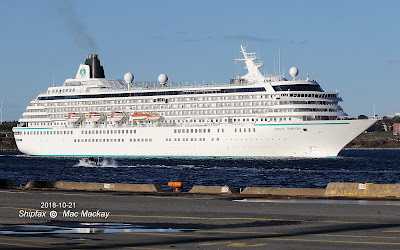
 Referred to as "one of the key luxury brands" of the cruise industry, Crystal Cruise Lines has been placed in receivership. The company recently diverted its Crystal Symphony to the Bahamas to avoid arrest. The ship was to be seized on arrival in Miami for unpaid fuel bills, so terminated its cruise in Bimini January 22 and transferred passengers by ferry to the US.

 Crystal's ships have always been attractive, and mercifully free of extraneous hull graphics.

Crystal's situtation is tied to the financial woes of its parent company Genting Hong Kong, including its insolvent German shipyards MV Werften Group and Lloyd-Werft. The huge Wismar and Rostock yards were building large cruise ships, but work has been suspended.

Genting Hong Kong, could not satisfy creditors with its latest restructuring plan, and announced January 22 that it would be winding up its operations, which also include Star Cruises and Dream Cruises and will be appointing liquidators.

Genting's founding family have casino and resort businesses based in Malaysia and Singapore, and operating world wide. They are not included in the Genting Hong Kong collapse. They also have interests in many other businesses which are also not included in the shut downs.

.

Monday, January 24, 2022

CCGS Hudson returns

 Crowds gathered all along the Halifax waterfront this afternoon (January 24) as the CCGS Hudson arrived home for the last time. In a welcome usually reserved for naval vessels returning from war, the crowds were largely silent, but some cheers went up when the ship was close enough that crew members could be recognized from shore. 

The ship was "dressed all over" with signal flags and was escorted into port by CCGS Sir William Alexander which put on a bit of a show with its rarely used water cannons.

 Family members of the crew, former crew members and scientists who worked aboard the ship were among the well wishers who came out to see its arrival.

It was announced last week that the Hudson will be decommissioned due to the high cost of repairing a burned out propulsion motor suffered in November off St.John's. The ship was able to return to Halifax on one motor (and one propellor) to tie up at its base at the Bedford Institute. [Known as the BIO for its former name the Bedford Institute of Oceanography. It is now called simply the Bedford Institute as it is also home to the Canadian Coast Guard and to fisheries research, all under the direction of Fisheries and Oceans Canada.]

The Hudson made a ceremonial sail past of its home since 1963 on its way to Bedford Basin where the Sir William Alexander was standing by.


The ship turned in the Basin, under the watchful eye of a CCG helicopter then returned to tie up for the last time alongside the BIO.

 The decommissioning processs will take some time, so it may well be next year before the ship is sent to the scrappers. Its replacement is now due in 2025 although that date is not carved in stone. 

.


Saturday, January 22, 2022

Back Again -Times Two

 Two returnees are in port today, and one may be somewhat less welcome than the other.

Number One

Returning last evening (January 21) to Pier 9C was the tanker Aurviken. It was last here January 12 and January 13 en route from Libya to Point Tupper. At the time I was informed by the ship's agents that the ship was here to take on fuel for its cargo heating boilers. That fuel turned out to be heavy Bunker C, and was transferred via open pipe and/or with atmospheric venting, from trucks to the ship. The escaping vapours "stunk up" the neighbourhood, alarming nearby residents, including Halifax Shipyards, and causing unecessary panic that a major crude oil spill was underway.


It came as a surprise today to see the ship taking on heavy fuel again with the same sickening aroma permeating the neighbourhood. It is surprising that after the last incident such a transfer was permitted. Open pipe transfers and atmospheric venting are usually conducted farther away from residential areas, such as at Pier 27-28.

The Norwegain owned Aurviken is a 62,372 gt, 112,802 dwt ship, and appears to be still carrying a significant quantity of crude oil cargo. Perhaps it used up all its boiler fuel before completing its unloading at Point Tupper. Due to the current frigid conditions, that cargo must be near solid by now, so maybe we can expect the ship to come back for a third time? 

In the past when incidents of solidified cargo have occurred another tanker was brought alongside to provide steam, but that is a costly process.

Number Two

This morning's arrival (January 22) was the container ship MSC Valencia on MSC's Indus 2 service from India via the Mediterranean. This is the ship's second call on that service. It was first here October 31, 2021 and was the fourth ship to call after the Indus 2 service started calling in Halifax.


The ship was built by Hyundai, Ulsan in 2006 and was initially named Hammonia Jork after a small village near Hamburg, Germany. Later in 2006 Hammonia chartered the ship as MSC Valencia. They renamed it CSAV Valencia * for a short time in 2012 but it reverted to MSC Valencia the same year. Hammonia Schiffarts is a Hamburg based shipowning and ship management company with somewhat more than thirty ships on charter to various operators.

The 89,941 gt, 102,756 dwt ship has a capacity of 8204 TEU including 700 reefers.

* CSAV, Compagnia Sud Americana de Vapores, is a large Chilean ship owner. In 2014 it merged its container shipping operations with Hapag-Lloyd, giving it a major stake in H-L ownership. Since then UASC, the United Arab Shipping Company merged into H-L in 2017 as its largest shareholder.


.