Showing posts with label CCGS Hudson. Show all posts

Friday, February 10, 2023

Alfred Needler and other old government ships

 The Canadian Coast Guard announced February 9 that it will not be repairing the CCGS Alfred Needler after the most recent incidents (See previous posts of December 22 and January 19) when the ship had equipment failures and was damaged while alongside at the BIO dock. They have cancelled a planned $5 million refit which was intended to squeeze a few more years of service out of the forty year old research trawler. They have determined that the ship is beyond repair and that further expenditure would not return it to safe operation.

Instead the ship will be prepared for what they politely refer to as "deconstruction" and "environmentally sound disposal." That means scrapping (in Canada) following safe regulations.

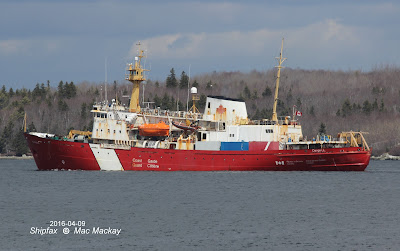
The announcement follows the retirement of CCGS Hudson late last year. A contract to demolish that research veteran (at sixty years of age) was awarded to R.J.MacIsaac Construction Ltd (RJMI). They took over "care and custody" of the ship, and in the spring of 2023 will tow it to Sheet Harbour for final disposal. In the meantime RJMI has moved the ship to Pier 9C in Halifax where it awaits the tow.

According to the CCGS press release in December, once the ship arrives in Sheet Harbour there will be a process of hazardous material remediation and disposal.

Then by Fall 2023, the vessel will be removed from the water and the hull and superstructure will be disassembled. The overall project is expected to be completed by the end of Fall 2023.

As per the press release "RJMI will ensure that any steel, stainless steel, aluminum, or other recyclable materials onboard the vessel are recycled while non-recyclable materials are disposed of in an environmentally-responsible manner, in compliance with federal, provincial, and municipal regulations. As well, the contractor will salvage and return the CCGS Hudson's hull transducers and propellers to the CCG."

There has been no visible activity on the Hudson at Pier 9C, and as of this morning, February 10, it still remains intact. RJMI's facility in Sheet Harbour is currently dismantling the fire damaged ferry Holiday Island.

That work is expected to have advanced enough by spring that room can be found for the Hudson.

As for the Alfred Needler there are other contractors that could also bid on the work, and since it is a much smaller ship there could be several locations to do it.

It was also recently announced that the Coast Guard itself has begin to demolish in place the former CCGS Tupper at Marie Joseph, NS. The ship was sold by the Coast Guard in 2000 for conversion to a yacht and renamed Caruso but work never took place and after a fire in 2008 it was sold to a scrapper and towed to Marie Joseph in 2011. Scrapping was never completed and the Coast Guard undertook to remove the remains as a pollution threat. They will likely also demolish the tug Craig Trans at the same location and attempt to recover costs from the same owner. See previous post of June 21, 2011 and April 4, 2021.

There was been a long list of "dreamers" buying former government ships with schemes to reuse or convert them, but the ships usually ended up abandonned when funds ran out, or were involved in smuggling operations. None of this did any credit to the government or to Canada. In recent years, whether intentionally or not, surplus government craft have been few and as per the first three ships mentoned above, were in no state to be reused and so have been sold to be dismantled appropriately.

.


Thursday, December 22, 2022

More DFO woes - now its the Needler

 The federal government's Department of Fisheries and Oceans operates a variety of reseach vessels and the ships of the Canadian Coast Guard. After many years of what can only be called neglect in government budgets, a program was finally put in place to rejuvenate the DFO fleet, but not before several aging vessels reached what should have been end of life. Notable among these was the recently decommissioned CCGS Hudson, which was well past its expected retirement date when it broke down. (See December 19 post).

The CBC is now reporting another ship with problems, but which must soldier on for several more years service. CCGS Alfred Needler is a 925 gt fisheries research trawler, built in 1981 by Ferguson Industries Ltd in Pictou, NS. 


 According to the news report a generator that powers the trawl winch failed in November and forced the ship to return to St.John's. Because the vessel's research involves the accumulation of comparative data, it is important that the ship replicate its previous missions (fishing in the same place, with the same gear, at the same time of year, etc.,) Repairing the generator is thus essential to being able to complete the research program. Then on November 23 there was a failure on an air receiver tank fitting. (The ship starts its engine on compressed air). That may have been repaired quickly, but the work to get the ship back in full service will not be completed until February. The ship has been alongside at the Bedford Institute since December 18.


 The Alfred Needler was to be retired this month, but will now require a $4.1 mn Vessel Life Extension project to keep it in service. The other DFO research trawler, the Teleost, which was also to be retired, will be maintained as well in order to transfer the above noted comparative data programs to new ships.

All this is very strange since the National Shipbuilding Strategy has long since delivered all three of the planned new offshore fisheries research vessels. CCGS Capt Jacques Cartier was delivered in 2019 and the CCGS John Cabot in 2020. (The first of the three, CCGS Sir John Franklin was delivered in 2019 for service on the West Coast.) There should have been time to carry out the transitions from old to new ships, but there may have been issues with the new ships too, all of which were built by Seaspan's Vancouver Shipyard Co Ltd.

.

Wednesday, December 14, 2022

End of the Year, End of the Line

 As the year 2022 comes to an end so do the careers of several ships from the region. At least four ships  are soon to be no more as the scrappers torches may already be at work.

Two ships from Newfoundland are included, both known in Halifax at one time in their careers.

 Number 1

The tug now known as the Matterhorn was built in 1956 for the Royal Canadian navy as the St.Charles ATA 533 and was based at HMC Dockyard in Halifax. Although intended to tow large navy vessels up to and including aircraft carriers it was frequently relegated to towing gunnery targets (some of which were old ships.) In 1994 it was sold to Secunda Marine Service and renamed Chebucto Sea, and saw varied duties, including a disastrous bareboat charter that resulted in a lengthy legal proceeding. A Newfoundland company became the owners in 2009. In 2014 while lying in Mount Carmel, NL, and with the name of Matterhorn, the tug sank at its berth.

With a gunnery target on the hip, the tug was returning to port in this photo.

There have been several accounts, and many photos of this tug and its two sister tugs in my Tugfax blog:

June 18, 2012 and February 18, 2015

After several years of trying to make the owners responsible for removing pollutants from the hulk, the Canadian Coast Guard took over cleanup efforts recently and removed a 256,7000 liters of oil / water. It appears that they had to raise the wreck to do so, and  it is likely that it will now have to be cut up in place as it is well beyond any poteantial salvage.

Number 2

 Also in Newfoundland, but in the port of Grand Bank, the Canadian Coast Guard removed 292,537 liters of oily waste from the abandoned fishing vessel Atlantic Pursuit. It was damaged in a storm in the year 2006 and was towed into port then moved to different ports under different owners who never seemed to be able to get the ship back into operating condition. It was even sold off for scrap but never broken up.

Built in 1976 as an offshore supplier / pipe carrier it was converted in 1988 to an offshore clam dredger. I have recounted its history here March 10, 2016.

The ship has now been towed by the McKeil Marine tug Beverly M 1 to Sydport, NS, arriving December 12, where it will be broken up by Marine Recycling Corp.

Two more ships will be broken up in Nova Scotia.

 Number 3

The tug Irving Beech is soon to arrive in Wood Island, PE to take away the burned out ferry Holiday Island. An engine room fire on July 22, 2022 resulted in irreparable damage to the ship. Fortunately all passengers and crew were rescued. 

Built in 1971 to operate seasonally between Cape Tormentine, NB and Borden PE, with sister ship Vacationland, it was moved to the Caribou, NS to Wood Islands PE crossing when the Confederation Bridge was completed in 1997.

Now the Antigonish, NS based company R.J.MacIsaac Construction Ltd has been contracted for $1.6 mn to scrap the ship. It will be towed to Sheet Harbour, NS where the work of removing hazardous materials and cutting it up is to be completed by Febrary 28, 2024.
 

Number 4

The same  R.J.MacIsaac Company has also been sontracted to break up the CCGS Hudson (see my post of November 30, 2022. ) However cutting up will not begin immediately. First the ship will be moved from its berth at the Bedford Institute to another location in Halifax Harbour where initial work will be carried out. It will eventually be towed to Sheet Harbour for scrapping. 

Even when showing obvious signs of deterioration, the Hudson's graceful lines could not be concealed.

 .


Monday, January 24, 2022

CCGS Hudson returns

 Crowds gathered all along the Halifax waterfront this afternoon (January 24) as the CCGS Hudson arrived home for the last time. In a welcome usually reserved for naval vessels returning from war, the crowds were largely silent, but some cheers went up when the ship was close enough that crew members could be recognized from shore. 

The ship was "dressed all over" with signal flags and was escorted into port by CCGS Sir William Alexander which put on a bit of a show with its rarely used water cannons.

 Family members of the crew, former crew members and scientists who worked aboard the ship were among the well wishers who came out to see its arrival.

It was announced last week that the Hudson will be decommissioned due to the high cost of repairing a burned out propulsion motor suffered in November off St.John's. The ship was able to return to Halifax on one motor (and one propellor) to tie up at its base at the Bedford Institute. [Known as the BIO for its former name the Bedford Institute of Oceanography. It is now called simply the Bedford Institute as it is also home to the Canadian Coast Guard and to fisheries research, all under the direction of Fisheries and Oceans Canada.]

The Hudson made a ceremonial sail past of its home since 1963 on its way to Bedford Basin where the Sir William Alexander was standing by.


The ship turned in the Basin, under the watchful eye of a CCG helicopter then returned to tie up for the last time alongside the BIO.

 The decommissioning processs will take some time, so it may well be next year before the ship is sent to the scrappers. Its replacement is now due in 2025 although that date is not carved in stone. 

.


Wednesday, January 19, 2022

CCGS Hudson - axed

 The propulsion motor failure on CCGS Hudson reported here December 17, 2021 has proven fatal to the future of the ship. The Department of Fisheries and Oceans announced today that the ship will be retired and not repaired. This leaves the department without its principal occeanographic and hydrographic research vessel. Adding to the problem is the embarassing fact that another year has now been tacked on to the delivery date for the replacement ship, which may now be delivered in 2025 even with ballooning construction costs. The department will be forced to hire in ships, at great expense, if it hopes to complete research programs that are vital to ongoing science. 

Built by Saint John Shipbuilding and Dry Dock in 1963 and commissioned in 1964, the 3444 gt, ice classs 2 ship has had many achievements over the years. Circumnavigating North America in 1969 and the western hemisphere in 1970 are only the most noteworthy events in an unprecedented history.

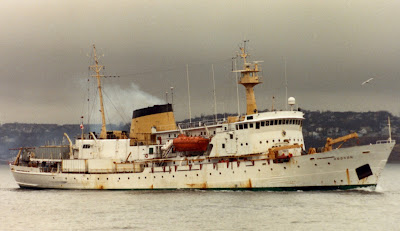
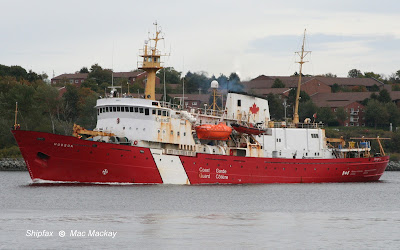
Initially serving the Canadian Oceanographic Service, as CSS Hudson (Canadian Survey Ship) it carried the same traditional white hull and buff funnel of its predecessors such as CSS Acadia. With government re-organizations it came under the control of the Minister of Fisheries and Oceans, Canadian Coast Guard in 1996. It then acquired the red hull paint and became CCGS Hudson. Its base remained the Bedford Institute Dartmouth (Halifax) and it was often seen sailing in and out of Halifax harbour.

As the years went on refits became more extensive and more lengthy and as more problems were "uncovered" and had to be repaired, more costly too.

The ship has a typical icebreaker diesel electric propulsion system consisting of four V-16 turbocharged Alco 251D diesel engines, built by Dominion Engineering Works under license, driving four generators feeding two electric motors. It has two fixed pitch props. This DC / DC arrangement gives an infinite variety of speed increments, which is ideal for slow speed survey work or working in ice. 

It is apparently one of the electric propulsion motors that failed, since the diesel engines themselves are virtually indestructable (despite being of 1951 design). Those engines are still available from current license holders Fairbanks Morse. The generators and electric motors may not be "off the shelf" however, which would explain the current situation. Replacement would likely take a year, for only a two to three year additional service life. Press reports indicate that the ship would also need other upgrades to meet current standards.
 

A particularly attractive ship, its graceful hull lines will be missed. Ships with hull sheer are rare these days!

It will take some time to decommission and de-store the ship, not to mention arranging for it to be scrapped in an environmentally acceptable manner, so it will be with us in some form for quite awhile yet, although non-operational.

The Hudson replacement, orginally due in 2017, but now with a price tag of $1 billion and rising, (up from $108 million), is to be built by Seaspan in Vancouver. Even the recently revised delivery date from 2024 to 2025 is not guaranteed.

.


Friday, December 17, 2021

CCGS Hudson - more problems and other CCG challenges

 The hydrogrpahic / oceanographic research ship CCGS Hudson is in the news again. The Department of Fisheries and Oceans has cancelled some research programs and is scrambling to find a ship to carry out some other work because the Hudson is unserviceable.

According to a CBC News report, the ship experienced a propulsion motor fault as it arrived in St.John's on November 5. The ship was able to tie up, but has been idled ever since as the Department endeavours to determine what to do. The ship was due to enter refit starting in January for at least three months.

Propulsion motors are not "off the shelf" items, and if this damaged one cannot be repaired, it is questionable how the ship can be returned to service any time soon.

The Hudson has had a distinguished career since taking to the water in 1963, but has become very expensive to maintain. The CBC reports refit and repair costs exceeding $33 million in the last nine years. A replacement ship, to be built by Seaspan in Vancouver, is not due until 2024 at the earliest.

When built, the ship had a white hull and buff funnel, the traditional livery of government survey ships.

 
 Built to icebreaker specs, the ship has a diesel electric propulsion system. Power is provided by four V-16 Alco / Dominion Engineering Works diesel engines, each 2,168 bhp, driving four generators of 1500 kW, 600 volts DC, connected to two electric motors each 3750 shp. This is a similar system to other Canadian icebreakers.

Hudson had a "generator failure" in May. Whether this was a propulsion generator or auxiliary generator is not clear, but it was repaired. 

 Other Challenges

Trouble seems to be following CCG ships recently as CCGS Pierre Radisson (built in 1978) had an engine room fire December 15 near Quebec City. The crew extinguished the fire and the ship returned to port, but there is no news on how soon it will be able to resume service. It also has an Alco propulsion system using six diesel engines to drive six generators and two electric motors.

Fleet mate Amundsen (also 1978) is in a long term Vessel Life Extension refit in St.Catharines, ON, in the former Port Weller drydock, so the CCG may also be short of icebreaking capability this winter. 

Fortunately the so-called "interim icebreakers"  Jean Goodwill and Molly Kool are expected to be fully operational again this winter. Vincent Massey was to be delivered in 2021 but there is still no sign of it emerging from the Davie yard.


 The  CCG's "newest" vessel the Mangystau 2 has passed Gibraltar en route from the Caspian Sea and is due in Sorel-Tracy, QC, December 30. The shallow draft icebreaking tug / supplier, built in 2010, bought for $45.2 million from Atlantic Towing Ltd (as intermediaries), will be assigned to the Great Lakes to cover for CCGS Samuel Risley and CCGS Griffon as they have refits and life extensions over the next few years. Mangystau 2 must be refitted to Canadian standards - not to mention getting a new name - which will not happen soon. Tenders for the work will be issued sometime in 2022.

.


Tuesday, March 30, 2021

CCGS Jean Goodwill - back from the Gulf and another CCG update

 CCGS Jean Goodwill returned today from its first ice assignment with the Canadian Coast Guard.


Although I was not tracking the ship carefully on AIS I did notice it working around the Gulf of St.Lawrence, including the Northumberland Strait. It must not have encountered very much ice since its hull paint still appears to be pristine.

The Jean Goodwill arrived in Halifax November 27, 2020 fresh from its rebuild at Chantier Davie  Canada Inc, Lévis, QC. The former icebreaking offshore tug/supplier Balder Viking is one of three ships bought by the CCG as "interim" for use until new ship are built. 

See more detail at: ccgs-jean-goodwill-arrives

CCGS Hudson

According to a March 29 news item Seaspan Shipbuilding in North Vancouver has recently begun cutting the first steel for the Offshore Oceanographic Science Vessel (OOSV) to replace CCGS Hudson. Projected to cost $966.5 million, the government is also projecting a 2024 completion date. Based on previous estimates, I would suggest that both may be optimistic. (Its construction has been rescheduled to occur between the first and second Joint Support Ships for the RCN,)

CCGS Hudson in a work cocoon at BIO this morning will hatch sometime this spring. It will be expected to remain operational until its replacement is delivered in 2024.

Perhaps the irony of the current ship's name has not escaped the powers that be and they will refrain from naming the replacement the Hudson. Although supposedly named for the Bay (a fleet mate was named Baffin - also for the Bay) and not the man Henry Hudson, the ship nevertheless once again commemorates, if indirectly, another discredited explorer. Aside from his many notable "discoveries" Hudson's 1609 voyage stopped in LaHave, Nova Scotia where his crew attacked a First Nations village with firearms and stole furs and boats. His record was no better in the United States, but locals were able to strike back and one of his crew died of an arrow to the neck.

No trace was ever found of Hudson, his son and seven crew who were cast away in a small boat by starving mutineers in Hudson Bay in 1611. If they made shore they had no means of finding sustenance and likely met a gruesome fate.

It is unlikely that the river, strait and bay named for him will ever be renamed, but surely we do not need another ship carrying his name too. The current ship has achieved great fame and (again) legendary status and will long be remembered without having to perpetuate its name.

No New Name

Speaking of names the CCGS Edward Cornwallis was expected to complete its Vessel Life Extension (VLE) at Irving Shipbuildings Inc's Shelburne Marine Shipyard at the end of March, but the date seems to have been extended to the end of April. That gives the Minister of Fisheries and Oceans one more month to find a suitable new name for the ship, in consultation with First Nations. 

With First Nations fisheries at the top of the agenda for the Minister, perhaps my suggested name Donald Marshall will be selected. (There were two Donald Marhalls - father and son - both worthy candidates for the honour, and that is why I prefer to omit the Sr and Jr from the name, so as to include both.)

The first CCGS Edward Cornwallis of 1949 after which the second ship was named in 1986. The first ship was christened during the 200th anniversary year of Halifax, which was founded by Cornwallis.


.


Tuesday, March 2, 2021

Hudson replacement balloons

 Latest reports indicate that the cost of the CCGS Hudson replacement has ballooned from the original estimate of $85 million to $765 million. Something has to be frightfully wrong if either or both of those numbers are correct.

CCGS Hudson presently out of service - again - for more refit work - is cocooned at the Bedford Institute.

The Hudson, commissioned in 1964 has been the subject of much refit activity in recently while the Department of Fisheries & Oceans and the Coast Guard try to eke more years out of it.  After the latest  refit it was estimated that its life had only been extended to 2024. However construction of its replacement has not even been started yet. 

The Coast Guard recently announced the award of a $453.8 mn contract to  Seaspan to "transition from the design phase to full construction". Construction is start in spring 2021 for delivery in 2024. Pardon my pessimism, but I suspect the 2024 date is very optimistic. It represents an expenditure of more than $20mn a month for three years - I say impossible.

Long delays in getting the replacement started (by building CCGS Capt. Jacques Cartier and CCGS John Cabot as learner ships)  should have begin to pay off by now in lowering costs.

As  I see it there are several issues.

1. Poor estimating. Whoever came up with that original number either knew not how to estimate for government shipbuilding or intentionally low balled the number, not taking into account factors 2 and 3 below. Also, inflation is not impossible to estimate, but it is rarely figured in costs, since it can double the figure in five to ten years. Giving an estimate in current dollars is folly, knowing it will take at least ten years to design and build a ship.

2. Poor project definition. The history of recent Canadian shipbuilding is that custom designed ships tend to become "all things to all people". There seems to be no discipline to distinguish between "wish lists" and "need lists". Even off the shelf designs must go through an inflated "Canadianization" process, some of which is completely bogus.

3. Immature shipbuilding industry. The bill has now come due for the decades of neglect by governments and their refusal to support a national shipbuilding industry. The industry has now been restarted, almost from from scratch, and investment is required in all aspects from plant to people. That investment cannot be spread over decades, but must be made up front before ships are built.

 Under current policy the industry has little if any incentive to be economical on major contracts, since there is no competition either with Canadian rivals or others. Overseers lack experience in managing major contracts of these types, and so will not be able to control costs.

If all this sounds familiar, it will become even more so as the estimates start coming in for the RCN frigates and supply ships. Those numbers will make the Hudson costs look like a dingy on a yacht.

In fact I believe the current National Shipbuilding strategy is in want of a serious review. Most military shipbuilding around the world is in a mess (see the US, Great Britain and Australia as examples). even commercial shipbuilding for government clients (see the Societe des TraversIers du Quebec) has had its issues with costs and or quality. So I don't see  a magic solution, but much tighter control is needed and perhaps some lowered expectations.

. 

Thursday, December 31, 2020

COVID scare at BIO and CCG News

 The local newspaper reported in this morning's edition that contractors working on CCGS Jean Goodwill and CCGS Hudson exposed crew members to COVID-19 before the crews went home for Christmas breaks. The Coast Guard's response and method of communication with the crews are being questioned by the Chronicle-Herald and others.

As previously reported, the Bedford Institute, where the boats are based, is full up over the Christmas week:

CCGS Jean Goodwill, G.Peddle S.C., Captain Jacques Cartier, Hudson, Corporal McLaren M.M.V., M.Perley.

Among the ships at the base is CCGS M.Perley. It would normally be in winter layup, but a crew may be called to re-activate the ship to participate in the wreck location of the scallop dragger Captain William Saulis which was lost in the Bay of Fundy with all hands on December 15. Some debris has been found, and the body of one of the six crew has been recovered. However despite air and sea searches the wreck itself has not been located, nor the remaining crew. 

CCGS M.Perley as seen in 2018.

Built in 2012 by Méridien Maritime Réparations in Matane, QC, the 22m long, 211 gt vessel is used for nearshore fisheries research. However for this operation it would assist the CCGC North Light workboat with a Sonar search.

(Moses Perley (1804-1862) was appointed New Brunswick's Fisheries Commissioner in 1855 and was an early cataloguer of fish species in the region.)

.

Sunday, August 2, 2020

Hudson returns

The legendary oceanographic / hydrographic research ship CCGS Hudson returned to its home base at the Bedford Institute today, following its latest refit in St.John's, Newfoundland.


Built in 1963 by Saint John Drydock and Shipbuilding Co, it entered service in 1964 and since then has piled up numerous achievements including a complete circumnavigation of the western hemisphere.

In recent years refits have become more extensive, and expensive, as the CCG tries to eke a few more years out of the ship. The most recent refit, which began early in 2019 is supposed to see the ship through to 2024 when a replacement will finally enter service.

.

Thursday, February 14, 2019

Miscellaneouis Updates

There are updates on a number of previous posts, so I have lumped then all together in one post.

Yantian Express

The ship was finally allowed to enter the port of Freeport, Bahamas and to tie up at the container terminal. It was held off the port from January 30 to February 3 until authorities were sure that there was no risk of a flare up, and that there was a plan in place for cargo clearance.
By February 13 investigators had determined that 198 containers were to be considered a total loss and will be removed and contents sent for destruction. Another 460 containers are likely to have damage of one sort or another, and will require inspection by insurance adjusters.
No date had yet been established for removal of the containers, and proposals are still being received for disposal.

 The tug Sovereign was still standing by the ship. This may be a necessary form of reassurance to port authorities that any flare up can be contained quickly. It may also just be a means of the salvors maintaining their claim on the ship.

The Canadian tug Maersk Mobiliser was released about January 31 and returned to St.John's NL. It was delayed by bad weather, but arrived in its home port February 12.

Captain Jim 

After the tragic sinking, with loss of a life January 29, the boat was quietly raised from its position in about 12 meters of water off Devil's Island. Apparently the Transportation Safety Board needed the boat to be raised to determine the cause of the sinking.
The boat appears to be reasonably intact, but it is unlikely to be rebuilt, since most of components would be ruined by immersion in salt water. I am not publishing a photo of the boat in its current condition.

CCGS Hudson and other Coast Guard issues

A $10mn contract has been awarded to Newfoundland Dockyard for the latest life extension refit of the hydrographic ship. Davie Shipbuilding declined to bid on the work. Citing the vessel's age and condition, it was their opinion that another refit is a waste of money.
My opinion is that the ship is on life support, rather than life extension, and the $10mn is a desperation move the keep the ship working for at least five more years. Since Seaspan hasn't begun to build a  replacement, even that figure may be optimistic.

The current CCG maintenance schedule shows the Hudson to be out of service from December 2018 to the end of March 2019. Since the ship will not arrive in St.John's until February 25 at the earliest, it is clearly impossible to spend that much money in a month - maybe in six months or a year?
In any event the ship will be out of service again, during the peak research season, and DFO will have to hire in other ships again this year to do some of Hudson's work. Ching Ching.

Newfoundland Dockyard currently has CCG Teleost and CCGS Terry Fox in drydock. Teleoest (fisheries research) is also due for replacement. Its refit is to be completed by the end of March.
Terry Fox (icebreaker) has gone well beyond its December 1 refit completion date, and should have been at work in the Gulf by now. However it got a bit of a reprieve since the newest CCG icebreaker Captain Molly Kool has gone into service in the Gulf after a quickie refit/conversion by Davie. It is the first of the three Swedish icebreaking supply vessels acquired last summer through Davie.

Newfoundland Dockyard also refitted CCGS Ann Harvey in a combined life extension repair after the ship ripped a hole in its bottom in 2015. (That work was supposed to be finished in September. Although the ship has left the NDY, the ship; is not in service yet.)

As per the last post, the inshore patrol vessels have issues with their seakeeping ability. The Coast Guard brass claims it is an issue of comfort not stability - a fine point, but likely correct in terms of  rolling, but does not address the Zodiac launching issue. 

Although there are four of these vessels in Halifax now, it appears that only one is in service. Corporal Teather C.V. is operational in place of Corporal McLaren M.M.V. which on the slip at CME in Sambro. It was recovered after being set loose by vandals, and is now undergoing repairs for that incident in addition to the two month planned refit it was there for originally.  The Teather is actually from the Central Region and would normally be laid up for the winter. It is to go back into refit In March.
 The other locally based boat, G.Peddle is supposed to be in a January/February refit, which may be occurring alongside at BIO. The fourth boat, A.Leblanc is also from the Central Region, and is to be in refit from January to the end of March, which may also be underway at BIO.

CCGS Sir Willima Alexander was supposed to enter Vessel Life Extension (VLE) in November, but it is at BIO and appears to be operational after icebreaking in the Gulf.
Edward Cornwallis was to be drydocked in January and February but it is operating in the Strait of Canso.
Alfred Needler (fisheries research) has completed an alongside refit at BIO and did sea trials last weekend.

Exceptionally heavy ice on the St.Lawrence River and Gulf is keeping the heavier icebreakers fully occupied. There have been shipping delays due to ice (and high winds and generally bad weather)  but all the CCG ships appear to be working withou mechanical issues.

APL Vancouver

A fire on this ship February 4 received a quick response from Vietnamese authorities, and was extinguished. After survey and declaration of general average it was cleared to carry on to Singapore with tug escort on February 12. It is due there February 15. Damage to cargo is expected to be significant.
I only mention this incident because the ship once called in Halifax. It was not en route to or from Halifax at the time of the fire.

Kivalliq W

The fire in the generator compartment on board the tanker while unloading at Imperial Oil on January 27, may have been more serous than originally thought. After naval fire fighters put out the fire in quick order, the ship moved to pier 9B for assessment and at least temporary repairs. After some delays due to berth availability, it returned to Imperial Oil briefly on February 5. When it sailed later that day it was to go the Lévis, QC to load again for Halifax. However that destination was changed to Las Palmas , Canary Islands. It arrived there February 14. That would certainly be a dramatic change of course (and weather) however it is expected that more repairs will be done to the ship there.
No substitute ship has appeared yet on the Lévis / Halifax shuttle, leaving Algonorth to make the run.

St.Lawrence Ferries

Although a temporary solution has been found to the Matane /Gobout/ Baie Comeau service there is still some doubt as to the future. The Société des Traversiers du Québec suddenly acquired the ferry Apollo from the Woodward Group. It had been due to retire from the Blanc Sablon / Ste. Barbe service and was apparently available on good terms. However STQ ran into criticism for buying it sight unseen!

It arrived in Matane for STQ upgrades and  modification to allow it to use the docks on the service. Meanwhile the CTMA Vacancier did complete its runs as per plan, and its fleet mate - really just a truck ferry now - CTMA Voyageur has been filling in  for the last few weeks, but Apollo has now entered service.
Problems with the F.-A.-Gauthier may be more serious than originally anticipated, and it is now out of service indefinitely.

To add to the problems, the Matane dock has also been plugged by ice. Someone - STQ or maybe CCG hired Groupe Océan's 8000 bhp icebreaking tug Océan Tundra to clear the ice in the enclosed port basin to allow the Voyageur and CN's train ferry Georges A. Lebel to maintain schedule. However it has now returned to Quebec City.


Sunday, September 23, 2018

Some weekend activity

Far from  a complete rundown of weekend activity - this will have to be a few glimpses.

On Friday the centre section of AOPS 2 (Halifax Shipyard Hull No. 104, future HMCS Margaret Brooke) was rolled out onto the hardstand. This is Megablock #2 of the three sections that will make up the ship, and is by far the largest.


 Workers are lowering the (red) transporters so that the (blue) cradles will rest on the ground.

Despite high winds and showers Megablock#3, the stern section, was rolled out Saturday morning and perfectly aligned with Megablock #2.

In the case of AOPS1, it was five months before the bow was moved into position.

The ship will likely remain in this condition for some time until the bow section, Megablock#1 is ready for assembly. In the meantime it is much easier for workers to access the innards of the ship.

It was still dark and blustery at 0800 hrs as CCGS Hudson arrived from sea, and it did not attempt to tie up at the Bedford Institute, instead continuing on out to anchor in Bedford Basin.

Hudson bypasses its berth at BIO.

 Those high winds caused some interesting moments docking the cruise ships Disney Magic and Adventure of the Seas on Saturday morning. The Disney Magic had tug assistance. However by sailing time conditions had changed considerably and it was a glorious sunny afternoon, although still windy.

Sailing in the late afternoon,  Adventure of the Seas made a large swing to starboard to create a lee for the pilot boat (which is barely visible alongside the ship).

The product tanker Star N was also due on Saturday, and it was planned that it would anchor in Bedford Basin until its berth at Imperial Oil was free. The Harbour Feature was due at the berth first. Instead Star N remained at sea until Sunday morning, then anchored in the lower harbour.

Unlike Saturday, Sunday was more or less dead calm - the anchor is straight up and down.

Star N dates from 2009 when it was built as Mekong Star  by Hyundai Mipo, Ulsan. A handysize tanker of 23,312 grt, 37,836 dwt, it was renamed in 2013 and is managed by Navios Tankers for anonymous owners. Its last port was Milford Haven, UK.

For a compressed view of last Thursday's bustling harbour activity see:


Be sure to read the play by play commentary on the YouTube page.

.

Saturday, March 31, 2018

Red DAY

Refits for two ships are drawing to a close.
Fundy Rose moved this morning from pier 9B to pier 9C, likely to give pier space to test evacuation chutes.


In port since January 25, the ship is due to resume service April 11 as previously reported.

The long awaiting return to service of CCGS Hudson must be very close as the ship sailed from Bedford Institute today, first to Bedford Basin then to sea.


Its return late this afternoon - not to be over dramatic - was majestic. When was the last time a ship with hull sheer and raked masts arrived?

 
The delay of almost a year in completing the refit has been discussed here before, but given the extended time, I expect the ship will be in great shape to finish out is career.
Built, unbelievably, in 1963 in Saint John, as CSS Hudson it initially worked for the independent Department of Mines and Technical Surveys . It was properly painted white in line with hydrographic survey tradition.Its operation was eventually melded into the Coast Guard, but it retained the white hull until March 1997.


A first time caller in Halifax sailed today. CSL Frontier arrived from Charleston, SC, loaded at National Gypsum and sailed for Savannah, GA.When it was built in only ten months  in 2001 by Hyundai Mipo, as Gypsum Centennial, it was a revolutionary vessel in may ways. It was the first ship with a large common rail fuel injection engine, making it essentially smokeless. Selective shut off of injectors allows engine speeds as slow as 12 rpm. Its patented moving hole self-unloader system means that there are no gates to feed the two conveyors.


 It was built to service for Gypsum Transportation specifically to load at Hantsport, NS, however it did not do so until 2004, preferring to call at US Gypsum's Little Narrows facility in Cape Breton. When US Gypsum (aka Canadian Gypsum) decided to close its Hantsport operation the ship was sent to work in Europe, then in Sierra Leone shuttling iron ore.
In 2015 CSL acquired and renamed the ship. Now it usually carries coal and stone as CSL Frontier.

.


Saturday, March 24, 2018

A very quiet day

It was an unusually quiet day in Halifax for a Saturday. The usual Maersk ship, this week it was the Maersk Penang, arrived and sailed without fanfare. The ferry Fundy Rose sailed for sea trials and will return tonight.
At Autoport Don Carlos finished cargo work (after a day at pier 31 also) and sailed.


The tug Mister Joe arrived from Saint John (via way ports) with the dump scow  S11 en route to Point Tupper. It will wait out some more weather for a few days before continuing its trip. And at the Bedford Institute Imperial Dartmouth bunkered CCGS Hudson - another sign that the refit must be nearing completion.


Meanwhile off the end of Pier B (berth 31) the scowl that has been working all this week was still hard at it. (A close examination will show three men operating the drill.)


This work is to take core samples from the harbour bottom, usually in advance of dredging or major marine construction. Although no plans have been announced there continues to be speculation that the Port's master plan does not involve moving the Halterm container pier after all, but to expand it dramatically by filling the cambers between some of the deep water piers.
(In the background of the photo above, the yellow objects are rail cars (car racks) waiting their turn at Autoport. They are now highly visible because little trace remains of the Imperial Oil refinery, which has been scrapped and demolished to grade level.

.

Wednesday, March 21, 2018

Roundabout the harbour

HMCS Toronto put to sea this morning for a day of exercises. With a storm brewing in from the sou'east (again) the ship was back in port by evening.

HMCS Toronto recovers its RHIB. It had returned the navy pilot back to the Dockyard.

The biggest thing that happened in Halifax harbour today was the Malta flag bulk carrier Proti at number one anchorage for Asian Gypsy Moth (AGM) inspection en route from Rotterdam (Maasvlakte) to Sept-Iles for a cargo of iron ore.


Built in 2015 by Japan Marine United, Ariake, as Indomitable, the 93,297 grt, 182,476 dwt ship was sold and renamed in 2016. (Japan United was formed in 2013 by merging Universal Shipbuilding and Ishikawajima - Harima Heavy Industries. It is now the second largest shipbuilder in Japan.)

Inspection completed, the pilot boat heads out to the Poti.

The ship spent no longer in port than it absolutely had to, and was gone as soon as the inspection was completed.


Another arrival for AGM inspection was the tanker Silver Express. A Mid-Range tanker of 26,900 grt, 47,701 dwt, it was built by Onomichi Zosen, in Onomichi Japan in 2009. It also used stay in port to take on bunkers.

 Algoma Dartmouth has taken up position alongside the ship for bunkering.

The ship arrived from New Haven CT, and does not show a destination, but is likely headed for Newfoundland.


Another Mid-Range tanker arrival was the NS Stella 27,357 grt, 47,197 dwt arriving from Saint John for Irving Oil.


Owned by the Russian company Sovcomflot, it is nevertheless registered in Liberia and managed from Dubai by SCF Management Services (a SovComFlot subsidiary). It was last in Halifax in Septmber 2016 when it docked at Imperial Oil.


There has been a bit of an unveiling at the Bedford Institute, as the hoarding around the wheelhouse and bow of CCGS Hudson has been removed. Bridge window replacement was apparently part of the refit work that the ship had yet to complete when it returned from Hamilton, ON last fall. The ship is looking pretty good, so it seems possible that it will make the revised completion date of April.

On March 7, work was still underway from staging around the bridge and bow.
Also a number of fenders had been rigged. 
The yellow bags are in fact water weight used to test the ship's davits.


Today all that was cleared away and the ship is returning to normal appearance.

Also in at the BIO is the CCGS Sir Wilfred Grenfell after assisting the distressed vessel Nordika Desagagnés off Louisbourg. [see Tugfax].


The ship was built originally as an anchor handling tug supplier and although converted for Search + Rescue, it still has its stern roller and winch house.

.