Showing posts with label CCGS Sir William Alexander. Show all posts

Friday, February 7, 2025

Loss of the Fortune Pride - Updated

The 18 meter long fishing vessel Fortune Pride capsized off Halifax February 6. An emergency beacon signal at about 2200 hrs AST initiated an intense rescue operation. Despite low visibility, due to snow, and high swells, rescuers were able to recover three of four persons during the night. The fourth member was found in a raft this morning February 7 and transferred to shore on a Royal Canadian Navy  Air Force Cormorant helicopter. Sadly two of the persons were termed "unresponsive". An update to this post will follow when more is known.


The Fortune Pride (January 2018 photo) was based in Sambro, NS at the mouth of Halifax harbour, and the incident occurred about 18 km southeast of the port, apparently in the "approaches" searoute into the port.
 
The boat, measuring 102.09 tons, was built in 1988 by Glovertown Shipyards Ltd in Newfoundland and is owned by Chester Basin Seafood Group Inc of Bridgewater, NS.
Amongst the the vessels responding were the CCGS Hare Bay - the Sambro-based lifeboat (April 29, 2024 photo) - which recovered the first three persons.
 

 The CCGS Sir William Alexander, based in Halifax, responded.(October 1, 2022  photo).
 

No doubt several local vessels would also have responded.
 
Update
It has been announced that two of the crew members have died. The first three members were recovered from the water by CCGS Hare Bay. They had been unable to board the life raft due to sea conditions and were in 2ºC water for up to an hour. The fourth person, although found in the raft, was unresponsive when recovered by SAR Techs lowered from the RCAF Cormorant.
 
 .


Tuesday, January 21, 2025

Mix and Match - tankers and box boats

One of the appeals of Halifax harbour to ship watchers is the several types of ships that call in the port. Container ships of various sizes from a variety of shipping lines are the most predominant form of shipping to be seen. There are regular callers - some of which will be calling in the port for their entire working lives of twenty-five years or more - but there are also short term and one-time ships that add variety. 

There are also bulk carriers and tankers on a steady basis with some general cargo ships from time to time, and a regular parade of auto carriers on about a weekly basis.  

There is also a substantial number of support vessels such as tugs, workboats and various marine construction and dredging "floating plant" that work around the harbour.

On the non-commercial side the Royal Canadian Navy has its Atlantic base in Halifax and there are often comings and goings of RCN ships and some NATO visitors. The Canadian Coast Guard and Canadian government research ships, operated the Coast Guard, form a colourful back drop with their red hulls. 

Halifax Regional Municipality operates harbour ferries on two routes across the lower harbour with plans under way for a longer run from Bedford. Halifax Fire and Emergency Services operates a fireboat which can be seen regularly, but is seldom needed to fight a fire.

Adding to all that activity are pleasure craft and tour boats, which operate seasonally, as do their larger passenger carrying kin - cruise ships.

All of the above leads up to the variety of shipping that can be seen on just one day - such as today - January 21.

At the PSA Fairview Cove container terminal ZIM Integrated Shipping Services operates two weekly services. One operates between the west coast of South America to the East Coast of North America, and Halifax is the nothernmost port. Called the ZCX, Colibri Express, it also serves as a feeder to ZIM's hub port of Kingston, Jamaica. 

ZIM also operates the ZCA (ZIM Container Service Atlantic) service from the Mediterranean to the North American east coast. Today's caller on that service is the chartered ship Spyros V on its return visit to Halifax. It was last here November 17, 2024.

The ZCA service makes 13 calls in its long loop from Ashdod to Haifa, Izmir (Aliaga), Piraeus, Genoa, Barcelona and Valencia to Halifax. It is next scheduled to call in New York, then to Norfolk and Savannah before heading back across the Atlantic to Valencia and Barcelona. 

The Spyros V dates from 2011 when it was delivered by Jiangsu New Yangzijiang Shipyard in Jingjiang, China, as theBella Schulte. In 2017 it was acquired by current owner Technomar Shipping Inc of Athens. The 40,542 gt, 49,891 dwt ship has a capacity of 4250 TEU.

(Note the larger number of Hapag-Lloyd containers on deck on this trip. Perhaps a sign of things to come as Hapag-Lloyd amd Maersk re-align their services under a new joint venture called the Gemini Cooperation.)

At PSA Halifax Atlantic Hub in the south end of the port, the Mediterranean Shipping company's MSC Tamara was at Pier 42 - a regular caller it is serving MSC's Med Canadian route from  Halifax and Montreal. 

At Pier 41 it was a "two chairs - no waiting" situation as the departing ONE Cygnus was soon replaced by the arriving sister ship ONE Falcon.

The outbound ONE Cygnus is accompanied by two tugs, as tethered escorts.
 
Ships of this class are regular callers now on THE alliance's Asia - North America service, arriving from Colombo, via the Cape of Good Hope. But that may change next month as Hapag-Lloyd withdraws from THE Alliance. (Another ship with a large number of Hapag-Lloyd and UASC boxes on deck.) The ship measures 146,694 gt, 138,611 dwt and has a capacity of 14,026 TEU, and was built by Japan Marine United in 2019.

There are tankers in and out of Halifax on a nearly daily basis as both Imperial Oil and Irving Oil have large storage and distribution depots. Today at Irving Oil it was the East Coast while at Imperial Oil the PS Augusta was still discharging after its arrival Sunday January 19 from Antwerp, Belgium.

Ships of this size, around 50,000 dwt are the most common type of tanker and are seen world wide. This one was built in 2011 by STX Shipbuilding Co in Jinhae, South Korea, and comes in at 29,717 gt, 51,063 dwt. It was built as Gold Point and was erenamed PS Augusta in 2020.
 
Another tanker was also in Halifax, but not at one of the fuel terminals. Instead the Sten Aurora was tied up at Pier 9C to take on fuel for its own use. Irving Oil delivered fuel to the ship by truck.
 

Largely concealed from view by a large number of wind turbine towers, the refueling trucks are not visible.
 
The ship was built in 2007 by the Jiangnan Shipbuilding Group at the Qiuxin shipyard in Shanghai. It is a 11,943 gt, 16,596 dwt ship, rated as Ice Class 1A with polymer lined tanks for chemicals. Its most recent routing is more specific to a chemical carrier. It was in Sarnia December 2 to 4 then called in Quebec City, New York, New Orleans and Houston December 31. It then returned to New Orleans and sailed January 2 directly to Port Alfred (La Baie), QC, arriving January 16. There is a demand for a variety of chemicals to support the aluminum and the biomaterials industries in the Saguenay region.
The ship is due to sail this evening for Taft, Louisiana, site of large Mosaic and Dow / Union Carbide chemical plants about 30 miles upstream of New Orleans..
 
The berth at Piet 9C was only vacated yesterday by the general cargo ship Nord Ling, which moved out to anchor in Bedford Basin to make room.
 
Since arriving January 6 [qv] the ship has been fitted with fiberoptic cable racks. If that work is complete, the ship may be anchored for a while waiting its turn to go the Portsmouth, NH to load the cable.
 
Adding to the colourful activity in the harbour the CCGS Sir William Alexander has been running in and out port on its winter buoy program, which involves removing buoys from ice prone areas. As a multi-tasked ship, it also provides icebreaking assistance, Search and Rescue standby and patrol.
 
On arrival January 20 the ship had a number of buoys on deck to be taken ashore for maintenance and storage until spring.

.


Thursday, February 22, 2024

Narrows Action

 Activity in Halifax harbour today (February 22) saw ships in the Narrows en route to or from Bedford Basin.

 The usual parade of Daedalus class ships continues for THE Alliance, but today's arrival is a reminder that one of the ships is sill in port after ten days.

NYK Constellation arrived this morning from Antwerp on the AL5 service, enroute to US east and west coast ports, before returning via Saint John and Halifax to North Europe. The port rotation is Southampton – Le Havre – Rotterdam – Hamburg – Antwerp – Halifax – Port Everglades – Cartagena – (Panama) – Rodman – Los Angeles/Long Beach – Oakland – Rodman – (Panama) – Cartagena – Caucedo – St. John - Halifax – Southampton. It headed for PSA Fairview Cove, passing smartly through the Narrows with the Atlantic Bear working as stern tethered escort.


 Built in 2007 by Hyundai, Ulsan, NYK Constellation is a 55,534 gt, 65,919 dwt ship with a capacity of 4922 TEU including 330 reefers. Meanwhile sister ship NYK Romulus, built in 2009, has been in port since February 13. It moved from PSA Fairview Cove to Pier 31 on February 17 for some kind of repair. A large crane has been seen on the dock - not to handle cargo but likely to lift some piece of equipment on or off.

Ships at Pier 31 are difficult to see from shore with P&H's flour mill to the left and container stacks all around, but a 55,00 tonner dominates the scene when it is alongside.

Waiting patiently in Bedford Basin was the bulker CSL Tacoma with a cargo of Gold Bond gypsum bound for Wilmington, NC. As soon as the Narrows was clear the ship stood on and was soon outbound.

An Equinox class ocean going self-unloader, the CSL Tacoma was built in 2013 by the Chengxi Shipyard in Jiangyin, China. The 43,691 gt ship has a deadweight tonnage of 71,552, but carries much less than maximum capacity when sailing from Halifax due to the restricted draft at the gypsum dock. On this trip its sailing draft was 9.5meters, representing about 43,000 tonnes deadweight.

After delivering a split load of coal to Point Tupper and Sydney, NS for power generation, the ship returned to Halifax for its third load of gyspum so far this year. (It also sailed from Halifax December 30, 2023.) Its coal loads have orginated from the Curtis Bay coal piers in Baltimore. Gypsum cargos have gone to Savannah and Baltimore.

Following the CSL Tacoma through the Narrows for sea was the CCGS Sir William Alexander. heading eastbound.

As with most CCG ships it is multi-tasked for Seach and Rescue patrol as well as its primary duties related to Navaids. It is carrying several buoys on deck, no doubt to replace those that are to be removed for maintenance. The label YS6 is visible on one buoy. (Number 578 Porter Island West light and bell buoy. Located off Clam Harbour, about 60 km NE of Halifax harbour.)

There was also tanker activity in the Narrows, and both ships were berthed. Algoscotia tied up at Pier 9B, after returning from CornerBrook to Imperial Oil yesterday. It appeared to be fueling from trucks this morning.

I hear that the Algoscotia will be headed to Viana do Castelo, Portugal for refit where it will also receive a new Ballast Water Treatment System at the West Sea Viana Shipyard. Fleet mate Algocanada received the new Teramtech BWTS system at the same shipyard last year.

Further alsong, awaiting its turn to refuel was the Liberian flag crude tanker Haifeng The ship had offloaded at Irving Oil's Canaport facility off Saint John, and anchored off Halifax February 20. It moved into port this morning.


The ship was built in 2018 by Shanghai Waigauqiao sshipyard in 2018. It is now working on its third name. First named Salamina it became Dumo Square in 2021 and Haifeng in 2023. It is registered at 62,508 gt, 109,898 dwt.

Neither Halifax (nor Saint John) have bunkering barges, and so ships needing to refuel must come alongside where the fuel can be pumped aboard from trucks. There are no suitable docks for that in Saint John, but Halifax is well equipped for the work, and apparently has trucks available, but even so ships apparently have to take turns.

.


Friday, September 23, 2022

Battening down the hatches

 Now mostly just a figure of speech, "battening down the hatches" no longer describes the process of making hatch openings ready for sea. At one time it was necessary to seal a ship's hatches with boards, and canvas tarps held in place by laths (battens) and wedges. Modern day ships have all sorts of steel hatch covers and seals that generally keep the cargo safe and prevent the hull from filling with water. Some ships are even designed to be "hatchless", such as the Oceanex Avalon (see many previous Shipfax references.)

Battens removed, tarps rolled back and hatch boards lifted to gain access to the hold.

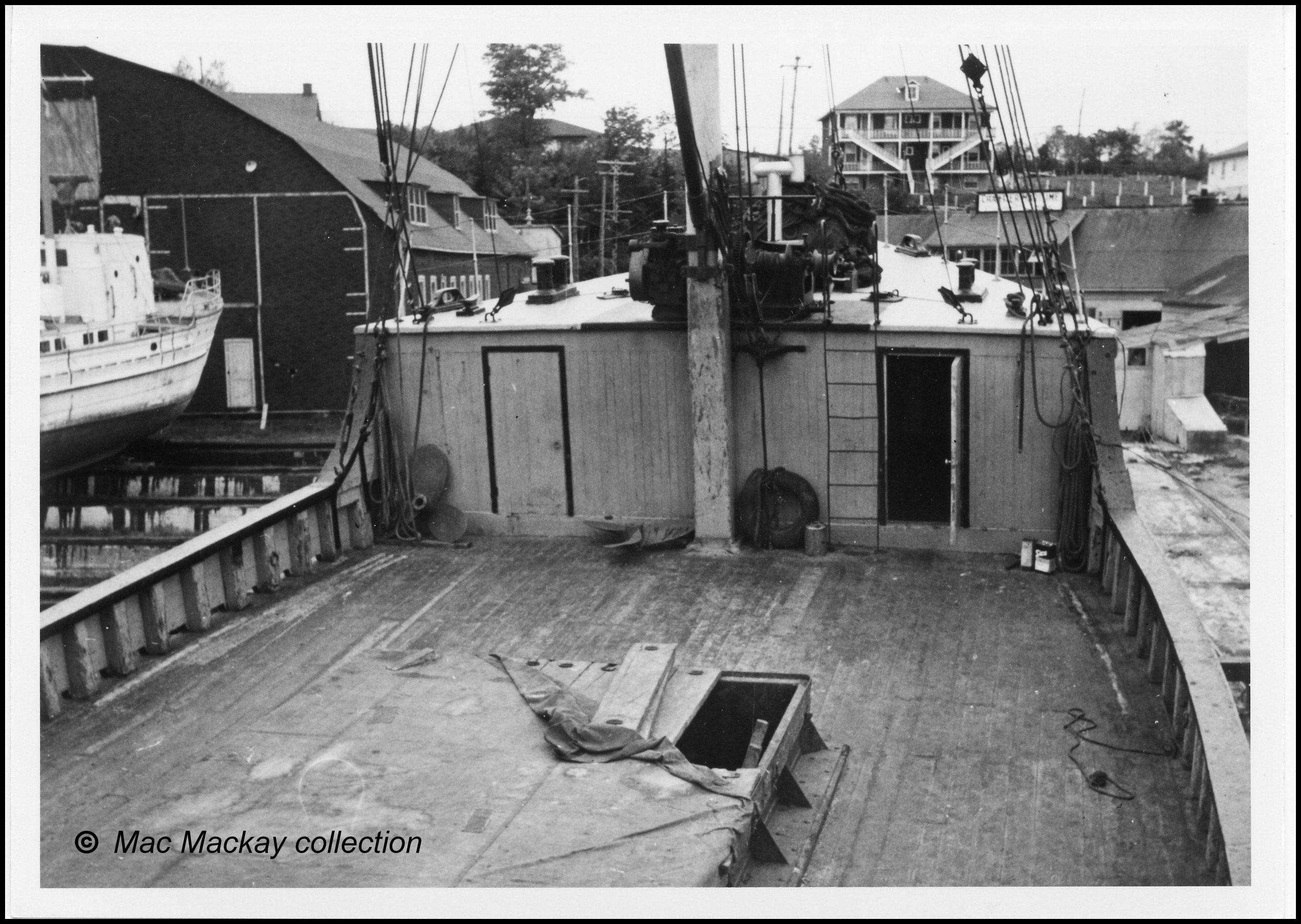
(The goélette Rivière-Verte at St-Laurent, Ile d'Orleans, in 1959.)

 Nowadays "battening down the hatches" means preparing for a tempest (either a real weather event or some other kind of crisis). So today September 23, in Halifax, there was evidence of such preparations in advance of the arrival tonight of Fiona. Currently a hurricane, it may be down graded to a post tropical storm (but still a dangerous northern hemisphere cyclone) when it makes landfall in our area, then tracks across the province and Gulf of St.Lawrence to the west coast of Newfoundland.

Workers from Develop Nova Scotia, the government agency responsible for waterfront amenities, were busy moving floating docks to safe storage at the Centre for Ocean Ventures and Entrepreneurship (C.O.V.E.) dock in Dartmouth (the former Coast Guard base). High winds and a predicted storm surge would certainly damage these structures and potentially cast them adrift. Develop Nova Scotia closed off most of  the waterfront boardwalk to pedestrian access too.

The visiting Irish Navy patrol vessel LÉ James Joyce P62  was tied up at the Tall Ships Quay, a timber pile wharf adjacent to Pier 20. It was decided to move the ship to HMC Dockyard where it will be safer during the storm, and would not risk damage to the dock.


The Samuel Beckett class vessel was built by Babcock Marine in Appledore, England and commissioned September 1, 2015. It carries a compliment of 55, which includes 10 trainees. 

The James Joyce arrived on September 21 and was open to public tours for a time. The tugs Atlantic Willow and Listerville stood by while the ship let go from the pier, which it did by "springing off" - a bit of seamanship rarely seen in these days of bow thrusters and twin screws.

As Listerville makes its way to the Tall Ships Quay, Develop Nova Scotia's work boat moves some floats and the supplier Atlantic Condor is visible in the background at the C.O.V..E dock.

 The number of commercial ships in port was at a minimum (see yesterday's post). The last container ship to sail, Conti Crystal got under way around noon time. That left the Oceanex Sanderling and Nolhan Ava anchored in Bedford Basin as the only sizeable commercial vessels remaining in port. The Canadian Coast Guard deployed CCGS Sir William Alexander to the Shelburne area of the south coast and CCGS Jean Goodwill to Sydney in Cape Breton, where they are on standby for Search and Rescue.

CCGS Sir William Alexander, September 13, 2022.

That left two ships tied up at piers, namely Atlantic Condor at C.O.V.E and the CCGS Kopit Hopson 1752 at the IEL dock. The latter is the former CCGS Edward Cornwallis currently rebuilding by Irving Shipbuilding Inc.  I assume that extra lines have been run to secure these craft during the storm. The barge Scotia Tide is alongside Pier 9  (despite the Harbour Master's requirement that all barges were to be removed moved from Halifax Port Authority berths by noon September 23.)

The yacht clubs and others with waterfront facilities such as the Atlantic Pilotage Authority and Dominion Diving have also "battened down the hatches" in various ways.

Halifax Harbour has experienced several hurricanes during my time, the most severe being Hurricane Juan September 29, 2003 which was a Category 2 when it tracked through the harbour with 150 kph winds (and a gust of 176 kph). Lessons learned by that event, and subsequent ones such as Dorian in 2019, have no doubt guided the preparations for this event.

There were two container ships that remained in port during Juan, and  one of the them, the Albert Oldendorff (ex Hoegh Dyke) parted its lines and ran down on the Saudi Tabuk causing damage to both ships and their cargoes. Numerous other vessels sank or were blown aground, at least partly due to inadequate preparations or the impossibility of emergency response during the storm.

 Albert Oldendorff ripped into containers on the adjacent Saudi Tabuk and dropped at least one of its own containers on the other ship's deck. Adding to the confusion - both ships were carrying National Shipping Company of Saudi Arabia (NSCSA) containers.

Let's hope that this time around Fiona will not be as brutal as its predecessors. However, Shipfax may not be able to publish due to power outages for the next few days. A summary of events will be provided when posssible.

.


Monday, January 24, 2022

CCGS Hudson returns

 Crowds gathered all along the Halifax waterfront this afternoon (January 24) as the CCGS Hudson arrived home for the last time. In a welcome usually reserved for naval vessels returning from war, the crowds were largely silent, but some cheers went up when the ship was close enough that crew members could be recognized from shore. 

The ship was "dressed all over" with signal flags and was escorted into port by CCGS Sir William Alexander which put on a bit of a show with its rarely used water cannons.

 Family members of the crew, former crew members and scientists who worked aboard the ship were among the well wishers who came out to see its arrival.

It was announced last week that the Hudson will be decommissioned due to the high cost of repairing a burned out propulsion motor suffered in November off St.John's. The ship was able to return to Halifax on one motor (and one propellor) to tie up at its base at the Bedford Institute. [Known as the BIO for its former name the Bedford Institute of Oceanography. It is now called simply the Bedford Institute as it is also home to the Canadian Coast Guard and to fisheries research, all under the direction of Fisheries and Oceans Canada.]

The Hudson made a ceremonial sail past of its home since 1963 on its way to Bedford Basin where the Sir William Alexander was standing by.


The ship turned in the Basin, under the watchful eye of a CCG helicopter then returned to tie up for the last time alongside the BIO.

 The decommissioning processs will take some time, so it may well be next year before the ship is sent to the scrappers. Its replacement is now due in 2025 although that date is not carved in stone. 

.


Sunday, March 29, 2020

Life Goes On

Services such as shipping continue as much as possible to deliver essential goods, and they must do so safely.

.
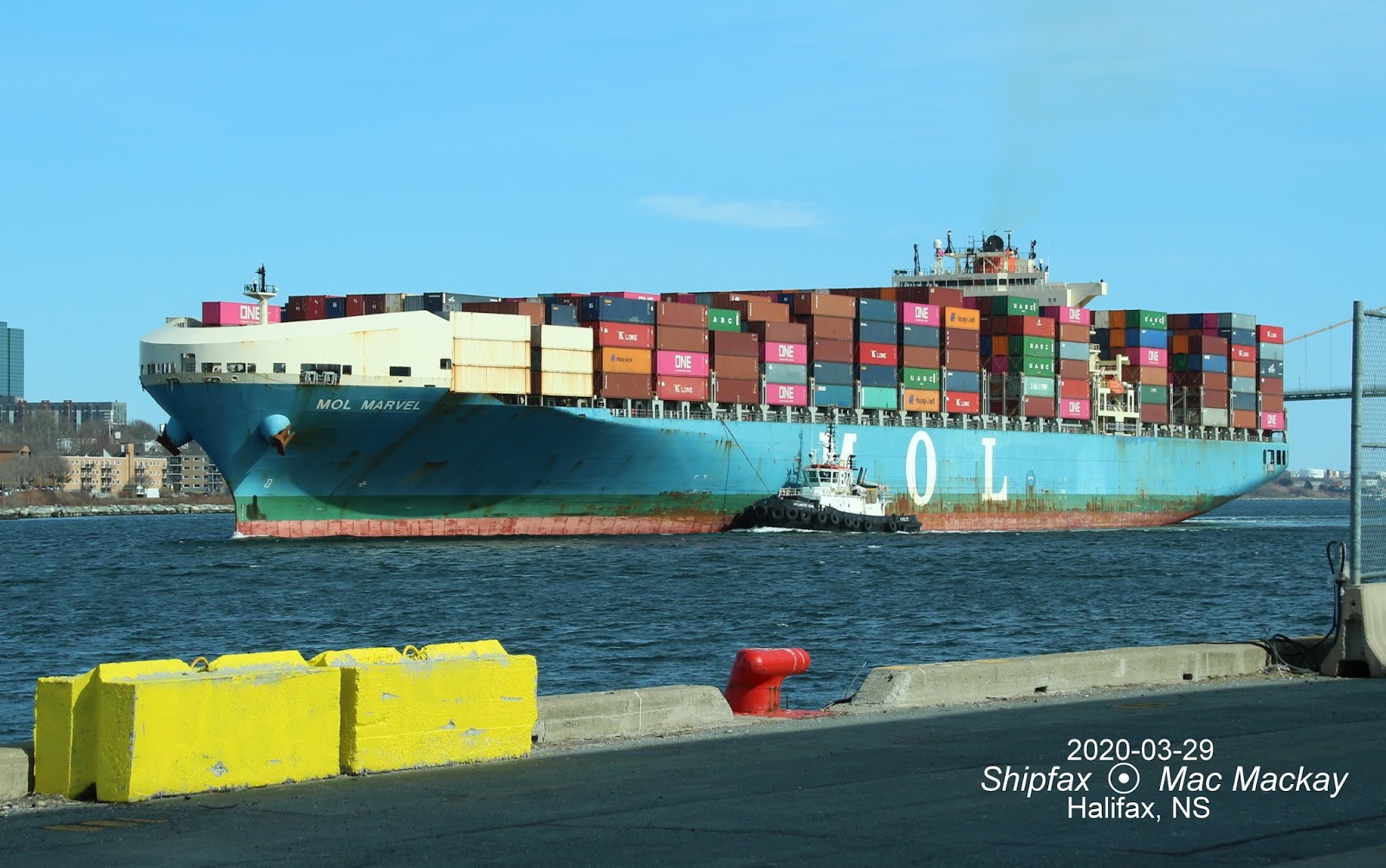
MOL Marvel arrives in Halifax for the first time, with a whole variety of cargo. The ship, measuring 78,316 gt, 79,460 dwt, was built in 2010 by Mitsubishi Heavy in Kobe. In 2015 it was fitted with an experimental screen forward aimed at reducing CO2 emissions by 2% by reducing wind resistance (while the ship was steaming at 17 knots). It has the added benefit of protecting containers stowed forward.


The ship's capacity of 6724 TEU (including 500 reefers) may have been reduced somewhat since the white containers just aft of the screen do not appear to be revenue boxes, but part of the screen. No other ships of the "M" class have been fitted with similar screens, so the results of the experiment may not have lived up to expectations.

For ships to navigate safely aids to navigation such as buoys must be maintained, and spring is usually the time to change then out as winter can be particular hard on them. Others are removed from service for the winter due to ice and are reinstated in spring.


CCGS Sir William Alexander sets this afternoon out for the eastern shore with a deck load of buoys. Having to dodge a solo sailor is a bit odd for this time of year, but the same boat has been running for all winter. (I took a photo of it on February 23: http://shipfax.blogspot.com/2020/02/an-unusual-winter.html )


Only two of the buoys are identifiable. TA4 for Flying Point and PQ4 for Horne Shoal in the Port Felix /Dover areas.

Another arrival, just getting into the inner anchorage before dusk, was the tanker Tower Bridge. It is coming from Saint John, NB with a part cargo from Europe, but will have to wait until yesterday's arrival sails from Irving Oil's Woodside terminal.


Of typical MidRange size at 27,725 gt, 47,199 dwt the ship is a bit unusual however in that it was built at the Admiralty Shipyard in St.Petersburg. It is operated by the Russian company SCF. Despite the admonishment that Safety Comes First, the company initials represent Sovcomflot. Originally a soviet state owned shipping combine it has been a joint stock company since 1988.

.

Saturday, January 18, 2020

Sir William Alexander - back on the job

Yesterday's post stated that CCGS Sir Wiiliam Alexander had not returned to service following a lengthy refit. I stand corrected. The ship sailed this morning, apparently in working order, bound for St.John's, NL. Whether that destination has anything to do with the extreme weather event there in the last days, it certainly means that the ship will not be servicing the Halifax buoys any time soon.

If navaids in Newfoundland have been blown out by hurricane force winds. the ship may be needed there more urgently.


Amid vapour from the Nova Scotia Power Inc gas fired generating plant and traces of sea smoke, from its cooling water discharge, CCGS Sir William Alexander puts out to sea this morning.

I do not have a date for the ship's return to service but it apparently occurred within the last week or two.
.


Friday, December 27, 2019

Red, White and Blue


After a lengthy refit that included removing and rebuilding the ship's crane CCGS Sir William Alexander moved out into Bedford Basin for some trials today.

Not far away the MOL Marvel was making its first visit to Cerescorp's Fairview Cove terminal.


Built by Mitsubishi Heavy Industries in Kobe in 2010 it is a 78,316 gt, 79,460 dwt ship with a capacity of 6724 TEU including 500 reefers.

At the other end of the harbour Titania discharged a load of cars at Autoport.

Still wearing the old Wilhelmsen orange and white colour scheme, Titania (and Atlantic Bear) pass Shearwater outbound from Eastern Passage.

Daewoo Shipbuilding and Marine Engineering in Okpo built Titania in 2010. Its 74,255 gt, 31,108 dwt gives it a capacity of  7934 cars.

Federal Churchill also got underway to make the short trip from anchorage to pier 28.


There was more blue to be seen, but it was so far offshore that it was not clearly legible.


Anchored outside the port limits, Ethan is waiting for something.

.


Friday, October 4, 2019

Sir William Alexander in refit

CCGS Sir William Alexander was to have been in refit in July and August as per published schedules. However I have observed that its crane has been removed, whether for repair or replacement, so the vessel remains out of service. CCGS Earl Grey and Edward Cornwallis may also be in refit at the Bedford Institute, but CCGS George R. Pearkes appears to be operational.

Sir William Alexander with crane removed.

Sir William's crane was not original equipment to the ship, but was installed in 1998, mounted on the main deck forward, replacing the original derrick that had not performed properly since new. Sister ship Edward Cornwallis retains the derrick, making it easy to distinguish between the two ships. They are also the only ships of their class with a three a deck superstructure. Other ships of the Martha L. Black class have four decks.

George R. Pearkes on the right has an additional deck compared to Edward Cornwallis (left).

Near my home, in Victoria Park in Halifax, a stone cairn commemorates Sir William Alexander, (1567-1640) First Earl of Stirling:


Erected by the North British [i.e. Scottish] Society in 1957, containing stones from Alexander's home castle, it carries a bronze plaque recognizing the poet, statesman and colonizer as the founder of Nova Scotia. At the time, that also included present day New Brunswick and much of the state of Maine. When the territory was returned to the French in 1632, Alexander was reduced to poverty. He never set foot in Nova Scotia, although his son (of the same name) spent a winter at Port Royal (now Annapolis Royal).


A confidant and Secretary of state to King James I of England / James VI of Scotland, Sir William Alexander (the elder) was also named Viscount of Canada.

CCGS Sir William Alexander is the second ship of the name. The first, launched in 1959 by Halifax Shipyards,  served until 1989, the last two years as William when teething problems delayed delivery of its replacement.
The following is extracted from my post of November 12, 2014:

SIR WILLIAM ALEXANDER (i)

One of the finest ships ever built by Halifax Shipyards, it was launched December 13, 1959 and served with distinction until July of 1989. Its service was memorable enough that its replacement received the same name- as much in recognition of the man who had Nova Scotia as an idea, as for the ship itself. The ship was built to the proven pattern established by the Edward Cornwallis (i) as a light icebreaker buoy tender.

 The prototype steamer Edward Cornwallis and the evolved, diesel version Sir William Alexander

Longer and narrower, but to perform the same basic work, Sir William Alexander was the epitome of the Canadian Coast Guard light icebreaker and buoy tender. The winch control room below the bridge and derrick mounted to to the superstructure was dropped in subsequent ships.

Powered by four Fairbanks Morse engines of 1333 bhp each, driving two electric motor it delivered 4250 shp to two controllable pitch props.

Built with a helicopter deck, the telescoping hangar was added later. In 1970 it was host to a Bell 206 A/B the standard CCG 'copter of the day.

The ship's most famous exploit was in rescuing the crew of the tanker Kurdistan in ice in the Cabot Strait in March 1979 when the tanker broke in two. Sir William Alexander assisted in escorting the ship to the Strait of Canso where it was pumped out and patched up for towing to a repair yard.
 
Sir William Alexander tied up at the eastern approach wall to the Canso Canal, standing by salvage operations. The DPW boat Maces Bay is ferrying people out to the Kurdistan, which is anchored beneath Cape Porcupine with a McAllister salvage barge alongside.


Renamed William in 1987 she was kept in service until July 1989 due to delivery problems with her namesake replacement.

In April 1987 William had the rare responsibility of lifting navigation aids in Halifax harbour when flow ice from the Gulf of St.Lawrence blew in. It had to navigate in heavy ice, but was not required to break the ice, since it had already broken up on its way south. Note her bridge wings had been plated in during a previous refit.
 
When finally laid up she became H-22, in February 1990. After sale to Bahamian owners she languished in Halifax until 1992, then moved to Pointe-de-Chêne, NB for another year. Finally she became the Belize flag Pilar del Caribe. When drugs were found aboard in Kingston, Jamaica in 1995 authorities seized the ship. Before it could be sold for scrap it parted its lines and blew ashore. Beyond salvage it was left on the beach at Bull Bay where it became local landmark.


.