Showing posts with label Cape Sambro. Show all posts

Saturday, February 22, 2025

Fishing trawler Northern Alliance

 I can remeber in the 1960s there were about seven fresh fish plants and at least two salt fish operations on the Halifax waterfront. It goes without sayiung that they lent a certain "ambiance" (pronounced in the French way), especially on humid days with very little wind. Thanks to over fishing - encouraged by government policy - and to the rapacious methods of European fishers - there was a rapid decline in fish stocks and one by one the fish plants disappeared. 

By the time the government brought in the cod moratorium in 1992 the last plants were gone and as a result we seldom saw fishing vessels in Halifax and no longer inhaled the "ozone" from the plants. The exceptions of course were the Japanese tuna longliners while they overfished that species into near extinction too. European freezer trawlers from the USSR, East Germany, Romania, Poland and Spain  also called for crew R+R and stores or to seek refuge from hurricanes.  However once Canada declared the 200 mile economic zone they also became rare sights.

In this century fishing operations have concentrated on numerous outports such as Lunenburg and nearby Sambro. Fishing is still an important industry in the region and there are countless boats engaged in inshore and offshore activity. Fish plants are now located in those smaller ports and fishing vessels have no reason to come to Halifax except in case of emergency or breakdown.

Today's arrival of the Northern Alliance likely falls in the latter category. Its track shown on AIS indicates a diversion from its northeasterly course from Lunenburg to a point east of Halifax. It may have a had a power loss, then headed directly for Halifax, It was met off Portuguese Cove by the tug Atlantic Maple and was escorted in to tie up at the C.O.V. E. pier in Dartmouth.


 The Northern Alliance was built in 1990 by Stocznia Potnocina in Gdansk, Poland for Icelandic owners and named Johann Gislason. In 1990 it was given the charmaing name Frosti, still under Icelandic flag. In 2012 Select Seafoods Canada Ltd of Richmond, BC acquired the ship and registered it in Lunenburg. It may have fished on the west coast for a time. (The company's web sites are vague on detail).

It is a 624.41 gross tons stern trawler with a capacity of 170 tonnes per trip. It is equipped to freeze its catch at sea (FAS). Select Seafoods and its associated company Aqualine Seafoods Ltd market hake, arrowtooth flounder, pollock and redfish in various states of process.

Back in the Day

 Fishing has been the backbone of the Nova Scotia economy since early days. Preserving fish with salt fish was the usual method until freezing technology came into being. Initially fishing boats would carry sufficient ice (loaded ar their home ports) but that limited the time at sea. Eventuallly freezing the fish came into being, and some larger boats had the capacity to package the fish too.

The Halifax fish plants, when they existed, processed "fresh" fish that had been partially processed, and iced down at sea. At the plants the catch was then processed into frozen blocks ready for shipment or storage for later processing during the off season, or packaged consumer-ready. "Fresh fish" could also be salted and salted fish could be packaged as there was still a market in the Caribbean.

The actual catching of fish was usually by trawler as the main catch was bottom fish such as cod.  By the mid 1960s stern trawlers were gradually replacing side trawlers as they were safer and could work in worse sea conditions, with the deck crew more sheltered. 

Early 1950s British built steam trawlers still supplied the Water Street plant of National Sea Products.


Newer diesel side trawlers like the Cape Hood fed the Forty Fathom plant of National Sea Products at Pier 29. The National Harbours Board maintained a huge freezer storage facility across the street to keep frozen fish for later distribution.

Halifax Shipyard built early stern trawlers, such as the Atkinson,

and larger boats such as the Cape Alert

and Cape John

These boats could work at sea in conditions that were not tenable for the side trawlers. Freezing spray could make a vessel top heavy.
 

The Pier 29 site is now occupied by the PSA Southend container terminal's new maintenace building, and no trace remains of the fish plant or the freezer.

.


Friday, September 27, 2019

Waterfront

An international day of protest for action to fight environmental degradation and species extinction. Halifax should be very aware of species extinction.

But now that distinctive waterfront aromas are faint memories only, it is easy to forget that Halifax was once a busy fishing port. Its eminence in that field faded as Canadian and foreign trawlers ravaged the fishing grounds to near extinction. The Canadian government abetted this carnage by subsidizing trawler and plant construction and ignoring and stifling research.

Cape Sambro, built in 1952, by Cochrane + Sons, Selby, was one of several British built steam powered side trawlers fishing out of a National Sea Products plant at the foot of  Morris Street in 1968.

In the mid to late 1960s Halifax had at least four active fresh fish plants and a couple of salt fish operations on the waterfront. Their pungent contribution to the atmosphere gave Lower Water Street a "je ne sais quoi" quite unlike any other Canadian City. A score of trawlers fished out of Halifax and landed their catches here regularly.

Built in 1962 in Leiden, Netherlands, Cape Hood fished out of Nat Sea's 40 Fathom plant at pier 29, directly in front of the National Harbours Board's freezer warehouse. (The grain elevators in the right background may help to position the location).

Halifax was also a welcoming port of refuge and source of stores for domestic and foreign fishing fleets. In the days before the 200 mile economic zone, fishing vessels of many nations were active close offshore and visited Halifax regularly.

The West German Venus out of Bremerhaven, arrives at pier 27 for stores.

Almost every European nation, especially those from behind the Iron Curtain were regular callers.

Foton and another small Russian trawler tied up at the Cable Wharf. The workboat Slipway II from Dartmouth Marine Slips is nosing up alongside.
Nowadays the Cable Wharf is prime tourist country.

These "Comecon" nations (in order of importance): USSR, Poland, East Germany, Bulgaria and Romania (and by convenience Cuba) joined the traditional nations (in no particular order) Spain,  Britain, West Germany, Portugal, France, and even Denmark's Faroes Islands, and rarely, Italy.


Faroese Hoyvikingur, tied up at pier 2 - now part of HMC Dockyard.
The Danes were blamed for fishing Atlantic salmon at sea, preventing them from returning to the rivers of Nova Scotia and New Brunswick to spawn.

At age fifty, time finally ran out for Karlsen's Tem. Built in Bath, ME in 1931 as Illinois it served the USN as Albatross 1940-45. Karlsen's renamed it in 1949 and it was used for fishing, sealing, whaling, research and cargo work.

Norway was represented indirectly since Karl Karlsen and Reiber Brothers had both established Canadian beach heads and operated Canadian flag trawlers, sealers and whalers.

A typical USSR freezer trawler, Severnaya Palmira tied up at pier 23.

The Comecon boats caught, processed, froze and even packaged the fish directly on board their factory/freezer trawlers. They were also immensely efficient catchers of fish, often working in groups to drag a huge swath of ocean bottom catching everything in their path. The called in Halifax frequently to take on fresh water (for fish processing) and shore time for the crews.

Canadian boats used ice to preserve "fresh fish" and returned to port more frequently to land their catch. Once processed by Halifax fish plants, the product could be stored in a large freezer warehouse operated by the National Harbours Board. Product was held there until demand required it. It would then be shipped by road, rail or sea to various markets.

The first Canadian built stern trawler, Halifax Shipyard 1965, H.B.Nickerson's Atkinson alongside pier 29 with the NHB's gigantic freezer store in the background.

Not all of Halifax's aura was related to fresh fish. The A.M. Smith wharf, now home to the Maritime Museum of the Atlanic, was a huge salt and salt fish warehouse. The salt was brought in from the Caribbean and shipped out to other ports, including Newfoundland. Salt fish was brought in by delightful little coasters like the Ambrose Foote or the motor schooner Delroy. They also used the adjacent Irving Wharf where fresh fish was landed by local inshore boats.


Note the covered gutting table - far right on the Irving wharf.


The Europeans pioneered the use of stern trawlers, that towed their nets aft and retrieved them by a ramp  built into the vessel's stern.

Cape Argos (Halifax Shipyard, 1968) shows stern ramp flanked by otter board / trawl doors.

In the mid 1960s Canadian stern trawlers began to supplant traditional side trawlers, and many of the new boats were built at Halifax Shipyards. Stern trawlers provided much safer (and comfortable) working conditions for the crew. They also allowed for the incorporation of more modern fish handling methods, reducing damage to the fish.

Cape John (Halifax Shipyard 1968) fished year round in all weathers from pier 29.

Cape Brier first of a trio of stern trawlers built at Halifax Shipyard in 1981-82.

The last trawler built at Halifax Shipyard, Cape Fourchu, completed in 1982. Lost May 3, 1989 in collision with the Ziemia Opolska 18 miles off Cape Race.

Eventually however that efficiency in catching fish resulted in the demise of the Northern Cod, the prime Atlantic fish species, and the virtual collapse of other species, some caught as "by catch",  scooped up indiscriminately by the bottom dragging otter trawls, or just simply over fished beyond the species' ability to reproduce.

Built for service in rough sea conditions, trawlers had pleasing lines.

Cape Norman Halifax Shipyard 1964.
.
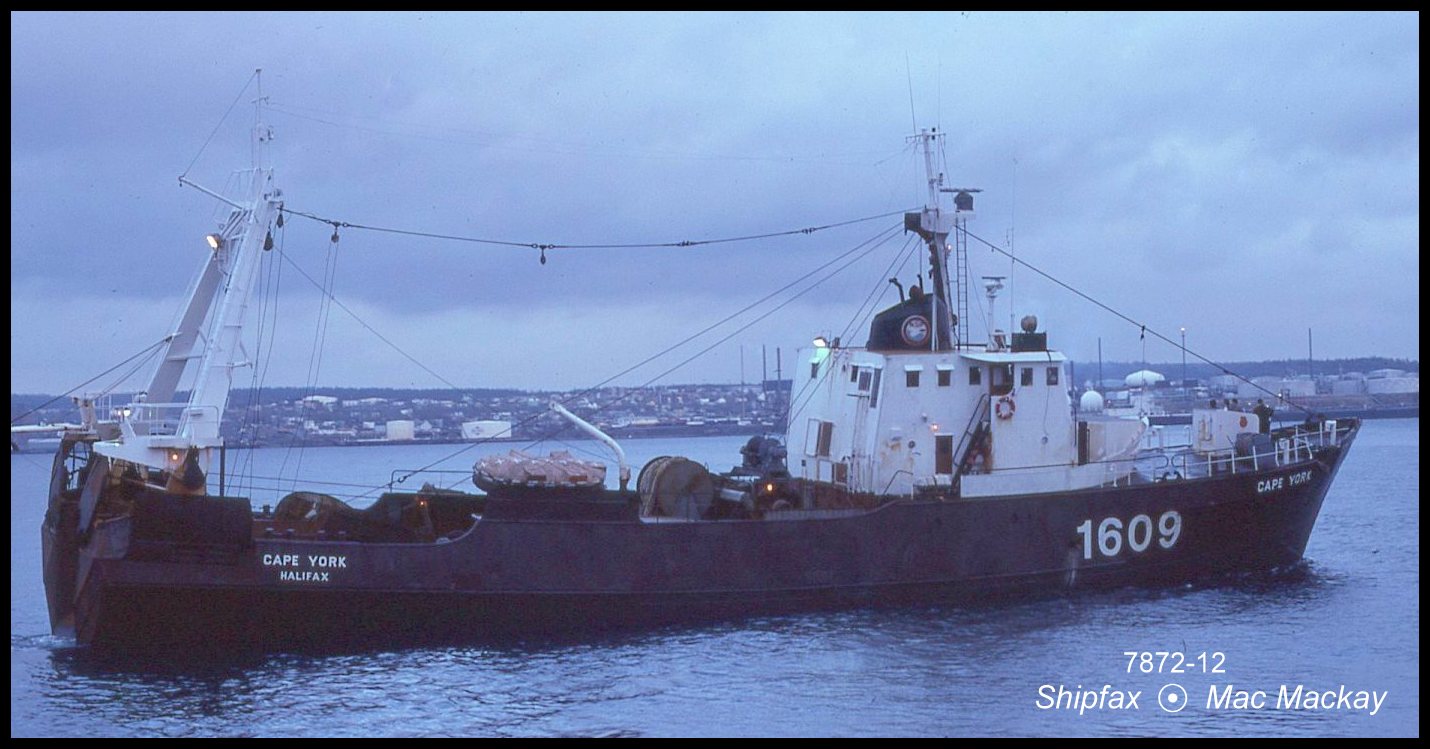
Stern trawlers lacked the charm of their predecessor side trawlers, though their basic hull lines were designed for  rugged work.

Cape York Halifax Shipyard, 1968.

Halifax Shipyard's Dartmouth Marine Slips was also a beneficiary of the fishing industry, refitting numerous Canadian and foreign flag vessels.

Dartmouth Marine Slips catered to the fishing fleets of all nations:(left to right)

  • Kvitfjell, British war built naval trawler  ex Morris Dance, Totten, Canadian flag. Owners, Carino Shipping, (Reiber Brothers, Norwegian parent), seiner/ sealer/ cargo.
  • Jupiter, French flag, Dutch built, ex Saturnia, trawler.
  • Olavur Halgi, Danish (Faroes) flag, Portuguese built, trawler.
  • Chester ex Thorfinn,  Canadian flag,  Norwegian built. Owners, Karlsen Shipping (Norwegian parent), whaler.

The fish plants have been demolished long since, as has the NHB cold store warehouse and Dartmouth Marine Slips has given way to new commercial development.

With the fish plant demolished at pier 29, work shifted to the cold store. The area is now used for container storage. The Port's master plan calls for the space between pier 30-31 (left) and 27-28 (right) to be filled.

The trawlers are all gone too,  lost at sea, scrapped, sunk as naval targets, sold foreign or abandoned. A few have been preserved for conversion to pleasure craft or expedition vessels, as they were sturdily built and some have many years left in them. Others remain derelict or semi-derelict in back waters such as Bridgewater, NS.

An old side trawler, the former Cape Mira (G.T.Davie, 1963) long anchored in Wright's Cove Bedford Basin may have slipped quietly out of harbour unnoticed this summer. Renamed Hydra Mariner many years ago, it may be headed for a new life or the scrappers.

Hydra Mariner anchored in the shadow of the National Gypsum loader in Wright's Cove.

Few traces of Halifax's deep sea fishing history can be found nowadays inside this harbour.  Sambro, at the outer reaches of the harbour still maintains an active fishery for a variety of species and still has small fish plants, but there is nothing in the harbour itself to recall the "glory days".


Three Halifax built stern trawlers, Cape Howe (1968), Cape Nelson and Cape Alert (both 1966) alongside NatSea's Forty Fathom plant and NHB cold store pier 29. Not a trace remains.

Perhaps a monument should be erected to remind us that our resources are not all as renewable as we think. Fortunes were made and lives lost in the pursuit of fish. Many jobs were maintained at sea, in fish plants and shipyards, but at what cost?

.


Saturday, March 14, 2015

National Sea Products steam trawlers

A recent query from England sent me to the shoebox for the story on seven steam powered trawlers that National Sea Products Ltd (NatSea) operated in the 1950s and 1960s.

A brief background on Natsea now known as Highliner Foods Ltd for its best known brand. It was formed in 1945 when two holding companies merged. W.C.Smith + Co of Lunenburg and Maritime - National Fish Co of Halifax were the major players in the industry controlling some 24 fish processing firms including: National Fish Co, Maritime Fish Co, The Lockeport Co Ltd, Leonard Brothers Ltd, Leonard Fisheries Ltd, O'Leary + Lee Ltd, Fasterfat Ltd, O'Connors Fish Co Ltd, White's Fish Co Ltd, National Laboratories Ltd, Lunenburg Sea Products, Nickerson Brothers, and D.Hatton.  The subsequent history is long and convoluted and beyond the scope of this posting, but there is lots of info out there, such as: http://www.company-histories.com/National-Sea-Products-Ltd-Company-History.html.

In 1950 National Sea Products moved to acquire steel hulled trawlers to add to its fleet of wooden draggers and schooners, and to replace some aged World War I era steam trawlers.

The first two were acquired as already built by  by Cochrane + Sons Ltd in Selby, England. A shipyard 50 miles inland from Hull on the River Ouse, it was famed for its trawlers, but also built tugs and other specialized craft.. The two trawlers were registered in Cardiff to Neale and West Ltd, and they had fished for about a year before Natsea purchased them.
They were 369 grt, measured 153'-8" loa x 25'-2" and were powered by an Amos+Smith triple expansion steam engine of 680 hp.

GATEHOLM / CAPE SMOKY
Fist acquired was the Gateholm, built in 1949. It arrived in Halifax October 31, 1950 after a ten day trip from Hull via St.John's, NL.Within days of its arrival it went to sea and was back in port November 7 with its first catch. Before the end of the year it was renamed Cape Smoky and fished for NatSea until 1968 when it was sold for scrap.

FLATHOLM
Sister Flatholm made it as far as the east coast of Newfoundland when it ran aground November 19, 1950 near Bay Bulls in dense fog and became a total loss.All eleven of the British delivery crew escaped safely, as did the Canadian captain and chief engineer that had also been making the trip to familiarize themselves with the boat. It was to have been renamed Cape Sambro.

The remaining boats were built directly for NatSea.
They were 396 grt, measured 152'6" loa x 26'-8" with Amos + Smith triple expansion steam engine of 680 hp.

CAPE BEAVER
Cape Beaver at its customary Halifax berth at the foot of Morris Street, but having seen better days.

Cape Beaver, completed in October 1951, departed Selby October 17 and Falmouth October 19, and arrived in Halifax October 31. It was the first steel trawler especially built for Canadian fisheries and worked out of Halifax starting November 7, 1951 until 1969. It was sold to various owners, not all accurately recorded, and hulked about 1971, and removed from registration.

An informal salvage crew has just refloated the little wooden vessel Miss Joyce and are tying it up to one of the three retired NatSea steamers at Purdy's wharf: Cape Beaver, Cape Brier or Cape Sambro.

Cape Beaver amongst the various hulks and junk at J.P.Porter's Dartmouth yard. The crane scow Hamilton 56, at left, eventually became Channelmaster and was only broken in Halifax up in 2014.

Cape Beaver then kicked around the waterfront until 1974 when it was bought by J.P.Porter + Co for conversion to a bottom dumping spoil carrier for dredging and permission was granted to rename it J.P.P.No.602. The work was never carried out and the hulk remained in Porter's yard in Dartmouth until 1977 when most of the company's assets were sold for scrap. Nittolo Metals Inc of Cap-St-Ignace, QC broke up the hull in situ, though I suspect portions of its bottom remain there still.

CAPE BRIER
Cape Brier at the NatSea plant near the foot of Morris Street, known as the FasterFat division.

Cape Brier arrived in Halifax early in 1951 and made its first trip in mid-February. It was sold in 1969 and was more or less derelict in Halifax until 1974 when J.P.Porter + Co bought it and Cape Sambro for conversion to a bottom dumping spoil carrier for dredging and permission was granted to rename it J.P.P.No.601. Cape Sambro became J.P.P.No.600. The work was done at Dartmouth Marine Slips and at Porter's yard, but on completion they were laid up and never used by Porter. Work included cutting off the stern overhang, building a new deck house, installing a pair of 340 bhp GM engines and twin screws and installing hopper shaped holds and hydraulically operated bottom doors. They remained laid up in Dartmouth and were put up for for sale from August 1977. The Porter company, owned by Richelieu Dredging of Sorel, QC was implicated in a price fixing scheme for federal dredging tenders and was essentially shut down along with its parent, and liquidated.

At Dartmouth Marine Slip, with the hull cleaned up and stern lopped off, work on the new superstructure has begun.

J.P.P.No.601 at left, and J.P.P.No.600 were laid up in 1974 and never used until sold in 1980. Note the slightly different bridge rails - one cambered and one horizontal. Rust streaks from the bridge drains streak the house. The hulls were painted green, the houses yellow

In 1980 the boats were sold to Artlac Dredging of Notre-Dame-de-Pierreville, QC and J.P.P.No.601 with sister J.P.P.No.600 left Halifax in tow of the tug Tusker on August 4, 1980. On arrival in Quebec 601 was renamed Kim R.D. and 600 became David T.D. after members of the Daneau family, owners of Artlac. The engines were rebuilt to 525 bhp each.

At Notre-Dame-de-Pierreville, Marie Lou is laid up opposite Artlac's shops in 1986.

Construction Canamount Inc of Montreal  bought the pair in 1983 and renamed them Marie-Lou (ex Cape Brier, J.P.P.No.601) Marie-Sol (ex Cape Sambro, J.P.P.No,600). They did some work for Canamount but were often seen laid up in Pierreville.

In 1990 the ownership was listed as CIBC Leasing, but this was a financing arrangement between McKeil Workboats of Hamilton, ON and Dean Construction of Windsor ON, to service a dredging contract on the Great Lakes. On June 26, 1990 they were reported upbound on the Welland Canal bound for Windsor. I have no details of where they  worked on the Lakes.
On May 5, 1992 they were downbound in the Welland Canal in tow of McKeil's tug Lac Manitoba for Hamilton. Once there workers cut the turtle back forecastle heads down to rail level and welded shut the bottom doors. Then on June 27 they departed in tow for Rochester and made their way through the New York State Barge Canal to the Hudson River and on to the Atlantic.

New owners, Unida Transportadora SA of Panama had bought the boats, registered then in Panama and put them to work as sand carriers. In 2010 ownership of Marie-Lou passed to Arenera Balboa SA, also of Panama City and as of 2014 they were both still operatonal.

CAPE ARGOS
Cape Argos  was completed in January 1952 and sailed for Halifax, arriving about February 15, and a newspaper photo on that day showed it heavily iced over. The boat was not drydocked after launch in Selby, and on arrival went to Dartmouth Marine Slips for bottom painting.Unlike the preceding two boats, it had a "cruiser" bow, instead of a bar stem, and carried 130 tons of fuel versus 100 tons. After drydocking, it was assigned to Lunenburg, but did return to Halifax from time to time, and was transferred back to Halifax in the 1960s. In November 1967 it was sold to Metal Processors Ltd of Sydney and was broken up there.

Cape Argos had the distinction of grounding on George's Island twice. First on March 23, 1964 and second on February 20, 1967. Both times it was in fog, and the ship fetched up in soft mud and was not damaged. The island was just off the wharf where these boats tied up, and as someone said "it is hard to miss".

CAPE BONNIE


National Sea Products Ltd billed itself as the "The King Fishers of Canada" and used the bird on the funnels of its Halifax based trawlers and on their their Sea Seald brand fish products.

Cape Bonnie arrived in Halifax April 3, 1952 and also went to the Marine Slips for bottom painting on arrival. While all it sisters had incidents of fouled props or fuel shortages, Cape Bonnie seems to have been accident prone. In 1956 it had to be towed into port with engine trouble. In 1960 an injured seamen had to be evacuated at sea. (He was placed in a lifeboat, which was payed out 100 feet astern to allow the helicopter to airlift him. It could not lift him directly from the Cape Bonnie due to the mass of rigging.)
In 1963 one man died when a fish pen collapsed while at sea on George's Bank. In 1964 after another engine break down Cape Beaver attempted to tow it into Halifax, but the line  parted and fouled Beaver's prop. CCGS Narwhal and Cape Sambro assisted the tow for 100 miles back to Halifax.

Then on February 21, 1976 in extremely bad weather and at 0400 hrs, the boat ran onto the Sambro Ledges off Woody Island only a dozen or so miles from Halifax and was holed and quickly engulfed. The crew took to boats but all eighteen were lost before reaching shore. An inquiry found that a navigational error was to blame, but no one can know exactly how the boat came to run ashore.


CAPE SAMBRO

Cape Sambro looking quite neat with its black hull and navy grey superstructure, must have been fresh from a refit - it didn't usually look this good.

As a liveaboard, Cape Sambro grew quite seedy, but still showed off its fine lines.

The last boat in the series was Cape Sambro. It arrived in Halifax soon after completion in July 1952. There was no fanfare when it arrived and it seems to have fished more or less anonymously until 1966. It then became a fixture on the waterfront as a liveaboard, moving around from pier 2 to various free berths until 1974 when purchased by J.P.Porter + Co. Its career than exactly paralleled sister Cape Brier, and is related in the entry above.

The conversion involved cutting off the original round stern and installing a square transom, with towing bitts for handling scows or dredges. The funnel was green with a yellow letter "P". That is Cape Beaver's stern in the right foreground, partially dismantled.

  Marie-Sol idle at Notre-Dame-de-Pierreville. It later lost the turtle back forecastle head before heading south.

As more modern diesel trawlers came along in the early 1960s and stern trawlers in the mid 1960s, the steamers became much less efficient fish catchers. Crews were hard to attract, since they worked on shares, and wanted to be on boats with bigger catches. These well built steamers were no match for the newer boats and were allowed to run down and as trawlers only lasted 15 or so years. However if two hulls are still providing useful service after more than 60 years, it would be a tribute to their builders.
Cochrane + Sons Ltd no longer exists, but many fine examples of their product are still at work.

.