An international day of protest for action to fight environmental degradation and species extinction. Halifax should be very aware of species extinction.
But now that distinctive waterfront aromas are faint memories only, it is easy to forget that Halifax was once a busy fishing port. Its eminence in that field faded as Canadian and foreign trawlers ravaged the fishing grounds to near extinction. The Canadian government abetted this carnage by subsidizing trawler and plant construction and ignoring and stifling research.
Cape Sambro, built in 1952, by Cochrane + Sons, Selby, was one of several British built steam powered side trawlers fishing out of a National Sea Products plant at the foot of Morris Street in 1968.
In the mid to late 1960s Halifax had at least four active fresh fish plants and a couple of salt fish operations on the waterfront. Their pungent contribution to the atmosphere gave Lower Water Street a "je ne sais quoi" quite unlike any other Canadian City. A score of trawlers fished out of Halifax and landed their catches here regularly.
Built in 1962 in Leiden, Netherlands, Cape Hood fished out of Nat Sea's 40 Fathom plant at pier 29, directly in front of the National Harbours Board's freezer warehouse. (The grain elevators in the right background may help to position the location).
Halifax was also a welcoming port of refuge and source of stores for domestic and foreign fishing fleets. In the days before the 200 mile economic zone, fishing vessels of many nations were active close offshore and visited Halifax regularly.
The West German Venus out of Bremerhaven, arrives at pier 27 for stores.
Almost every European nation, especially those from behind the Iron Curtain were regular callers.
Foton and another small Russian trawler tied up at the Cable Wharf. The workboat Slipway II from Dartmouth Marine Slips is nosing up alongside.
Nowadays the Cable Wharf is prime tourist country.
These "Comecon" nations (in order of importance): USSR, Poland, East Germany, Bulgaria and Romania (and by convenience Cuba) joined the traditional nations (in no particular order) Spain, Britain, West Germany, Portugal, France, and even Denmark's Faroes Islands, and rarely, Italy.
Faroese Hoyvikingur, tied up at pier 2 - now part of HMC Dockyard.
The Danes were blamed for fishing Atlantic salmon at sea, preventing them from returning to the rivers of Nova Scotia and New Brunswick to spawn.
At age fifty, time finally ran out for Karlsen's Tem. Built in Bath, ME in 1931 as Illinois it served the USN as Albatross 1940-45. Karlsen's renamed it in 1949 and it was used for fishing, sealing, whaling, research and cargo work.
Norway was represented indirectly since Karl Karlsen and Reiber Brothers had both established Canadian beach heads and operated Canadian flag trawlers, sealers and whalers.
A typical USSR freezer trawler, Severnaya Palmira tied up at pier 23.
The Comecon boats caught, processed, froze and even packaged the fish directly on board their factory/freezer trawlers. They were also immensely efficient catchers of fish, often working in groups to drag a huge swath of ocean bottom catching everything in their path. The called in Halifax frequently to take on fresh water (for fish processing) and shore time for the crews.
Canadian boats used ice to preserve "fresh fish" and returned to port more frequently to land their catch. Once processed by Halifax fish plants, the product could be stored in a large freezer warehouse operated by the National Harbours Board. Product was held there until demand required it. It would then be shipped by road, rail or sea to various markets.
The first Canadian built stern trawler, Halifax Shipyard 1965, H.B.Nickerson's Atkinson alongside pier 29 with the NHB's gigantic freezer store in the background.
Not all of Halifax's aura was related to fresh fish. The A.M. Smith wharf, now home to the Maritime Museum of the Atlanic, was a huge salt and salt fish warehouse. The salt was brought in from the Caribbean and shipped out to other ports, including Newfoundland. Salt fish was brought in by delightful little coasters like the
Ambrose Foote or the motor schooner
Delroy. They also used the adjacent Irving Wharf where fresh fish was landed by local inshore boats.
Note the covered gutting table - far right on the Irving wharf.
The Europeans pioneered the use of stern trawlers, that towed their nets aft and retrieved them by a ramp built into the vessel's stern.
Cape Argos (Halifax Shipyard, 1968) shows stern ramp flanked by otter board / trawl doors.
In the mid 1960s Canadian stern trawlers began to supplant traditional side trawlers, and many of the new boats were built at Halifax Shipyards. Stern trawlers provided much safer (and comfortable) working conditions for the crew. They also allowed for the incorporation of more modern fish handling methods, reducing damage to the fish.
Cape John (Halifax Shipyard 1968) fished year round in all weathers from pier 29.
Cape Brier first of a trio of stern trawlers built at Halifax Shipyard in 1981-82.
The last trawler built at Halifax Shipyard, Cape Fourchu, completed in 1982. Lost May 3, 1989 in collision with the Ziemia Opolska 18 miles off Cape Race.
Eventually however that efficiency in catching fish resulted in the demise of the Northern Cod, the prime Atlantic fish species, and the virtual collapse of other species, some caught as "by catch", scooped up indiscriminately by the bottom dragging otter trawls, or just simply over fished beyond the species' ability to reproduce.
Built for service in rough sea conditions, trawlers had pleasing lines.
Cape Norman Halifax Shipyard 1964.
.
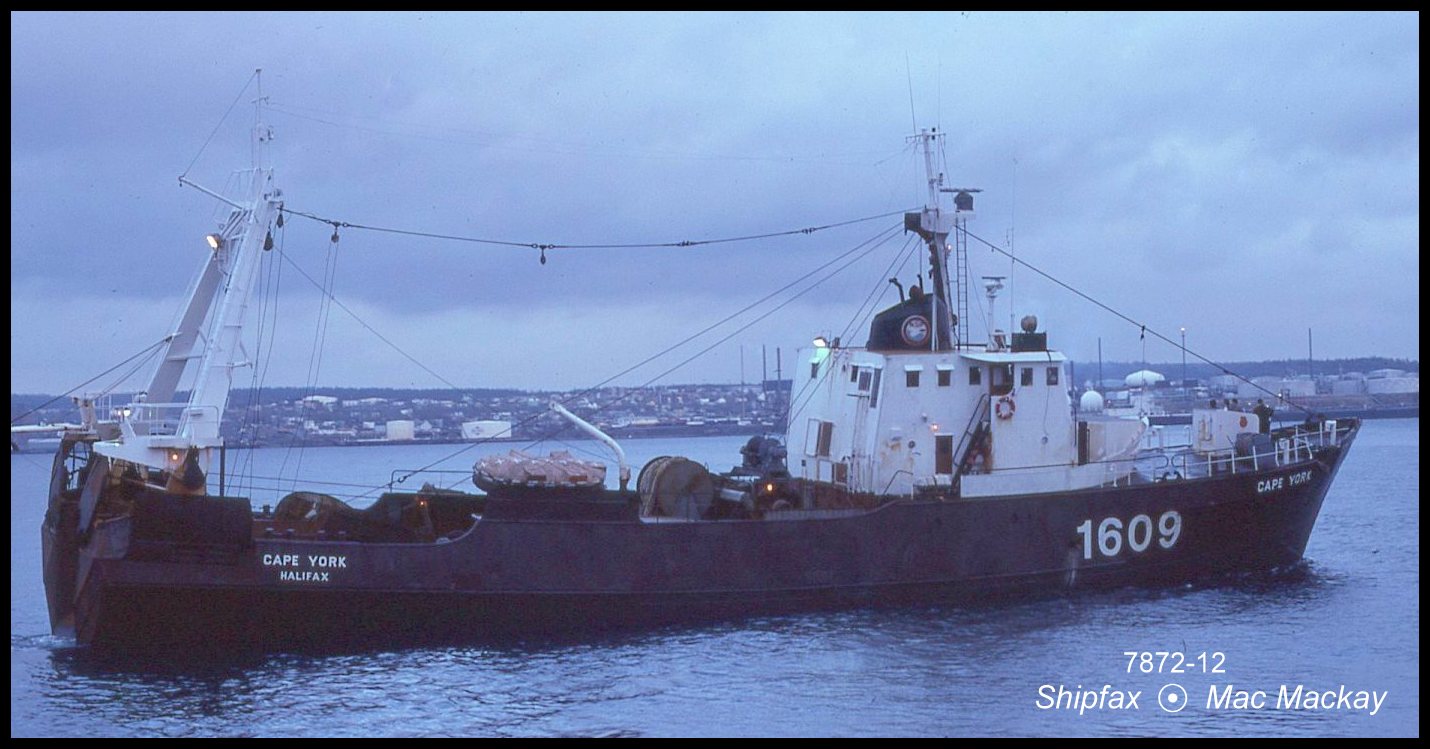
Stern trawlers lacked the charm of their predecessor side trawlers, though their basic hull lines were designed for rugged work.
Cape York Halifax Shipyard, 1968.
Halifax Shipyard's Dartmouth Marine Slips was also a beneficiary of the fishing industry, refitting numerous Canadian and foreign flag vessels.
Dartmouth Marine Slips catered to the fishing fleets of all nations:(left to right)
- Kvitfjell, British war built naval trawler ex Morris Dance, Totten, Canadian flag. Owners, Carino Shipping, (Reiber Brothers, Norwegian parent), seiner/ sealer/ cargo.
- Jupiter, French flag, Dutch built, ex Saturnia, trawler.
- Olavur Halgi, Danish (Faroes) flag, Portuguese built, trawler.
- Chester ex Thorfinn, Canadian flag, Norwegian built. Owners, Karlsen Shipping (Norwegian parent), whaler.
The fish plants have been demolished long since, as has the NHB cold store warehouse and Dartmouth Marine Slips has given way to new commercial development.
With the fish plant demolished at pier 29, work shifted to the cold store. The area is now used for container storage. The Port's master plan calls for the space between pier 30-31 (left) and 27-28 (right) to be filled.
The trawlers are all gone too, lost at sea, scrapped, sunk as naval targets, sold foreign or abandoned. A few have been preserved for conversion to pleasure craft or expedition vessels, as they were sturdily built and some have many years left in them. Others remain derelict or semi-derelict in back waters such as Bridgewater, NS.
An old side trawler, the former
Cape Mira (G.T.Davie, 1963) long anchored in Wright's Cove Bedford Basin may have slipped quietly out of harbour unnoticed this summer. Renamed
Hydra Mariner many years ago, it may be headed for a new life or the scrappers.
Hydra Mariner anchored in the shadow of the National Gypsum loader in Wright's Cove.
Few traces of Halifax's deep sea fishing history can be found nowadays inside this harbour. Sambro, at the outer reaches of the harbour still maintains an active fishery for a variety of species and still has small fish plants, but there is nothing in the harbour itself to recall the "glory days".
Three Halifax built stern trawlers, Cape Howe (1968), Cape Nelson and Cape Alert (both 1966) alongside NatSea's Forty Fathom plant and NHB cold store pier 29. Not a trace remains.
Perhaps a monument should be erected to remind us that our resources are not all as renewable as we think. Fortunes were made and lives lost in the pursuit of fish. Many jobs were maintained at sea, in fish plants and shipyards, but at what cost?
.