Showing posts with label Tem. Show all posts

Friday, September 27, 2019

Waterfront

An international day of protest for action to fight environmental degradation and species extinction. Halifax should be very aware of species extinction.

But now that distinctive waterfront aromas are faint memories only, it is easy to forget that Halifax was once a busy fishing port. Its eminence in that field faded as Canadian and foreign trawlers ravaged the fishing grounds to near extinction. The Canadian government abetted this carnage by subsidizing trawler and plant construction and ignoring and stifling research.

Cape Sambro, built in 1952, by Cochrane + Sons, Selby, was one of several British built steam powered side trawlers fishing out of a National Sea Products plant at the foot of  Morris Street in 1968.

In the mid to late 1960s Halifax had at least four active fresh fish plants and a couple of salt fish operations on the waterfront. Their pungent contribution to the atmosphere gave Lower Water Street a "je ne sais quoi" quite unlike any other Canadian City. A score of trawlers fished out of Halifax and landed their catches here regularly.

Built in 1962 in Leiden, Netherlands, Cape Hood fished out of Nat Sea's 40 Fathom plant at pier 29, directly in front of the National Harbours Board's freezer warehouse. (The grain elevators in the right background may help to position the location).

Halifax was also a welcoming port of refuge and source of stores for domestic and foreign fishing fleets. In the days before the 200 mile economic zone, fishing vessels of many nations were active close offshore and visited Halifax regularly.

The West German Venus out of Bremerhaven, arrives at pier 27 for stores.

Almost every European nation, especially those from behind the Iron Curtain were regular callers.

Foton and another small Russian trawler tied up at the Cable Wharf. The workboat Slipway II from Dartmouth Marine Slips is nosing up alongside.
Nowadays the Cable Wharf is prime tourist country.

These "Comecon" nations (in order of importance): USSR, Poland, East Germany, Bulgaria and Romania (and by convenience Cuba) joined the traditional nations (in no particular order) Spain,  Britain, West Germany, Portugal, France, and even Denmark's Faroes Islands, and rarely, Italy.


Faroese Hoyvikingur, tied up at pier 2 - now part of HMC Dockyard.
The Danes were blamed for fishing Atlantic salmon at sea, preventing them from returning to the rivers of Nova Scotia and New Brunswick to spawn.

At age fifty, time finally ran out for Karlsen's Tem. Built in Bath, ME in 1931 as Illinois it served the USN as Albatross 1940-45. Karlsen's renamed it in 1949 and it was used for fishing, sealing, whaling, research and cargo work.

Norway was represented indirectly since Karl Karlsen and Reiber Brothers had both established Canadian beach heads and operated Canadian flag trawlers, sealers and whalers.

A typical USSR freezer trawler, Severnaya Palmira tied up at pier 23.

The Comecon boats caught, processed, froze and even packaged the fish directly on board their factory/freezer trawlers. They were also immensely efficient catchers of fish, often working in groups to drag a huge swath of ocean bottom catching everything in their path. The called in Halifax frequently to take on fresh water (for fish processing) and shore time for the crews.

Canadian boats used ice to preserve "fresh fish" and returned to port more frequently to land their catch. Once processed by Halifax fish plants, the product could be stored in a large freezer warehouse operated by the National Harbours Board. Product was held there until demand required it. It would then be shipped by road, rail or sea to various markets.

The first Canadian built stern trawler, Halifax Shipyard 1965, H.B.Nickerson's Atkinson alongside pier 29 with the NHB's gigantic freezer store in the background.

Not all of Halifax's aura was related to fresh fish. The A.M. Smith wharf, now home to the Maritime Museum of the Atlanic, was a huge salt and salt fish warehouse. The salt was brought in from the Caribbean and shipped out to other ports, including Newfoundland. Salt fish was brought in by delightful little coasters like the Ambrose Foote or the motor schooner Delroy. They also used the adjacent Irving Wharf where fresh fish was landed by local inshore boats.


Note the covered gutting table - far right on the Irving wharf.


The Europeans pioneered the use of stern trawlers, that towed their nets aft and retrieved them by a ramp  built into the vessel's stern.

Cape Argos (Halifax Shipyard, 1968) shows stern ramp flanked by otter board / trawl doors.

In the mid 1960s Canadian stern trawlers began to supplant traditional side trawlers, and many of the new boats were built at Halifax Shipyards. Stern trawlers provided much safer (and comfortable) working conditions for the crew. They also allowed for the incorporation of more modern fish handling methods, reducing damage to the fish.

Cape John (Halifax Shipyard 1968) fished year round in all weathers from pier 29.

Cape Brier first of a trio of stern trawlers built at Halifax Shipyard in 1981-82.

The last trawler built at Halifax Shipyard, Cape Fourchu, completed in 1982. Lost May 3, 1989 in collision with the Ziemia Opolska 18 miles off Cape Race.

Eventually however that efficiency in catching fish resulted in the demise of the Northern Cod, the prime Atlantic fish species, and the virtual collapse of other species, some caught as "by catch",  scooped up indiscriminately by the bottom dragging otter trawls, or just simply over fished beyond the species' ability to reproduce.

Built for service in rough sea conditions, trawlers had pleasing lines.

Cape Norman Halifax Shipyard 1964.
.
Stern trawlers lacked the charm of their predecessor side trawlers, though their basic hull lines were designed for  rugged work.
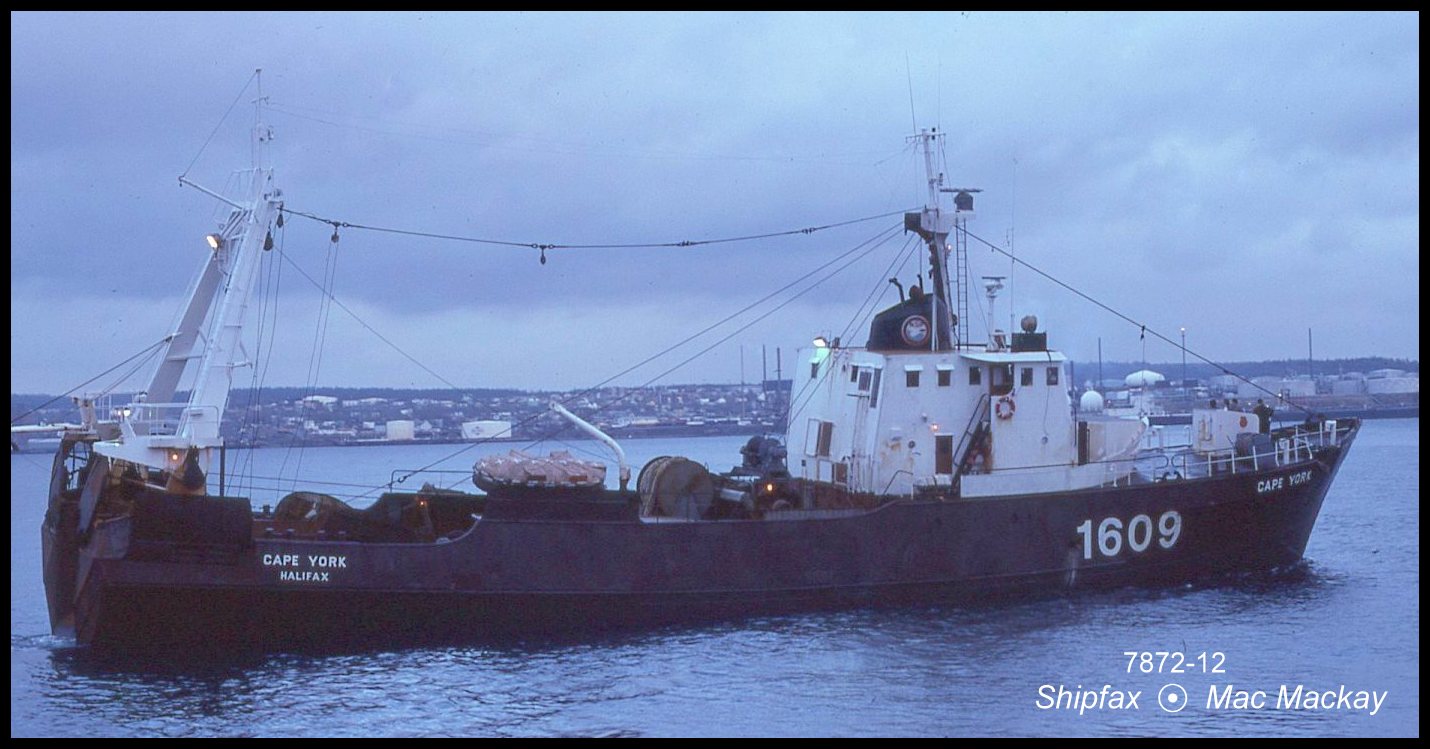
Cape York Halifax Shipyard, 1968.

Halifax Shipyard's Dartmouth Marine Slips was also a beneficiary of the fishing industry, refitting numerous Canadian and foreign flag vessels.

Dartmouth Marine Slips catered to the fishing fleets of all nations:(left to right)

  • Kvitfjell, British war built naval trawler  ex Morris Dance, Totten, Canadian flag. Owners, Carino Shipping, (Reiber Brothers, Norwegian parent), seiner/ sealer/ cargo.
  • Jupiter, French flag, Dutch built, ex Saturnia, trawler.
  • Olavur Halgi, Danish (Faroes) flag, Portuguese built, trawler.
  • Chester ex Thorfinn,  Canadian flag,  Norwegian built. Owners, Karlsen Shipping (Norwegian parent), whaler.

The fish plants have been demolished long since, as has the NHB cold store warehouse and Dartmouth Marine Slips has given way to new commercial development.

With the fish plant demolished at pier 29, work shifted to the cold store. The area is now used for container storage. The Port's master plan calls for the space between pier 30-31 (left) and 27-28 (right) to be filled.

The trawlers are all gone too,  lost at sea, scrapped, sunk as naval targets, sold foreign or abandoned. A few have been preserved for conversion to pleasure craft or expedition vessels, as they were sturdily built and some have many years left in them. Others remain derelict or semi-derelict in back waters such as Bridgewater, NS.

An old side trawler, the former Cape Mira (G.T.Davie, 1963) long anchored in Wright's Cove Bedford Basin may have slipped quietly out of harbour unnoticed this summer. Renamed Hydra Mariner many years ago, it may be headed for a new life or the scrappers.

Hydra Mariner anchored in the shadow of the National Gypsum loader in Wright's Cove.

Few traces of Halifax's deep sea fishing history can be found nowadays inside this harbour.  Sambro, at the outer reaches of the harbour still maintains an active fishery for a variety of species and still has small fish plants, but there is nothing in the harbour itself to recall the "glory days".


Three Halifax built stern trawlers, Cape Howe (1968), Cape Nelson and Cape Alert (both 1966) alongside NatSea's Forty Fathom plant and NHB cold store pier 29. Not a trace remains.

Perhaps a monument should be erected to remind us that our resources are not all as renewable as we think. Fortunes were made and lives lost in the pursuit of fish. Many jobs were maintained at sea, in fish plants and shipyards, but at what cost?

.


Wednesday, March 4, 2015

Brandal - a first, but Tem more popular -REVISED

The first stern trawler built in Canada was launched at Halifax Shipyard March 18, 1965 according to the Halifax newspapers. However, in fact Bathurst Marine was building stern trawlers from 1962. No correction was made in the newspaper, but I am correcting this post. Thanks to a correspondent for bringing this to my attention.


The launch took place without the customary champagne ceremony. The bubbly was placed in reserve until June 5 when the vessel was completed and handed over to its owners. Mrs. Karl Karlsen, wife of the owner of Karlsen Shipping and more specifically M.V. Tem Ltd, the nominal owner, christened the trawler Brandal.
 

Brandal was originally delivered in white paint. Here it is fitting out for the 1967 seal hunt, as a helicopter pad is installed on its deck. 
[Apologies for a 1967 photo taken on 127 film, but it is the only photo I have of Brandal in white.]

Stern trawlers were more efficient and safer than the traditional side trawlers because they could keep their head up to the seas and thus keep a dry deck. The deck crew could be more productive and many of the dangerous wires were clear of the working area.


Rigged as a trawler, Brandal soon adopted Karlsen's red hull colour, for high visibility in ice.

Brandal was a bit of a prototype for a small run of similar vessels, but it was also a unique vessel to suit the owners' particular needs. Karlsen Shipping, associated with a parent company in Norway, was involved in fishing, sealing and whaling, but also found work for their ships in the off seasons by doing research and oil exploration. While Brandal was fitted out for fishing, it was also equipped with a crow's next, and was reinforced for working in ice.

Brandal is the name of a small village in northern Norway, noted as the ancestral home to the Norwegian seal hunt, both in the White sea, and off Newfoundland. Brandal is also a family name, and at least one of Karlsens skippers was a Brandal. Brandal was also the home of Karl Karlsen, patriarch of the Norwegian and Canadian companies,  later based in nearby Aalesund, Norway.
The Canadian company, Karlsen Shipping, had a plant at New Harbour on the Blandford Peninsula, southwest of Hailfax, and a building and pier in Halfax.

In the summer of 1966 Brandal was sent to the Great Lakes for hydrographic research. On return it may have refitted for fishing, but in the spring of 1967 it was fitted with a helicopter deck and set out on the annual seal hunt. In the summer of 1967 it was sent back to the Great Lakes for more research. 
In 1968 it concentrated on fishing and did not participate in the seal hunt.

In 1973 it was a support vessel for Shell Oil's exploration program and worked as a supplier for the drill rig Sedneth I.


Later the after bipod mast was removed, and it acquired several derrick and a platform built above the stern ramp. It retained the crow's nest and polar bear crest on the bow.
 
Preparing to sail as Granchio the deck is filled with crab traps.

Over the subsequent years it did less and less fishing and was often unemployed for long periods.
Finally in 1995 it was fitted for crabbing and renamed Granchio. (Italian for crab, but also slang for mistake) but was laid up in Bridgewater, NS, under the Barbados flag.
In 2001 it was sold to new owners in Namibia. The delivery trip was interrupted when the ship was arrested in Bermuda. Thew same owner bought it back at a sheriff's sale but ran out of food and water 700 miles short of its destination. Finally after paying in advance for a tug, the owner delivered the boat to the port of Luderitz, Namibia.
No record of the boat being laid up or scrapped has reached me, but that is more than likely after all this time.

The Karlsen's shipowning company m/v Tem Ltd was named for the veteran side trawler Tem.

 Karlsen's wharf was populated with sealers, whalers and research ships of all sorts. Left: Brandal, right: Tem; background left: Martin Kalrsen, right: Arctic Endeavour; foreground: unknown drifter.

The old Tem was originally a trawler, but also became a sealer with Karlsens. It's canvas crow's nest must have been a pleasant spot.


It was built in 1931 by Bath Iron Works in Bath, ME as Illinois for General Seafoods.Booth Fisheries [thanks to another reader for pointing out this error]. In 1940 it was requisitioned by the US Navy, renamed USNS Albatross and given pennant number AM-71 to 1944 and IX-171 until 1945, when it was returned to its owners.

The Canadian subsidiary of the Norwegian company A/S Thor Dahl, Christensen Canadian Enterprises, bought the trawler in 1948 and registered it in St.John's, NL and placed it under the management of Karlsen Shipping of Halifax. It went out on the 1949 seal hunt, still carrying the name Illinois, but was renamed Tem later in the year, and registration moved to Halifax.

On its way to the scrappers in 1981 Tem had been damaged by a small fire in the wheelhouse.

In 1957 the company M/V Tem Ltd was formed and became owner of the ship. It continued fishing, sealing, research and even some whaling,  but by the 1970s it was largely idled. A wheelhouse fire in 1979 finally prompted Karlsen to sell the ship to a local scrapper.

The new Tem had the graceful lines of a whaler.

There was another Tem in the Karlsen fleet. It took that name in 1984 when they renamed their standby and rescue vessel Rescue K. It was built in 1957 by Haarlemsche Scheepswerft Maats. as the whaler R4. That was a short lived occupation and in 1966 it was converted to a patrol ship named Senja. In 1982 it was reconfigured by K/S Remoy Standby A/S of Norway as an offshore standby vessel named Rescue Kim. Karlsen's acquired the vessel in 1983, and shortened the name to Rescue K.

On March 13, 1985 Tem (ii) took in tow the vessel Meta when it broke down off Beaver Harbour and towed it to Halifax. The 384 grt Meta was built, coincidentally, in 1954 in Trondheim, Norway as Namsos, but had spent from 1969 as Galway Blazer and since 1977 as Meta for the Canadian company Stephenville Shipping Ltd. It seems to have been used for research (it was seen at the Bedford Institute in May 1978), and some cargo/passenger work on the Newfoundland coast. The same copmany had previously owned the former Lady Grenfell posted here: http://shipfax.blogspot.ca/2015/02/nova-scotia-coasters-part-3-lady.html

Directly behind Meta is Brandal again, bristling with antennas, a satellite dome and refitted with its after bipod mast. It was doing seismic work.
On arrival in Halifax Meta was soon under arrest and sold to Mission Possible Co Ltd, flagged in the Turks and Caicos Islands, and renamed Sonship 1. In 1989 it became Ebenezar Express under the Honduran flag for Ebenezer Naviera. It is still in service as of June 2014 according to online sources.

Tem continued as a standby boat off Nova Scotia until 1989 when it was chartered out and renamed CAM Vigilant under the British flag and returned to the North Sea. In 1993 it was renamed  St.Lucia and in 1995Viking Standby. In about 2003 it was sold to BUE Viking Ltd but arrived in Grenaa Denmark in September 2004 where it was broken up for scrap.

Karlsen's wharf was always a colourful sight. Right to left: Tem (ii), Brandal, and the research / sealer Chester. In the background the former CCGS Edward Cornwallis, renamed Edward. (It was not associated with Karlsen's in any way but was well colour coordinated.)

.