

Halifax Shipyard was founded as the Halifax Graving Dock Co. Its prime asset was a graving dock, carved into the Halifax shoreline. It was built to cater to iron and steel ships of the Royal Navy and merchant ships that were fast displacing wooden ships. There were no adequate repair or docking facilities in eastern North America and the Royal Navy was pressing for such a facility. Even the US Navy could not drydock its largest ships in the USA.
Samuel L. Brookfield, a local industrialist, raised capital in the UK and arranged yearly subsidies from the Royal Navy, the Canadian government and the City of Halifax. Each contributed $10,000 per year for twenty years.
Graving Dock

Correction: the ship is the barque Noel.
Construction started in 1885 and the rock cut was lined with stone and concrete and equipped with an iron gate. When it opened for business in 1889 it was the largest graving dock on the eastern seaboard of North America. The first ship to use the dock was HMS Canada, a rather small ship for the size of the dock, but when USS Indiana was able to drydock, it was a major coup for the Shipyard.
The USN’s first battleship, Indiana had been built without bilge keels, as it would have been too wide for any US east coast drydock. However on trials in 1896 the ship rolled alarmingly, causing its gun turrets to swing out of control, and bilge keels were ordered to be installed on it and other members of its class. This work was done in Halifax.
An iron caisson was used as a gate to the dock, fitted into a slot in the seaboard end of the dock. When a ship entered the dock the caisson was floated into position, then flooded to sink it into its slot, forming a tight seal. The dock itself could then be dewatered.

The original graving dock gate. Note the tapered and raked ends that allow it to drop into slots in the dock walls. It is built of riveted iron construction and lasted for more than one hundred years.
As a the ship gradually settled on blocks while the water was pumped out of the dock, it was left totally in the dry, allowing unlimited access to the hull. When work on the ship was complete the dock was filled with water thus refloating the ship. The gate was then pumped out, allowing it to float up out of its slot, and it was moved aside, to permit the ship to exit the dock.
The old gate was drydocked on the Dartmouth Marine Slip in September 1994 and was found to be in very poor condition. Work on a new steel caisson gate began soon after and it was completed in July 1995.

CCGS Labrador was an easy fit in the graving dock. Note the keel blocks and the special block under the bow. Rail tracks along the dock served cranes and an internal shipyard railway.
Graving Dock
Dimensions: 172.81m x 31.09m
Lionel A. Forsyth
Built originally for the Department of National Defence, but operated by Halifax Shipyard, the floating drydock Lionel A. Forsyth was an essential part of the yard’s plant during World War II when it was called upon to repair severely damaged ships. The graving dock was in constant use and additional facilities were needed quickly. The floating dock, a submersible platform, that can raise ships out of the water, was built by the yard in 1941. It was the only floating drydock in Canada for many years. It was built in three sections, that were connected together, but could be detached when the dock was itself drydocked. Following hard use during the war, the dock was disconnected in 1950 and the three pieces moved to the graving dock for a much needed refit.
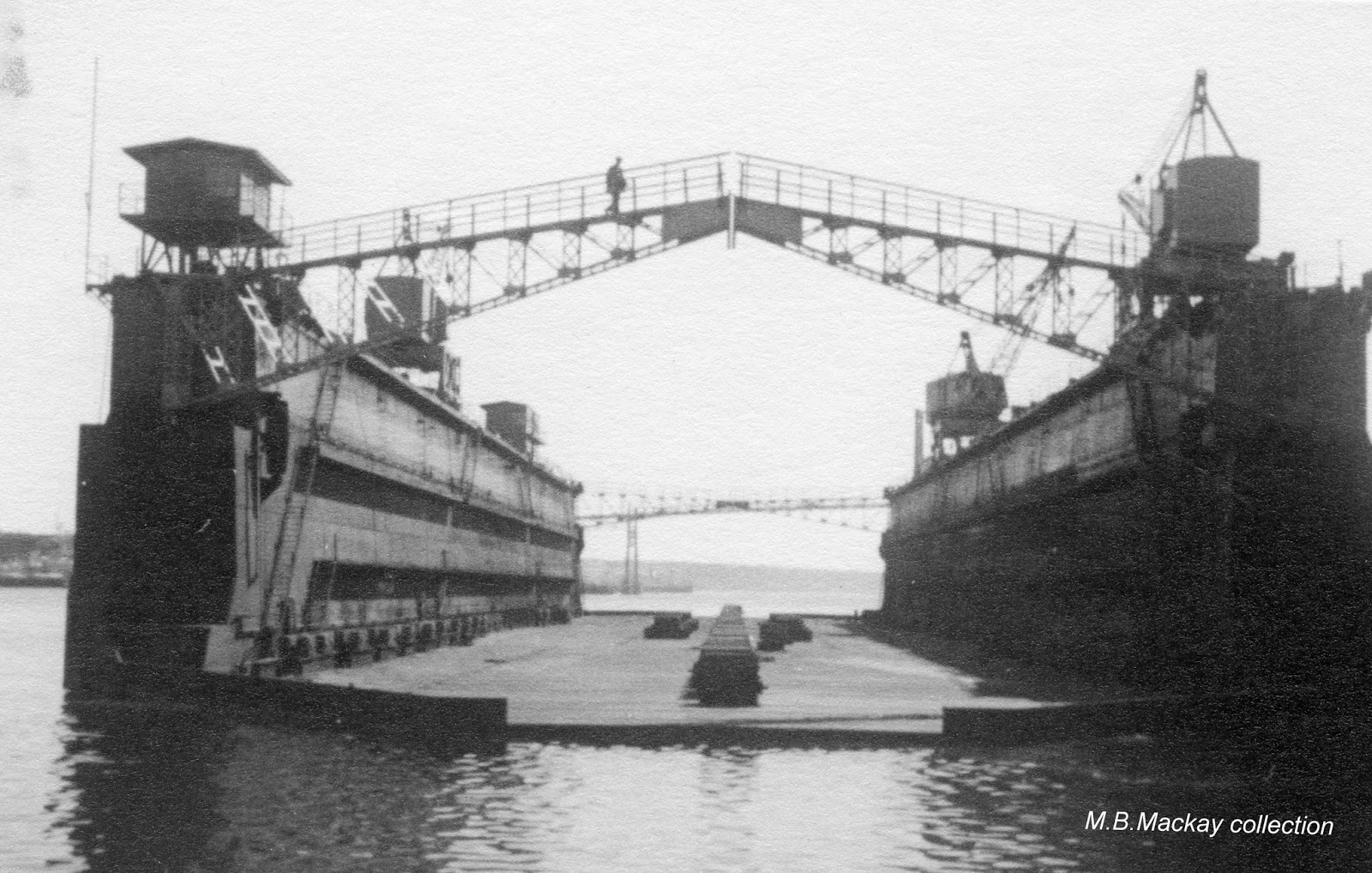
The dock was named for the Chairman of Dominion Steel and Coal Co (DOSCO), Lionel Avard Forsyth, QC, 1890-1957, a Nova Scotian by birth. Ownership was transferred to DOSCO (then parent of Halifax Shipyard) at the end of the War, but wound up in the hands of the Province of Nova Scotia when the yard was taken over in 1978. However the dock was in poor condition and a replacement was soon found.
Aside from two barges, the last ship to be lifted by the dock was the ferry Princess of Acadia in January 1979. Meanwhile the Minister of Public Works put the dock up for sale by sealed bid with the closing date of January 31, 1979.
The successful bidder was the Robert E. Derecktor Shipyard of Rhode Island Inc, which had just landed a contract to build US Coast Guard cutters. The Lionel A. Forsyth was towed out of Halifax by the tug Irving Miami on May 3, 1979 for the former Newport, Rhode Island Naval Base in Middletown, RI.
In 1992, when the Derecktor shipyard was declared bankrupt, most of its assets were sold for scrap, including, presumably, this drydock.
Lionel A. Forsyth O.N. 195182
Built: 1941 by Dominion Bridge (Dosco)
18,058 gross tons
Lifting capacity: 25,000 tons
Dimensions: 600 ft x 96' (clear of fenders)
Equipment: 2 x 5 ton, 1 x 17 ton cranes
Scotiadock
The Minister of Development of the Province of Nova Scotia acquired a similar dock from the Netherlands for $6mn. The Prins Hendrik Dok No.4 was actually older than the dock it replaced. It was built in 1933 by and for De Rotterdamsche Drooogdik Maats NV. It had been extensively rebuilt following World War II and had a lifting capacity of 14,000 tons and was slightly smaller than its predecessor.Legend has it that the drydock had been taken over by German forces during World War II, but was sabotaged by the resistance and British commandos, and thus survived the war on the bottom of Rotterdam harbour, which did it no real harm. Other working drydocks were bombed by the Allies, and so this one survived.

It arrived in Halifax in tow the Dutch tug Zwarte Zee on June 6, 1979, was extensively refitted by HIL, and made its first lift January 13-18, 1980 with the ferry Princess of Acadia.
The dock’s name was changed officially to Scotiadock in 1983 [1984] but the new name had been used informally since it arrived.

A sad looking Scotiadock is moved from position in preparation to be towed away.
In June 1998 the dock was removed from service, to be replaced by a newer structure. Deterioration over time had resulted in the dock's original safe lifting capacity to be reduced to about half. Its last lift was the small bunkering tanker Imperial Lachine from April 23 to May 4, 1998.
The Province of Nova Scotia put the drydock up for sale and on November 5 it was towed out by the tug Kochab for Tampa, FL for new owners Gulf Marine Repair. It seems that the Florida yard outbid a local rival, International Ship Repair, in order to eliminate competition. They had no real need for the dock, but did not want their competitors to have it and it lay idle for a time, but was rebuilt and is still in service with Gulf Marine Repair and is known as "Scotia". See http://www.gulfmarinerepair.com/service.html

Bright Florida sunshine did not improve the looks of the dock which remained idle in Tampa for a time before it was reconditioned.
Dimensions 607' x 81'
Built: 1933, rebuilt 1945, refitted: 1979
9,897 gross tons
Lifting capacity: 14,000 tons (27,5000 deadweight)
Dimensions: 607 ft x 81' (clear of fenders) x 7m clear over blocks
Equipment: 3 and 8 ton electric cranes
Novadock
To meet the demand to repair ever larger ships, the yard needed a larger floating drydock. Tankers, container ships and bulk carriers using the port of Halifax, and in transit through nearby waters, were generally to Panamax dimensions. These were the largest ships that could pass through the locks of the Panama canal as it existed. [A new Panamax definition will be required when larger locks are opened in 2016]
In the early 1980s such a large dock was beyond the capability of the yard to build, and the Minister of Development contracted with Marine Industries of Sorel, QC to build the larger portion of the dock. A smaller portion was built by Ferguson Industries Ltd of Pictou, NS. The dock was to be owned by the Province of Nova Scotia and leased to the yard.
On November 15, 1982 the larger section arrived from Sorel in tow of the tugs Irving Miami and Irving Cedar with Irving Beech on the stern to provide steering. The shorter section arrived November 21 in tow of Irving Miami. The two sections were permanently connected at pier 6 and then moved to mooring dolphins outside the Scotiadock.

The first section of the Novadock arriving in Halifax.
Named Novadock, the new facility lifted its first ship, Irving Eskimo from November 11-28, 1983. (The yard's crane Timberland was the first vessel to be lifted for trials.)
Ownership of the dock was transferred to Halifax Shipyards at some point, well after Irving Shipbuilding acquired the yard in 1993.

Novadock was moored to dolphins off pier 6. It was connected to a jetty at the south end.
In July 2014 Irving Shipbuilding Inc announced that the dock had been removed from service in April because it was beyond repair and needed replacement. The last lift on dock was the tanker Havelstern in February 2014.
The dock was subsequently sold to International Ship Repair in Tampa, FL (Remember them? - the unsuccessful bidders for Scotiadock) and in August 2015 it was moved to the IEL dock in Dartmouth where it was cut in two athwartships.
In October 2015 the first section was floated aboard Boa Barge 33 and towed by the tug Boa Odin to Tampa, FL. The tug and barge returned in November and towed away the second section.
Novadock ON 800549
Panamax floating drydock
Built: 1982: portion by Marine Industries, Sorel QC (hull no. 448)
1982: portion by Ferguson Industries Ltd, Pictou, NS (no hull no.)
34,186 gross tons, as completed 1983
Dimensions: 257.25m x 52m x 19,81m
Lifting capacity: 36,000 tons
Deck dimensions: 257m x 38m (clear of walls) x 9m over blocks
Equipment: 2 x 40 tonne cranes
Scotia Dock II ex General Georges P. Vanier
With the aging Scotiadock in need of replacement the yard had the opportunity to purchase another floating dock. General Georges P. Vanier was built by and for the Canadian Vickers shipyard in Montreal. The last owners of the yard, Versatile Vickers Ltd had closed the yard and the dock was surplus. It was moved to Sorel and then to Lévis before it was sold.
(After a distinguished career in the military in two World Wars and as a diplomat, Montreal native Major-General Georges-Philéas Vanier PC DSO MC CD served as Governor General of Canada from 1959 to 1967.)
On June 9, 1998 the dock arrived in Halifax in tow of the tugs Atlantic Cedar, Atlantic Oak, and Atlantic Hemlock . The tow had sheltered in Gaspé en route due to inclement weather.

Renamed Scotia Dock II it was about the same size as Scotiadock, and so fit into the same spot, inboard of the Novadock. After a refit and upgrade, the dock went into service. Its first lift was the coastal tanker Wellington Kent September 28, 1998.
With enhanced capabilities the dock was suitable for the many smaller ships that came to the yard for repair.and refit.


Scotia Dock II was moored to dolphins off pier, inboard of the larger Novadock.
On May 5, 2010, while starting to berth the tug Stevns Breaker, a malfunction caused the dock to sink to the bottom. Several ruptures between compartments, and damage to equipment meant that the dock could not be raised on its own. The tug was unharmed, but the dock received extensive damage. Unfortunately the dock was just completing a major refurbishment, and much new work was lost.
A salvage operation started immediately, but it took a month to raise the dock from its position in 50 feet of water where only the crane rails were above the surface. Once raised it was moved to pier 6 until a decision could be made on its future. Damage was found to be so severe that it was declared a constructive total loss.
On August 12, 2012 the tug Eileen McAllister towed the Scotia Dock II out of Halifax destined for Brownsville, TX where it was scrapped.
Scotia Dock II ex General Georges P. Vanier O.N. 322223
Built: 1964 Canadian Vickers Ltd, Montreal (Hull No. 283)
17,309 gross tons (later revised to 15,692)
Hull dimensions: 161.19m x 32.6m x 5.09m (depth of hull)
Capacity: 24,000 tonnes
Deck dimensions: 183m x 31.5m(clear of walls) x 8 m (over blocks)
Equipment 2 x 15 tonnes cranes
Launching Platform
As part of the reconstruction of Halifax Shipyard in 2014-2015 to build new ships for the Royal Canadian Navy, the yard has established a new system of launching ships. No longer will ships slide down the launch ways and splash into the harbour. Instead they will be moved overland from the building hall to a launch platform which will then be submerged, and the ship will be floated off. A much less dramatic, but certainly safer method of putting ships in the water, with less risk of damage to ship or workers.The new launching platform will be a floating dock in fact. Since it will only be used rarely for launching purposes, it may be used as a drydock for servicing other ships. So far Halifax Shipyard has not made any announcements about the launch platform, except to show it in artists renderings.
For now however the yard has no floating drydock - for the first time since 1941.
.


.jpg)
.JPG)
.jpg)
.jpg)