Thursday, May 17, 2012
Garnet Leader -feeding the demand
North America's constant demand for automobiles is being fed by ships such as Garmet Leader, arriving this afternoon from Emden, Germany. Operated (under charter) for NYK Line of Japan, the ship, built in 2008 and 57,692 gross tons has a rated capacity of 6,600 autos. Flying the Bahamas flag, it is owned by a company domicilied in the Isle of Man, but associated with Stamco Ship Management of Piraeus, Greece.
NYL Line (Nippon Yusen Kabushiki Kaisha) does about $22bn of business each year from a variety of transportation related operations. About a year ago they were operating 827 major ocean vessels including 143 containerships, 344 bulk carriers, 57 woodchip carriers, 118 car carriers, 86 tankers, 29 LNG carriers, three cruise ships, and 47 other ships. They also have fleets of planes, trains and trucks and containers.
Imperoyal - time running out
This is first of all bad news for consumers, who will be faced with increased costs of gasoline and heating oil.
It also bad news for the some 200 plus employees and an equal number of contractors.
It signals the mess in Canada's petroleum industry where some companies are getting wealthy on oil sands and exploration, but have no commitment to actually serving consumers.
Eastern Canada depends almost exclusively on imported crude oil, whereas western Canada wants to export to the United States and Asia, instead of shipping it east.
Now, with the impending closure of this refinery in 2013, we will be in the postion of having to buy refined product, not just crude. That is unless Ultramar in Lévis, QC or Irving Oil in Saint John, NB can supply local needs.
Somehow this broken model must be fixed.
Tuesday, May 15, 2012
A.P.A No.1 outbound - and me too.
The pilot boat A.P.A. No.1 is outbound off the Tall Ships Quay, where there is a notorious "hole" and usually a nice swell to liven up things for the unsuspecting.
Just as the boat is outbound, so am I.
Due to travelling over the next month, posts may be limited on this site. I will attempt to post words from time to time, but pictures may prove to be impossible.
Just as the boat is outbound, so am I.
Due to travelling over the next month, posts may be limited on this site. I will attempt to post words from time to time, but pictures may prove to be impossible.
Monday, May 14, 2012
Höegh ships
The arrival on Saturday of the autocarrier Höegh Singapore was reminder that Lines were once regular callers in Halifax with general cargo and containers.
Höegh Singapore (47,266 gross tons) was built in 2011 by Xiamen Shipbuilding Industry Co Ltd in China and is rated for 4300 autos.
The Leif Höegh & Co A.S. was founded in Norway in 1928 as tanker operators, getting into general cargo in the 1930s and later ore carriers, reefers, forest products ships and in recent years autoliners and LNG carriers. The company started calling in Halifax in the early 1950s as tramps and established itself later as a shipping line. Halifax became a stop on its far east/ Canada /US route.
1. Höegh Elite 10,998 gross tons, built 1964 at Bordeaux, France was a typical general cargo ship of the 1950s and 60s. Fitted with cargo derricks, it could carry a few containers on deck. Sold in 1979 it lasted to 1985 under five different names until broken up in China.
2. Höegh Opal built in 1967 in Turku Finland had engines aft, but was a conventional general cargo ships. It was lengthened in 1975 and carried 1x80, 1x50, 2x30 and 16x10 tonne derricks. It was broken up in China in 1992.
When faced with the container revolution they converted adapted cargo ships and operated some pure container carriers, but opted to try multi-purpose vessels carry containers and general cargoes, such as paper and baled rubber, long timber, bulk grain, cars or whatever was offering in addition to containers. Their C class ships carried containers but had a full suite of cargo handling cranes and derricks for general cargo.
3. Höegh Cairn was a C class vessel of 15,422 tons, bult in 1979. It could carry 504 TEUs (including 50 reefers), but also had 2x25 tonne cranes, 2x25 and 8x12 tonne derricks to handle bulk and general cargo. It was sold in 1996 to Rickmers Linie, which has continued to offer round the world liner service for special, general and container cargo. It was broken up in India in 2009.
In the early 1980s Höegh built the D class ships, which were to be the largest multi-purpose ships in the world.
4. The impressive D class ships were the largest multi-purpose ships in the world and were regular callers in Halifax.
A company noted for its ability to reconfigure itself to suit market demands, eventually it realized that there was a limited future in the multi-purpose market and a huge investment would be needed in new ships. In September 1998 they signed a letter of intent with Oldendorff Carriers of Germany to buy the D class ships, charter them back to Höegh for two years and to operate the line as Höegh Oldendorff Indotrans. At the end 2000 Oldendorff bought out Höegh’s interest and the line became simply Oldendorff Indotrans effective December 31, 2000.
(At the same time Leif Höegh sold its Bona tankers subsidiary for shares in Teekay shipping, exited the reefer business entirely and transferred its forest products interests to Saga Forest Carriers.)
Oldendorff Carriers operated the four D class ships for only four years until selling Indotrans to Hong Kong based John Swire & Sons (one of the oldest British founded trading houses in Hong Kong) to be operated by their China Navigation Co Ltd. The ships by this time were becoming rather ripe and the old liner routes were cut back reconfigured and the Indotrans name disappeared, with the ships renamed to suit Swire’s normal system with Pacific prefixes.
Finally Swire Pacific (as it was known in the west) halted the Leif Höegh-founded route entirely and transferred the ships to the Pacific. There at least three of the ships were fitted with deckhouses on the after deck to carry cars. Only the former Duke seems to have escaped this indignity. The ships never called in Halifax with this configuration.
Earlier this year the ship were all renamed for the trip to the scrap yards in China.
Characteristics of the D class ships: 30,150 gross tons, 41,600 deadweight, capacity of 1656 TEU (but they rarely carried this many) and fitted with 3x36 tonne cranes, 1x25 tonne crane and one traveling gantry with 41 tonne capacity. Built with seven holds, four holds were strengthened for heavy cargoes (these were also open hatch holds, with the hatch ciovers thew same width as the holds) and three holds fitted to carry containers (924 TEU) and 732 on deck, with 50 reefer plugs.
Three ships were built by Oy Watsila AB, Turku/Abo, Finland and Höegh Duke by Swan Hunter Neptune yard, Wallsend, UK.
1. The ship arrives in Halifax with a crew boat and yacht mixed in with containers on deck.
2. In Egon Oldendorff colours, the ship has no containers on its after deck. It had no gear of its own to handle boxes in that location, so relied on shore cranes.
3. In Swire colours, the ship leaves with no containers on the open hatch section.
Höegh Dene entered service in February 1984 Its last call in Halifax with the Höegh name was January 30-31, 2001 and it returned June 1 as Gitta Oldendorff. On May 9, 2004 it arrived as Indotrans Java.It was renamed Pacific Java in 2004 and Hunan in 2012.
Höegh Duke
1. Sailing from Halifax with a substantial deck load of containers.
2. Oldendorff opted to paint the derricks and gantry in a tan/buff colour.
Höegh Duke was launched at Wallsend September 6, 1983 and was completed in June 1984. It became Edward Oldendorff in 2001 and Indotrans Makkassar in 2004. It was renamed Pacific Makassar in 2006, arriving Halifax with that name October 25. It was renamed Hangchow late in 2011.
1. In addition to containers the deck load included some odd metal fabrications.
2. The Oldendorff hull colour was an attractive charcoal.
3. With the gantry arms swung out over side, the traveller has been fitted with a spreader to handle containers. It could also carry devices for loading paper rolls and other special cargoes.
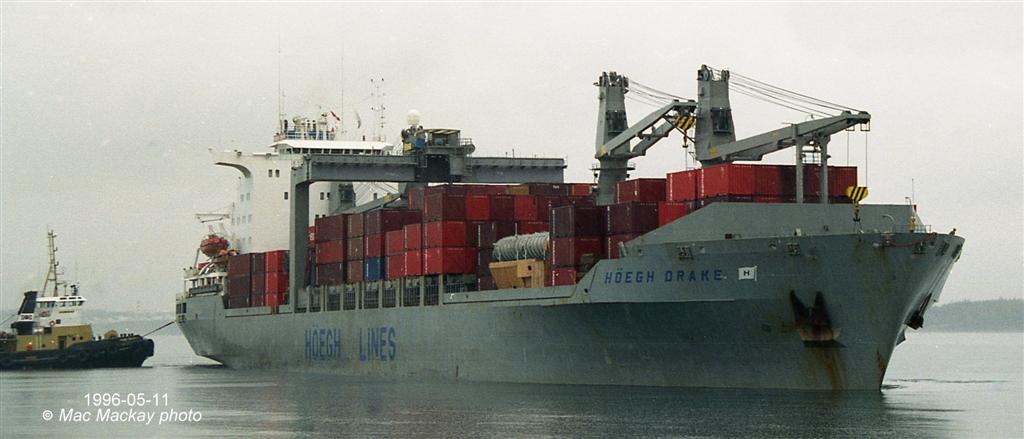
Höegh Drake was launched October 29, 1983 but entered service in May 1984. It became Ingrid Oldendorff in 2001 and Indotrans Flores in 2004, arriving in Halifax May 29. It was renamed Pacific Flores in 2006 and Hupeh in 2012.
2. When Hurricane Juan struck Halifax September 28-29, 2003 the ship parted its lines at pier 30-31 and impacted the Saudi Tabuk at pier 27-28, damaging both ships and their cargoes. Ironically Albert Oldendorff was carrying many Saudi containers.
Höegh Dyke was launched February 8, 1984 and entered service in September. It was renamed Albert Oldendorff in 2001, Indotrans Celebes in 2004 and Pacific Celebes in 2006, finally becoming Hoihow in 2012.
As Pacific Celebes it was the last ship of the line to call in Halifax on February 21, 2007. The sips continued to call in Saint John for a time until moving to the Pacific coast only.
The Höegh company has now evolved into one of the largest car carrier operators, with 45 owned ships and 15 on time charter. They are also important players in the LNG tanker field. Their excellent website lists all the ships owned between 1928 and 2008, totalling 291 vessels, with photos of most.
.
Höegh Singapore (47,266 gross tons) was built in 2011 by Xiamen Shipbuilding Industry Co Ltd in China and is rated for 4300 autos.
The Leif Höegh & Co A.S. was founded in Norway in 1928 as tanker operators, getting into general cargo in the 1930s and later ore carriers, reefers, forest products ships and in recent years autoliners and LNG carriers. The company started calling in Halifax in the early 1950s as tramps and established itself later as a shipping line. Halifax became a stop on its far east/ Canada /US route.
1. Höegh Elite 10,998 gross tons, built 1964 at Bordeaux, France was a typical general cargo ship of the 1950s and 60s. Fitted with cargo derricks, it could carry a few containers on deck. Sold in 1979 it lasted to 1985 under five different names until broken up in China.
2. Höegh Opal built in 1967 in Turku Finland had engines aft, but was a conventional general cargo ships. It was lengthened in 1975 and carried 1x80, 1x50, 2x30 and 16x10 tonne derricks. It was broken up in China in 1992.
When faced with the container revolution they converted adapted cargo ships and operated some pure container carriers, but opted to try multi-purpose vessels carry containers and general cargoes, such as paper and baled rubber, long timber, bulk grain, cars or whatever was offering in addition to containers. Their C class ships carried containers but had a full suite of cargo handling cranes and derricks for general cargo.
3. Höegh Cairn was a C class vessel of 15,422 tons, bult in 1979. It could carry 504 TEUs (including 50 reefers), but also had 2x25 tonne cranes, 2x25 and 8x12 tonne derricks to handle bulk and general cargo. It was sold in 1996 to Rickmers Linie, which has continued to offer round the world liner service for special, general and container cargo. It was broken up in India in 2009.
In the early 1980s Höegh built the D class ships, which were to be the largest multi-purpose ships in the world.
4. The impressive D class ships were the largest multi-purpose ships in the world and were regular callers in Halifax.
A company noted for its ability to reconfigure itself to suit market demands, eventually it realized that there was a limited future in the multi-purpose market and a huge investment would be needed in new ships. In September 1998 they signed a letter of intent with Oldendorff Carriers of Germany to buy the D class ships, charter them back to Höegh for two years and to operate the line as Höegh Oldendorff Indotrans. At the end 2000 Oldendorff bought out Höegh’s interest and the line became simply Oldendorff Indotrans effective December 31, 2000.
(At the same time Leif Höegh sold its Bona tankers subsidiary for shares in Teekay shipping, exited the reefer business entirely and transferred its forest products interests to Saga Forest Carriers.)
Oldendorff Carriers operated the four D class ships for only four years until selling Indotrans to Hong Kong based John Swire & Sons (one of the oldest British founded trading houses in Hong Kong) to be operated by their China Navigation Co Ltd. The ships by this time were becoming rather ripe and the old liner routes were cut back reconfigured and the Indotrans name disappeared, with the ships renamed to suit Swire’s normal system with Pacific prefixes.
Finally Swire Pacific (as it was known in the west) halted the Leif Höegh-founded route entirely and transferred the ships to the Pacific. There at least three of the ships were fitted with deckhouses on the after deck to carry cars. Only the former Duke seems to have escaped this indignity. The ships never called in Halifax with this configuration.
Earlier this year the ship were all renamed for the trip to the scrap yards in China.
Characteristics of the D class ships: 30,150 gross tons, 41,600 deadweight, capacity of 1656 TEU (but they rarely carried this many) and fitted with 3x36 tonne cranes, 1x25 tonne crane and one traveling gantry with 41 tonne capacity. Built with seven holds, four holds were strengthened for heavy cargoes (these were also open hatch holds, with the hatch ciovers thew same width as the holds) and three holds fitted to carry containers (924 TEU) and 732 on deck, with 50 reefer plugs.
Three ships were built by Oy Watsila AB, Turku/Abo, Finland and Höegh Duke by Swan Hunter Neptune yard, Wallsend, UK.
Höegh Dene
1. The ship arrives in Halifax with a crew boat and yacht mixed in with containers on deck.
2. In Egon Oldendorff colours, the ship has no containers on its after deck. It had no gear of its own to handle boxes in that location, so relied on shore cranes.
3. In Swire colours, the ship leaves with no containers on the open hatch section.
Höegh Dene entered service in February 1984 Its last call in Halifax with the Höegh name was January 30-31, 2001 and it returned June 1 as Gitta Oldendorff. On May 9, 2004 it arrived as Indotrans Java.It was renamed Pacific Java in 2004 and Hunan in 2012.
Höegh Duke
.jpg)
1. Sailing from Halifax with a substantial deck load of containers.2. Oldendorff opted to paint the derricks and gantry in a tan/buff colour.
Höegh Duke was launched at Wallsend September 6, 1983 and was completed in June 1984. It became Edward Oldendorff in 2001 and Indotrans Makkassar in 2004. It was renamed Pacific Makassar in 2006, arriving Halifax with that name October 25. It was renamed Hangchow late in 2011.
Höegh Drake
1. In addition to containers the deck load included some odd metal fabrications.
2. The Oldendorff hull colour was an attractive charcoal.
3. With the gantry arms swung out over side, the traveller has been fitted with a spreader to handle containers. It could also carry devices for loading paper rolls and other special cargoes.
Höegh Drake was launched October 29, 1983 but entered service in May 1984. It became Ingrid Oldendorff in 2001 and Indotrans Flores in 2004, arriving in Halifax May 29. It was renamed Pacific Flores in 2006 and Hupeh in 2012.
Höegh Dyke
1. The after deck was usually reserved for empty containers.2. When Hurricane Juan struck Halifax September 28-29, 2003 the ship parted its lines at pier 30-31 and impacted the Saudi Tabuk at pier 27-28, damaging both ships and their cargoes. Ironically Albert Oldendorff was carrying many Saudi containers.
Höegh Dyke was launched February 8, 1984 and entered service in September. It was renamed Albert Oldendorff in 2001, Indotrans Celebes in 2004 and Pacific Celebes in 2006, finally becoming Hoihow in 2012.
As Pacific Celebes it was the last ship of the line to call in Halifax on February 21, 2007. The sips continued to call in Saint John for a time until moving to the Pacific coast only.
The Höegh company has now evolved into one of the largest car carrier operators, with 45 owned ships and 15 on time charter. They are also important players in the LNG tanker field. Their excellent website lists all the ships owned between 1928 and 2008, totalling 291 vessels, with photos of most.
.
Sunday, May 13, 2012
Fairchem Steed - in ballast
1. Fairchem Steed rest at anchor on a quiet Sunday morning, with the Halifax skyline in the background.
The chemical and products tanker Fairchem Steed anchored over night to await a berth at Imperial Oil. The ship is fitted with twenty stainless steel tanks of various sizes to carry all sorts of liquids including petroleum, edible oils, and on and on. Usually these ships (as with the previously posted Glory) are always carrying several chemicals and pick up and drop off at various ports. However this ship is in ballast. It discharged cargo in Hamilton ON on May 6-7 , returning down the Seaway via Montreal May 9.
Part of the Fairfield Chemical Carriers fleet the ship is registered in Panama and operated by Anglo-Eastern Ship Management. It was built in Usuki, Japan in 2005 and measures 11,642 gross tons and 20,0762 deadweight at summer draft.
The ship is managed by Anglo-Eastern Ship Management's Singapore office.
Fairfield operates more than 30 tankers from operating offices in Wilton CT, Antwerp and Singapore.
For more on Fairfield, see their web site: http://www.fairfieldchemical.com/
For more on Anglo-Easstern be surte to look at: http://www.angloeasterngroup.com/
Saturday, May 12, 2012
CCGS Private Robertson V.C. - slo-mo launch
It wasn't the text book launch, with a ship barreling down the launch ways and splashing into the water. No, it was more like a slo-mo version, with the vessel taking the better part of an hour to reach the water, with many stops and starts along the way. The launch ceremony forCCGS Private Robertson V.C. took place at about noon-time.
The first of nine offshore patrol craft for the Canadian Coast Guard, Private Robertson V.C. is a handsome looking craft, which promises to be speedy, but I worry about its sea keeping abilities in really rough stuff.
1. 12:17 the launch starts and the boat begins it slow descent down the launchway. (As seen from the Dartmouth shore.) Dominion Pursuit stands by.
2. 12:31 the boat makes it almost to the end of the launch way. A Connnors Diving inflatible sits off to one side. Its crew had previously checked the submerged launch rails to ensure they were clear.
3. 13:04 with just the tips of the rudder in the water, a shipyard crew has now boarded the boat from the landside.
4. 13:05 the boat begins to make it into the water.
5. 13:07 finally clear of the land, the deck crew can release the cradle so that the boat will float off. Atlantic Oak stands in to assist.
6. Safely in control of Atlantic Willow and Atlantic Oak with CCGC Sambro standing by the flotilla moves off toward pier 9B. (As seen from the Halifax shore)
7. Private Robertson V.C.
But it did happen, the ship made it to the water and was whisked away to pier 9B where final touches will be made.The first of nine offshore patrol craft for the Canadian Coast Guard, Private Robertson V.C. is a handsome looking craft, which promises to be speedy, but I worry about its sea keeping abilities in really rough stuff.
Friday, May 11, 2012
Glory - diminished
The Stolt tanker Glory sailed this morning on a voyage from Rotterdam to Searsport. The ship is what is known as a parcel tanker. It can carry 14 different types of cargo at the same time and has sophisticated pumping systems allowing it to discharge the cargoes independently.
This concept of parcelling was invented by Stolt Tankers founder Jacob Stolt-Neilsen of Norway, who was a ship broker in New York at the time. From a start in 1953 with one chartered tanker, he built the company up to the power house it is today with over 150 tankers and interests in terminals, tank containers, fish farms, etc., Read more at: http://en.wikipedia.org/wiki/Jacob_Stolt-Nielsen
As such a large company it is odd that we have seen so little of Stolt tankers in recent years. The ships normally operate on liner routes, following a schedule of dates and ports as they work around the seas of the world, so perhaps they just have had no cargoes to or from Halifax.
One cargo they used to load in Halifax regularly was tallow. This cargo, the product of rendering meat scraps, used to be stored in tanks at pier 20. However the tanks have long since been removed and that reason for calling no longer exists.
Glory was formerly called Stolt Glory until 2010-and it is odd that the name was changed, even though it is still in the Stolt fleet. Built in 2005 at Shin Kurushima Dockyard in Onomichi, Japan it is a ship of 20,095 gross tons, 33,302 deadweight.
Among the early Stolt tankers to call in Halifax was Stolt Argobay built in 1960 in Norway. It was a traditional tanker with island bridge. It was broken up in 1984. It is shown here getting away from pier 20 on a foggy day.
Stolt's distinctive putty/yellow colour scheme and lower case lettering of the ships' names made them favourite photo subjects. Their names were also distinctive in themselves giving pause for thought to some, such as this line handler waiting for the ship to berth at pier 20.
Subscribe to:
Posts (Atom)


.jpg)
.jpg)
.jpg)
.jpg)
.jpg)
.jpg)
.jpg)
.jpg)
.jpg)
.jpg)