Friday, April 29, 2022

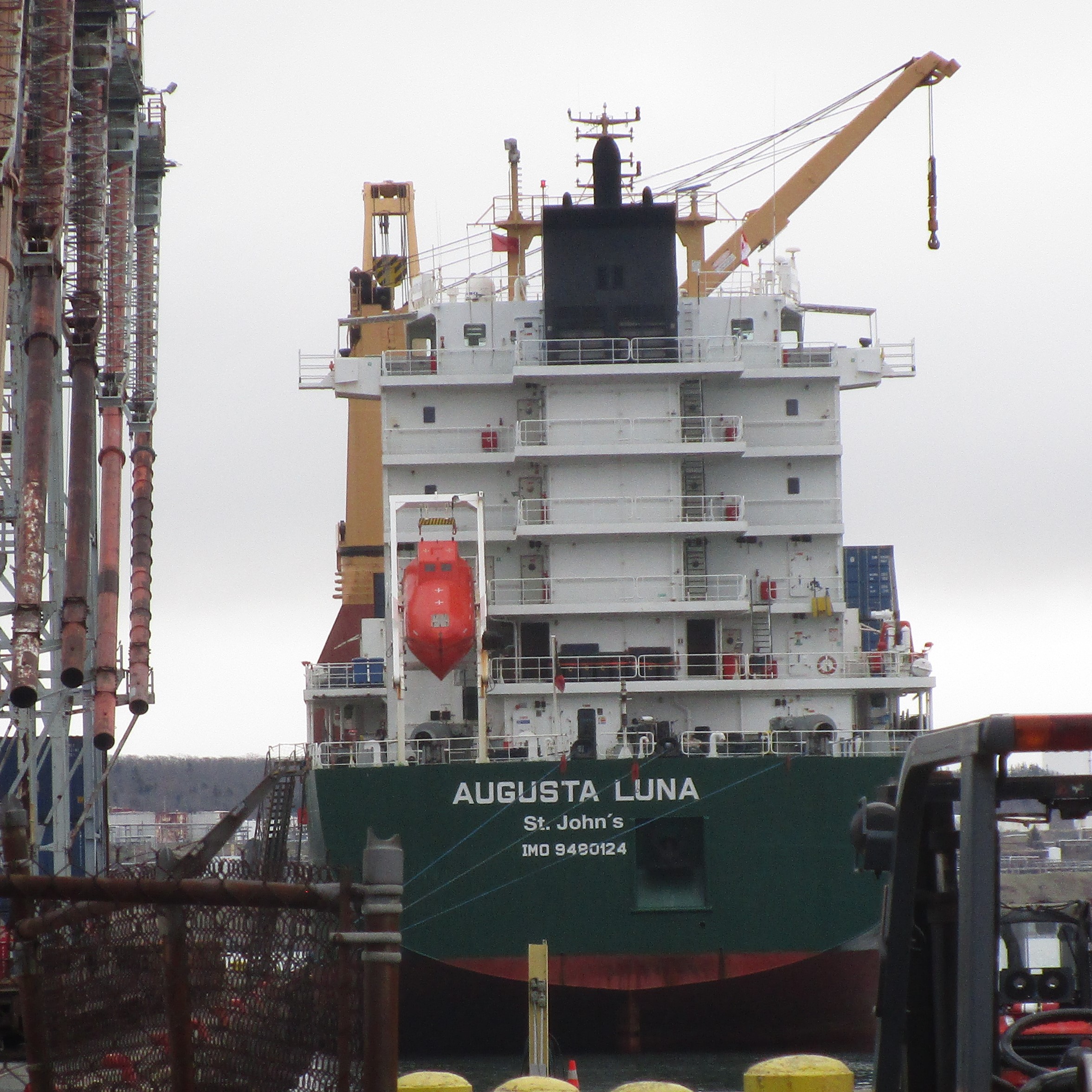
Augusta Luna shift to Pier 27.

 Nirint Shipping BV from the Netherlands is the long time operator of a container and general cargo service from Europe to Cuba. On the return leg from Cuba, Nirint ships stop in Halifax to unload nickel sulfide which is then sent out by rail to Fort Saskatchewan, Alberta for refining. Until now the nickel sulfide, shipped in bags, has been handled at Pier 30-31. The bags can be loaded directly to gondola cars or stored in the trasit shed before being loaded on the rail cars. Because the cargo is considered to be hazardous, the bags are stored indoors to avoid the dust being blown about.

The project to expand the southend container terminal is due to start May 1. Work will include filling in the camber south of Pier A-1, and demolition of the shed on Pier 31. Consequently Nirint is moving its operations to the adjacent Pier 27-28 where the nickel cargo can be stored in the last remaining transit shed in the deepwater piers section of the port. (There is also a transit shed at Pier 9C).

Nirint's Augusta Luna arrived April 27 and is the first to use Pier 27-28. It completed unloading its nickel cargo today, Friday April 29, sailed in misty conditions this evening.

 The ship is heemed in by various obstacles at Pier 27, so iis very hard to see.

 Built in 2011 by Xinshun Shipyard Group in Yueqing, China, Augusta Luna is a 12,772 gt, 17,370 dwt ship with three cranes, two of 150 tonne capacity and one of 80 tonne capacity. It can carry about 900 TEU (698TEU if loaded to 14 tonnes) and has 60 reefer plugs. Built as Rickmers Yokohama it was renamed Lolland in 2015 and Augusta Unity in 2019. Since built it has been owned by Lolland Schiffahrts GmbH + Co of Lübeck, Germany and registered in Antigua and Barbuda.

The nickel is mined and shipped from Moa, Cuba by Moa JV a 50/50 operation of General Nickel SA of Cuba and Sherrit International of Canada. While I call the product Nickel Sulfides, it also contains cobalt (about 10%) so should probably be called "mixed nickel-cobalt sulfides".

 The ship looked much the same when it arrived in Halifax August 28, 2021:


As noted in previous posts, the ship also carries tank containers, believed to be carrying molasses or rum.


Thursday, April 28, 2022

Ocean Voyager

 The cruise ship season began on Tuesday April 20 after a two year interruption. The first ships provided a contrast in size betweeen the Norwegian Getaway and the Ocean Navigator. (See previous post).

Today, April 28, there was a repeat of sorts with the noon time arrival of the Ocean Voyager, a sister ship of the Ocean Navigator

The two ships have had parallel careers, staying together through several ownrrship and name changes. Today's ship was built in 2001 by Atlantic Marine in Jacksonville, FL as Cape May Light, becoming Sea Voyager in 2010, Saint-Laurent in 2015 and Victory II in 2016. It has also been acquired by Hornblower Group and is sailing for American Queen Voyages this year under the new name Ocean Voyager. Oddly, published statistics vary somewhat between the two ships, with Ocean Voyager showing a capacity of 216 in 105 cabins and 90 crew, whereas the Ocean Navigator has 220 passengers in 110 cabins and 77 crew. Certainly the smaller crew number seems more reasonable.

Ocean Voyager will remain in Halifax overnight and is due to sail at 1745 tomorrow, allowing a day and a half ashore for passengers. By that time they will have had more than enough of the forecasted frigid, drizzly weather.


.

Wednesday, April 27, 2022

Dartmouth - where the action is

 The eastern shore of Halifax harbour is still identified as Dartmouth even though it was amalgamated with Halifax, along with the town of Bedford and Halifax County to form the Halifax Regional Municipality (generally called Halifax) in 1996. Mail addressed to Dartmouth will still reach its destination however as there are numerous duplicate street names on the two sides of the harbour. The Dartmouth side has significant shipping activity, as today's four piloted arrivals were all destined for berths in Dartmouth.

The tug Atlantic Elm arrived from Saint John, NB towing the barge Atlantic Marlin and tied up at the IEL dock in the Woodside neighbourhood. (The City of Dartmouth annexed numerous suburbs in 1961, most of which are still identified with their traditional names.) The IEL dock is the site of the former Acadia Sugar Refinery, which was later used as a Volvo car assembly plant.

The barge will be used to transfer bow fabrications from Irving Shipbuilding Inc's Woodside Fabricators plant to the Halifax Shipyard, where they will be incorporated in construction of Arctic Offshore Patrol Vessels for the RCN. Interestingly the same tug and barge are usually to be found in the arctic during the summer months, transferring supplies to remote communities.


 The Atlantic Marlin was built in 2000 by Jinling Shipyard in Nanjing, China as Boa Barge 18. Atlantic Towing Ltd acquired, and renamed, the 2318 gt barge in 2010 from BOA Offshore AS of Norway. It is a flat deck project cargo barge, but also has built up bulwarks to support or protect cargo.

The 3460 bhp tug Atlantic Elm dates from 1980 when it was built in Saint John as Irving Elm. It took its present name in 1995 as part of a company wide renaming program.

Also arriving in Woodside (or maybe South Woodside) later in the morning was the tanker Claxton Bay with a cargo of refined product for Irving Oil from Amsterdam.


 A handysize vessel of 23,373 gt, 36,686 dwt, it was built in 2010 by Hyundai Mipo in Ulsan. Operators Cido Shipping Hong Kong Ltd own and manage about 65 ships of all types.

The third arrival, was actually for Eastern Passage which was never part of the "old" Dartmouth, but is on the eastern side of the harbour, in what was once Halifax County. Autoport, owned and operated by the Canadian National Railway (CNR) is the port of entry for new cars to eastern Canada.

The car carrier NOCC Atlantic is a first time caller as far as I can tell. The ship was built in 2009 as Dyvi Atlantic by Samjin Shipbuilding Industries Co in Weihai, China. It was renamed in 2011 following the formation of Norwegian Car Carriers in 2010 when Eidsiva Rederi ASA and Dyvi Shipping AS merged.  (Dyvi owned the first true car carrier in 1964).

NOCC Atlantic is a 60,686 gt, 22,500 dwt Pure Car and Truck Carrier (PCTC) with a capacity of 6,754 Car Equivalent Units. In addition to the usual stern ramp of 125 tonne capacity, it also has a side ramp.

The fourth arrival for Dartmouth took place after dark, so I do not have a fresh photo. The Articulated Tug Barge (ATB) Leo A. McArthur / John J. Carrick brought in a load of asphalt from Hamilton, Ontario for owners McAsphalt Industries. The barge is equipped with boilers to maintain the asphalt in liquid form. Paving season is about to start and the asphalt plants are gearing up. I do hope they get into production soon as "pothole season" is in full swing.

McAsphalt has its own dock in Eastern Passage. Once known as Dook's Dock it is immediately adjacent to Autoport and connects to storage tanks on shore by means of a heated pipeline. McAsphat then delivers by truck to customers including its own parent company Miller Group (owned by Colas Canada). It can also receive asphalt by rail at the Eastern Passage depot.

I am assuming the pair have not changed appearance since this photo was taken May 23, 2021.

.


Tuesday, April 26, 2022

Container Growth

The Mediterranean Shipping Company MSC is firmly entrenched in first place in the pantheon of container shipping companies, thanks to an aggressive buying plan that saw the line purchase 186 "used" ships since August 2020. This puts the fleet at 664 ships / 4,351,960 TEU of which 325 are owned and 339 are chartered. (Other sources say the fleet is only 650 ships / 4,337,384 TEU). Among the chartered ships is today's (April 26) arrival, the Liberian registered Varna Bay owned by the drawer in a Marshall Island office building called Arzel Shipping Inc. It is servicing MSC's Indus 2 route from North India.

 Built in 2009 by Hyundai Ulsan, it is a 94,511 gt, 95,810 dwt vessel with a capacity of 8562 TEU. Orginally built for Arzel it was first chartered to Hyundai Merchant Marine as Hyundai Mercury. It was under that name that the ship called in Halifax September 10, 2017 but then on a sub charter to ZIM. (HMM with 76 ships/ 820,500 TEU is currently 8th and ZIM with 125 ships / 451,855 TEU is 10th largest container line.)

On arrival this morning Varna Bay took the western channel, allowing the Norwegian Getaway a strait run in the eastern channel. [Was the pilot on the cruise ship the Getaway Driver?]

Meanwhile the 5th largest container line, Hapag-Lloyd: 246 ships / 1,741,980 TEU has announced a new service to Saint John, NB. Termed a "seasonal extra loader" [which is code for something - not sure what] the service called the AT3 will use 2200 to 2300 TEU ships running weekly from Hamburg and Antwerp, starting May 14 with Milan Express 2268 TEU followed May 21 with Valencia Express.


                            Valencia Express 2330 TEU and a kayak 0 TEU, on the St.Lawrence.


That puts Saint John it in direct competition with ACL's Halifax service which has been carrying H-L boxes for years.

Saint John's rejuvenated relationship with the merged Canadian Pacific / Kansas City Southern (and its newly minted deal with CSX / Pan Am) boasts of shorter rail routes to the US midwest from Saint John through Maine. (CP also has running rights on CSX trackage between Buffalo, NY and Chicago, and operates through trains from Montreal to Chicago, crossing into the US at Fort Erie.) However there is extra sea time to reach Saint John, versus Halifax, which is not publicized.


 +


Hapag-Lloyd remains a partner in THE Alliance, which is probably the largest customer of the port of Halifax, so the announcement does not threaten that traffic. It may however effect H-L's and even Maersk's services to Montreal, which take significantly longer sea time and have to deal with ice and whale zones, also seasonally.

.

Cruise Control

 Cruise ships returned to the Port of Halifax today, April 26, after a lengthy hiatus. When the last cruise ship called here, the Riviera on November 6, 2019 , no one had any idea that two entire cruise seasons would be cancelled completely. 

 The pilot boat Capt E.T.Rogers approaches Pier 24 as Ocean Navigator ties up at Pier 23.

Now with strict health measures in place, cruise ships returned with two ships tying up at adjacent berths early this morning. First place honours went to the "pocket" cruiser Ocean Navigator when it docked at Pier 23. The newly renamed ship was built by Atlantic Marine in Jacksonville, FL in 2004 as Cape Cod Light. It became Coastal Queen 2 in 2007, Clipper Discovery 2 in 2009, Sea Discovery in 2009 and Victory II in 2008. With sister ship Victory I the former Cape May Light it made previous calls to Halifax. The 4954 gt ship can carry 220 passengers in 110 cabins, with a crew of 77. Owners the Hornblower Group renamed the ship this year to operate under the American Queen Voyages banner.

At the opposite end of the scale was the second arival this morning. Norwegian Getaway is a 145,655 gt ship built in 2014 by Meyerwerft, Papenberg. Its 3,969 passsengers and 1640 crew capacity made it the world's ninth largest cruise ship when it was built. (It now shares 34th and 35th place with sistership Norwegian Breakaway).


The amazing growth of the cruise industry since 2014 has been stalled by the pandemic with scores of older ships heading to the scrappers as previously ordered new ships are delivered. Some lines have gone out of business, but those that have survived - possibly at a reduced scale - a hopeful for a rebound this year.

.

Monday, April 25, 2022

Ludogorets - in to top up (updated)

 The Ludogorets arrived today, April 25, to top up its cargo of soy beans*. It is one of several Navigation Maritime Bulgare ships that are frequent callers to Great Lakes ports. When they load export cargoes on the Lakes, they are restricted to the St.Lawrence Seaway draft of 26 feet 6 inches, and so they can "top up" with more cargo once they reach salt water ports.

Atlantic Fir makes up to Ludogorets to assist it in berthing at Pier 28.
The crew has already cracked some hatch covers in preparation for loading.

The Ludogorets was built in 2010 by Wuhu Xinlian in Wuhu (Sanshin), China as Fritz for German owners associated with Intersee Schiff. In 2015 it was renamed Marbacan by MC Schiff of Hamburg  then took its current name in 2016. Despite its Bulgarian operator, it is registered in Malta. The 20,491 gt, 29,998 dwt ship carries three 30 tonne capacity cargo cranes.

The Ludogorets began it current voyage in Ust-Luga, Russia where it took on a cargo of fertilizer, sailing February 27. On arrival off Sorel, QC on about March 20 there was some controversy about the cargo in view of Russia's invasion of Ukraine and a general ban on Russian shipping but the ship was cleared to unload some cargo April 4-5. It then went to the Lanoraie anchorage downstream of Montreal before transiting the Seaway April 8-9. 

Once the ship arrived in Hamilton, ON April 10 it unloaded the remaining cargo and began to load its new cargo April 15. It sailed April 20 and made good time down through the Seaway, passing Montreral April 22.

Update:

In my initial post I was speculating on the ship's cargo:

* I believe the ship is carrying soy beans, since that is the usual bulk cargo these days from the Halifax Grain Elevators. However I do not have independent confirmation.

Since making that post a reader has kindly confirmed that indeed it is soybeans. It will take on an additional 8,000 tonnes here for a total of 24,000 tons for delivery to Italy. it is expected to return to Hamilton, possibly in ballast, for another load and if so may top up here again.

The reader also noted that the crew is Bulgarian. 

.

Saturday, April 23, 2022

Atlantic Star - nostalgia time

The name Atlantic Star has no doubt been carried on the bows of many ships over the years [see footnote]. In my mind however there are two that stand out. Atlantic Container Line's current Atlantic Star is always impressive. Sailing this evening April 23 for New York on the westbound leg of its regular transatlantic run it caught a few of the last rays of the setting sun.


 Built in 2015 by Hudong-Zhonghua in Shanghai, the 100,430 gt, 55.649 dwt ship was the first of the 4th generation ACL ships. Along with its four sister ships, Atlantic Sail, Sea, Sky and Sun, they are the largest ConRo ships in the world. They maintain the weekly service, usually calling in Halifax eastbound and westbound, carrying a variety of containers and RoRo cargo.

One interesing aspect of that cargo is a regular traffic of European recreational vehicles (seasonally) usually German and Swiss. Until the COVID era the owners of these vehicles had the option of travelling on the same ship and on arrival in Halifax (or a US port) could start their North American tour right from the terminal.

Many of the European recreational vehicles are set up as expedition vehicles, capable of traversing rough terrain. I don't know how comfortable they are on the road, but they are largely self-contained. (See recent Truckfax posts for more on this topic.)
 

Due to health concerns ACL is not accepting passengers for the time being, but they may resume the service later this year. (The ships could carry a limited number of "pedestrian" passsengers too.) ACL is still carrying the vehicles, and there are usually a few on each trip at this time of the year. The owners have to find their own way to Halifax.

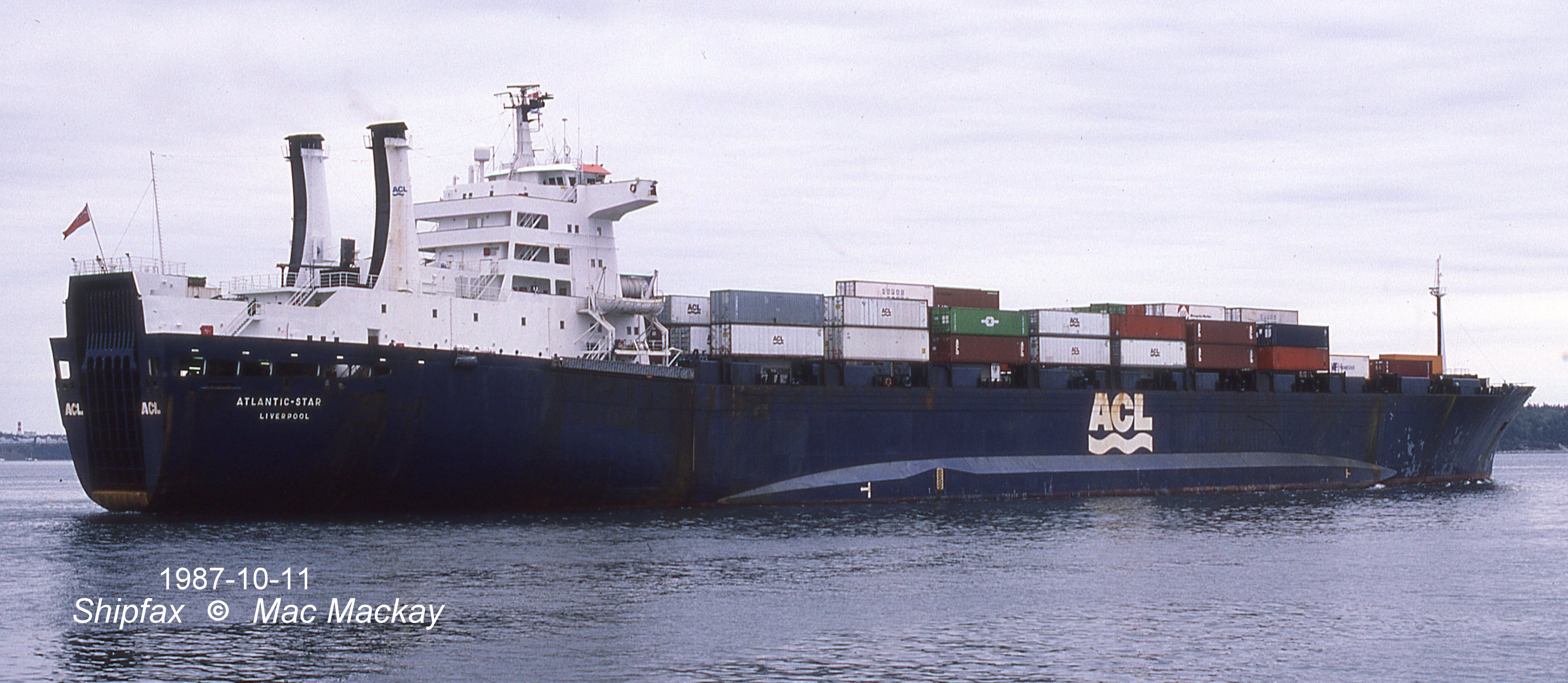
The current Atlantic Star is the second ACL ship to carry the name. The first was one of the original "S" class First Generation ACL ships. With Atlantic Saga, Song and Span (later renamed Service) they were among the pioneering ConRos. Atlantic Star (i) was built in 1967 by Atelier et Chantier de Dunkerque/Bordeaux (France-Gironde) in Dunkirk and measured 11,839 gt, 18,500 dwt. Its massive (for the time) 20,700 bhp MAN engine could drive the ship at 21 knots.

In 1976 the ship was lengthened 16m (four cellular holds, installed forward of the car decks) at Hitachi Zosen, Innoshima and sponsons were added to strengthen the hull, resulting in revised tonnages of 15.055 gt, 20,346 dwt. The three doors on each side were also eliminated.

The container capacity of 501 TEU, was thus increased to 1154 TEU. The ship soldiered on for another  nine years until sold for scrap. Atlantic Star arrived in Kaohsiung December 14, 1987 and was broken up.

The first Atlantic Star was the first RoRo service ship to call in Halifax - even before there was a container pier, March 30, 1970. It carried 200 finished Volvo cars destined for the US and 200 knocked-down kits, for assembly in Halifax. In those days it was accomodated at Pier 36 where a ramp had been built into the pier face.


The side doors are visible in the above photo. They were never used in Halifax as far as I know.

The first Atlantic Star was built for Holland-America Line, one of the founding partners of ACL. It later transferred to Cunard as ownership in ACL was consolidated. The line is now owned by the Grimaldi Group.

The Pier 36 ramp will soon be history as the area will be filled in to provide more backup land for the Southend Terminal operated by PSA Halifax. 

Footnote

Another Atlantic Star of a far different size was, surprisingly, also from the Netherlands. Built in 1964 by Nieuwe Noord Nederlandse Schps., Groningen, it was a 499 gt, 975 dwt general cargo / reefer. 


Owners were the well known reefer operators Dammers + van der Heide Shipping and Trading Co Ltd., also of Groningen. However between 1964 and 1973 the Halifax company Shaw Steamship Co Ltd chartered the ship for their Caribbean service. It maintained a regular trade of general freight, including salt fish, southbound, with whatever offered north bound (Jamaican rum being a favourite).

In the photos above the ship is docked at Pier 34 - raising the possibility that both Atlantic Stars from Rotterdam were in port at adjacent berths at the same time. I have no record of this happening. This is the area that will be filled in.

When the Shaw SS service was wound up the ship was sold and over the ensuing years had nine different names, latterly in the Honduran registry. It took its last name of Tarigtiq in 1997. Lloyd's Register dropped its listing in 2012 with the notation "existence in doubt".

.