Tuesday, July 30, 2019

New and not new

There was one new ship to Halifax today, and several return callers.
New to Halifax ship is the X-Press Makalu making its first voyage for Melfi Lines.


Built in 2008 by Stocznia Gdanska/Gdynia, it is a 2714 TEU ship with three 45 tonne capacity cranes. Built originally for the Peter Doehle company it was built as Arelia but immediately renamed Maruba Victory until 2010 when it became Arelia again. In 2013 it joined X-Press Feeders and took it present name. X-Press Feeders bills itself as the world's largest common carrier, with more than 110 ships of all sizes, and all chartered out to various shipping lines. The 32,161 gt, 38,629 dwt ship will load and sail tomorrow for Cuba.

Among the return callers is the tanker Elka Angelique, from Amsterdam for Irving Oil.


When it was here in 2013 it loaded some remainder cargo from the old Imperial Oil refinery.
http://shipfax.blogspot.com/2013/10/elka-angelique-arrives-to-load.html

At Autoport MSC Cristiana has been here many times. However since its first visit in 2016 it has received a new paint scheme.


http://shipfax.blogspot.com/2016/02/msc-cristiana-something-different-for.html

Speaking of paint schemes, Wilhelmsen's Themis continues to fade. Built in 2016 by Hyundai Samho, the 75,283 gt, 23,783 dwt car carrier has a capacity of 8,000 cars. It is also one of the HERO class of environmentally advanced ships.


The normally bright Wilhelmsen red/orange colour is now only visible on some touched up areas near the waterline. This is surprising in a barely three year old ship.
Themis unloaded cars at Autoport yesterday and moved to pier 31 this morning to off load some other RoRo cargo.

Due to sail sometime tonight the French cable ship Ile d'Aix has been loading (or maybe unloading?) cable at 9B IT Telecom.

Cable is fed to or from IT Telecom's warehouse by means of a conveyor bridge, through a hatch in the ship's side.

Built in 1992 by Far-East Levingston (Keppel Fels) in Singapore, the 12,384 gt, 8,373 dwt ship has some of the classic cable ship lines with bow sheaves. Many new cable ships work only over the stern, but this ship maintains the traditional function.


The ship made the headlines last year after a lube oil spill in Halifax Harbour.

It's last assignment as far as I can tell was in the Irish Sea where it was doing early work for a new cable linking the US to Europe.

.

Sunday, July 28, 2019

A new Rosborough Roughwater

Locally based Rosborough Boats dates back to 1955 when the founder began to refit then build custom wooden sailing yachts. In the 1970s the company found that there was an untapped market for semi-custom vessels for government agencies to be used for enforcement, patrol and survey work.  They have since produced a wide range of craft from open RHIB types (Rigid Hull Inflatable Boats) to hulls with solid walls and decks and RHIB type D collars, called Wings.

The company now does business world wide, but is still family owned and based in Halifax.

On Friday, July 26 I noted a newer model of Rosborough's "Roughwater" [TM] series operated by Canadian Border Services. While the cabin looked familiar, the bow was much shorter, and the collar did not extend the full length of the rigid hull. There is no boat that looks like this on on Rosborough's web site: http://www.rosboroughboats.com/


The unnamed and unnumbered boat was giving close escort to Queen Mary 2. (Note the "Azipod" symbol on the big ship's side - also the large blotches of scaled steel.)

Rosborough also builds conventional looking craft such as the survey boat pictured earlier this year doing a bottom profile survey at the Fairview Cove containment basin.


.


Saturday, July 27, 2019

October-November Launch for AOPV 2

Irving Shipbuilding Inc has applied for a coasting license to use the semi-submersible Boa Barge 37 to launch the second of the Arctic Offshore Patrol Vessels. The license period is from October 18 to November 19, 2019.

Halifax Shipyard has no floating drydock anymore, and has instead chartered the big Norwegian barge for use as a launch platform. As a foreign flag vessel, it is required to have a coasting license to work in Canadian waters. Coasting licenses may be issued by the government of Canada if no suitable Canadian vessel is available.


AOPV #2, the future HMCS Margaret Brooke is currently assembling on the hard stand at pier 6 -8 while AOPV #1 (future HMCS Harry DeWolf) is fitting out alongside. It was launched from the same barge  in September 2018. The barge has the capacity to lift the ship, along with its cradles and the 232 line axle SPMTs used to transport the ship from land to the barge. The estimated weight is 7,129.5 metric tonnes.

Although no statement has been made about last year's launch I think there were ballasting issues, as the barge did not submerge evenly. It will be interesting to see if this year's launch goes differently.


Last year's launch of AOPV #1 in Bedford Basin.

.


Friday, July 26, 2019

Big Show Today

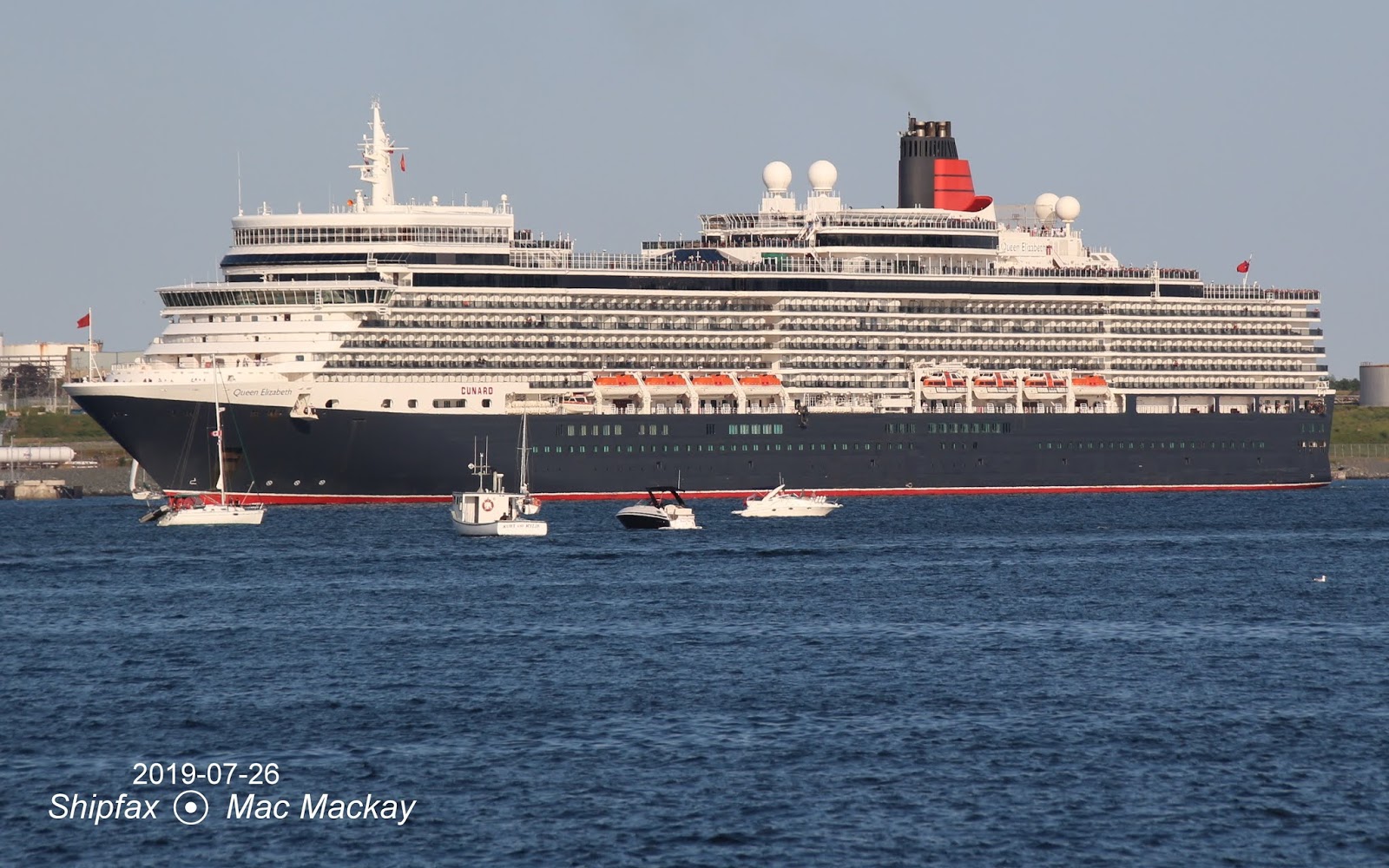
Cunard's Queen Mary 2 and Queen Elizabeth arrived this morning, to tie up at adjacent piers 20 and 22. It is always an impressive sight when Queen Mary 2 arrives and sails, but there will be a special treat this evening when both ships leave port at the same time.


Starting at 6 pm when the ships begin to let go their lines, there will be a complex maneuver as the ships meet north  of George's Island and sail outbound in tandem. It takes some time to get away and move slowly, so the entire operation is expected to take 90 minutes (or more).

Cunard, now part of Carnival, still pays tribute to its founder Samuel Cunard, a Halifax businessman, with special events, awards and now this sail past.

.

Later:

On schedule, Queen Elizabeth got away first, moving south around George's Island, then northbound on the east side.


There were lots of spectator craft in attendance including the harbour mascot Theodore Too.


Meanwhile the tug Spitfire III was assisting Queen Mary 2 to get off pier 20 and head north of George's Island.


Once Queen Mary 2 was well underway, the tug scooted ahead and began a water display as Queen Elizabeth made its turn.


With its turn completed the two ships met at the ferry track and exchanged whistle salutes.


The tug fell in behind Queen Elizabeth and accompanied it outbound west of George's Islands, saluting at several locations en route.


Queen Mary 2 completed it turn and followed. Aside from a small Border Services patrol boat, it was unaccompanied. I thought this was a breach of etiquette. As senior ship, and flagship of the fleet, it deserved better. I guess the cost of two tugs was too much for Cruise Halifax.


Although it is an imposing looking ship, Queen Elizabeth is the smaller of the two. Due to the higher freeboard of the transatlantic liner, Queen Mary 2 has fewer open and exposed decks, and this greater gross tonnage.

Queen Elizabeth 90,901 grt, 294m x 32.3m, 2,092 passengers (lower berths only).
Queeen Mary 2 149,215 grt, 345m x 45m, 2,695 passengers (lower berths only).

Wednesday, July 24, 2019

Ships named Halifax part 4

I have had several occasions to mention ships named Halifax or with Halifax in the name. Now another ship has been added to the list, but unlike the previous ships, this one unlikely to call in its namesake port.

The ship achieved world notice March 6, 2018, when, as Maersk Honan, a fire broke out in the forward section of the ship and soon spread to the accommodation block and bridge located forward of amidships. It was 900 nautical miles off Oman in the Arabian Sea, and a total of five crew members lost their lives.

Firefighting proved to be difficult and it was not until April that the fire was extinguished. Nevertheless there was little damage aft of the superstructure, and the engine and machinery space and a good portion of the 7960 containers aboard were untouched.

A Goggle search reveals many imagesof the fire and its aftermath:
https://www.google.com/search?q=maerk+honan&hl=en&source=lnms&tbm=isch&sa=X&ved=0ahUKEwivsdz34M3jAhXohOAKHbK8ALEQ_AUIESgB&biw=1115&bih=665&dpr=1.25

The ship was towed to Dubai where the forward section including bow and superstructure were broken up. The remainder of the hull was loaded onto a semi-submersible ship and returned to Hyundai Heavy Industries in Ulsan, South Korea where it was joined to a newly built bow, forward holds and superstructure. In a recent ceremony the ship was renamed Maersk Halifax.

It is now reported that the ship will re-enter service August 9 on the joint Maersk / MSC AE11/Jade service between Asia and the Mediterranean.

The original ship was one of nine ships of the "H" class, of 153,153 gt, 162,051 dwt with a nominal 14,000 TEU design capacity. (Actual capacity has been variously reported as 15,226 and 15,282 TEU.) The rebuilt ship has a newer bow design and therefore tonnages may be adjusted. It will still be significantly larger than the largest container ships that call in Halifax, and its better suited to the heavy traffic lanes between the far east and Europe.


For info on some of the ships with Halifax names see:

http://shipfax.blogspot.com/2012/02/halifax-express-first-visit-with-new.html

http://shipfax.blogspot.com/2015/02/ships-named-halifax-msc-halifax.html

http://shipfax.blogspot.com/2015/02/ships-named-halifax-melfi.html

So far to my knowledge no container ship has been named after Halifax from new.

.

Thursday, July 18, 2019

Harbour Round up

Before setting out upon a road trip to Quebec, I did a final look round the harbour today.

At Imperial Oil's number 3 dock the Largo Mariner was at work unloading a cargo of refined product from Antwerp.


This is the second ship recently that was built by the Hyundai Vinashin Shipyard in Ninh Hoa, Vietnam (High Challenge was here on July 14- [qv]). This one dates from 2018 when it was built as Desert Mariner but was renamed on delivery, with a double change of ownership on the same day. This is a reminder (if we needed one) that ships are commodities, much like their cargo, and can be traded or sold for business reasons. Mid Range tankers, such as this one at 20,407 gt, 49,992 dwt are the work horses of the "clean" (i.e. refined) product business and are operating more profitably than other shipping sectors at this time.

Current owners, listed are Meridian 15 Ltd, but interestingly managers are Cargill Ocean Transportation, the shipping arm of the giant grain trading business. With about 570 dry cargo bulk carriers under it control, it also has a small position in tankers. Cargill expects to have some twenty tankers (all chartered) in its fleet by next year.

A familiar ship appeared at National Gypsum today, but in a new guise. Algoma Verity is the new name hastily applied to the former Alice Oldendorff, one of three ships recently acquired by Algoma when Oldendorff Carriers withdrew from the CSL self-unloader pool. Klaveness exited the pool a few years ago, leaving only CSL Americas and Algoma as members.

Algoma Verity alongside National Gypsum with the ship's 65.5 meter long self-unloading boom swung way out over land to give the traveling ship loader room to work.

Algoma does not stand on much ceremony when it takes over a ship, with funnel marks and hull paint to follow - sometimes years later.

The ship was built in 2000 by Shanghai Shipyard as a typical bulk  carrier with four cranes. However when the Asain economic crisis  ment a change of plans and a series of hoppers, and deck mounted conveyors and a long boom were added to permit the ship to unload to a stockpile. The cranes bucket the cargo out of the hold into the hoppers. It then runs along the conveyors to the boom which deposits the material on land.
Self-unloaders with conveyors in the bottom of the hold (gravity fed) are more expensive to build and sacrifice carrying capacity due to the sloping sides to the holds. They make up in speed of unloading to compensate.
This ship at 28,747 gt is able to reach 48,000 dwt, where a similar tunnel type self-unloader might only make 35,000 to 40,000 dwt. It is not a particularly fast unloader. It can only manage about 750 tonnes per hour, whereas the tunnel types can reach 3500 to 5000 tonnes per hour depending on the cargo.

Autocarriers were particularly present in the harbour today with Tombarra at pier 31 unloading Canadian military vehicles and other non-auto RoRo cargo.  At Autoport the first ship in was Olympian Highway in the flashy new K-Line livery.


It was carrying import cargo, and sailed mid-afternoon for Baltimore. Its place was soon taken by Columbian Highway, which I did not see, but suspect was still carrying the old plain gray hull colour. It was not in port long either, and sailed for Emden, Germany, with some export cargo.

There was also activity at pier 42 as the second crib for the pier extension was coseyed into place.


The painfully slow tow from Pier 9C with Sandra Mary pulling full and with its towing line bar taught, and J.F.Whalen pushing took about three hours.


It was then nudged into place with the crane barge Idus Atwell holding it. The crane barge Derrick # 4 was then moved to the outer face to secure it for the night.


Once in final position the crib will be sunk in place, by admitting water through valves in the bottom.

The tender notice for structural fill was advertised in today's paper, with a closing date of August 1. It is the third phase of the project to extend Pier 42 to accommodate two large container ships at the same time.

Extending the pier is only part of the work needed to accommodate 10,000 TEU+ ships. Back-up land to store the boxes will have to double in size also, and that will necessitate filling in the spaces between the current finger piers if the South End Container Terminal is to remain the port's only facility for the large ships.

As I mentioned earlier in the week, traveling during the next month or so will mean sporadic postings here, and some of those will not be from Halifax.

Bandura for cable baskets

The Dutch general cargo ship Bandura arrived this morning and tied up at Pier 9C to be fitted with cable baskets. The prefabricated steel structures will be fitted in the ship's holds to enable it to carry fibreoptic cable.


Once the frames are in place the ship will likely sail to Portsmouth / Newington, NH to load the cable. Halifax is a popular spot for this type of work, with several ships loading the baskets, also known as tanks, in recent years.


Bandura is one of many ships built by the Damen company. Its hull was built by Zaliv in Kerch, Ukraine and delivered to Damen's Bergum yard in the Netherlands for completion. The 5425 gt, 8217 dwt ship is fitted with two 40 tonne capacity cranes.

.