Wednesday, March 30, 2022

Directing traffic - Comings and Goings

 Ships arrive and depart regularly from Halifax harbour, but due to the tight channels and restricted space in some parts of the main harbour careful orchestration is sometimes needed to keep ships safely apart. With all the comings and goings today, March 30, the harbour pilots had to do something that is rarely seen. With two ships wanting to be in the same place at about the same time, one of the ships took an unusual route.

The arriving ship was the MSC Antigua on MSC's Indus 2 route from the mid-east and Indian sub continent. At this time of the year ships coming from that region must be inspected for the larva of a particular invasive species, namely Lymantria dispar asiatica, the LDA moth, formerly known as the Asian gypsy moth. The Canadian Food Inspection Agency (CFIA) conducts the inspection while the ship is at anchor and before it berths. [The word "gypsy" was considered to be demeaning and was eliminated.]


Due to its size, MSC Antigua was directed to anchorage number one, which is usually reserved for large ships and for short duration stays. It is also immediately off the PSA terminal, the ultimate destination of the ship once it has been cleared by the CFIA, and the berth is clear tomorrow morning. (PSA Halifax was all out today handling MSC Tamara and Tropic Hope).

MSC Antigua was built in 2013 by Hyundai Samho, and is registred at 94,453 gt, 112,516 dwt with a capacity of 8900 TEUs including 1,000 reefer plugs.

While the MSC Antigua was arriving the autocarrier Lake Wanaka was getting underway from Autoport. Its usual route would take it directly through number one anchoraage. To avoid any risk of close quarters, the ship continued from Eastern Passage east of George's Island, then turning north of the island passed outbound to the west of George's.

It is unusual to see an autocarrier in this part of the harbour, passing the George's Island jetty, with its gangways stowed for the winter.
 
It is also rare to get a close up view of an autocarrier from the Halifax side of the harbour.

Built in 2008 by Xiamen Shipbuilding Industry Co in Xiamen,as the Triumph, it was renamed (for a New Zealand lake) in 2019. The 46,800 gt, 12,272 dwt ship has a capacity for 4,902 autos, making it one of the smaller "car boats" and not a regular. Its last ports were in Spain, Morocco and Germany and its next port is given as Veracruz, Mexico, also not a usual destination.

As the ship passed Pier 20, MSC Antigua was just coming to anchor. It is worth noting that both ships have been retrofitted with exhaust gas scrubbers, contained in huge boxes, much large than a normal funnel.

 MSC Antigua's scrubber is located on the starboard side of the bridge, whereas the original funnel is located on the traditional midship line.

Later in the afternoon it was clear going for two other departures. SD Victoria, the Royal Navy support ship, has been in port since February 10. It destination was given as its home port of Portsmouth, UK. See previous post: February 10

The last departure that I observed was that of the Ruby Confidence. It arrived from Baltimore March 25, and loaded wood pellets at Pier 28 [ see previous post March 26]. It departed for Sudstrup, Denmark, the location of a large power plant fueled by biomass.

The stanchions to secure deck cargoes of timber are easier to see in this photo.
.


Is it a boat; Is it a ship; or maybe neither ?

 An article in the April-May 2022 issue of the excellent magazine Canada's History contained an error that reminded me how "unmaritime" Canada has become - not only that, but how "untechnical" many educated people may be. Most Canadians live close to navigable waters, but are woefully uninformed about ships and shipping.  Similarly, despite relying on technology for much of our lives' activities, we have little detailed knowledge of how things actually work.

The magazine piece entitled "Winging It" (page 15) describes a voyage by the American naturalist John Ripley Forbes in 1937 and his subsequent illustrated article published in the magazine The Beaver in June 1942. (The Beaver was the house magazine of the Hudson's Bay Company, and the direct antecedent of Canada's History - now independently operated by Canada's History Foundation.)

Forbes made the trip with Captain Donald B. MacMillan, an American explorer / adventurer of note (it was his sixteenth arctic expedition) voyaging along the Labrador coast as far north as the Arctic Circle and Cumberland Sound. Forbes saw and photographed many species of seabirds but was particularly enamoured of the puffins.

However here was the error: the article writer states that Forbes made the voyage on MacMillan's "steamship the Gertrude L. Thebaud." This is wrong on so many levels that I must shift into my pedantic rant mode.

Firstly the Gertrude L. Thebaud was most assuredly not a steamship or a steam ship either. It was purposely built in 1930 to rival Canada's Bluenose in the international fishing schooner races (it beat the Bluenose two races to none in 1930 and lost to the Bluenose two races to none in 1931 and lost in three races to two in 1938). It was built as a fishing and racing schooner, and after the orginal Bluenose, was arguably the second most famous Grand Banks fishing schooner of all time. The power of the internet would have revealed this to anyone within five seconds of typing its name. I refer you to Wikipedia's brief history at Gertrude L. Thebaud. Mention is made there of the fact that the Bluenose was fitted with a diesel engine by 1936, which put an end to the hopes of Fishermen's Cup races for 1937, because the owners could not afford to have it removed for racing. With that, the Thebaud was leased to MacMillan for his 1937 expedition. The Wikipedia piece does not mention that the Thebaud raced again in 1938 and was again defeated by the Bluenose. Presumably the engines were not used or were removed for those last races!

Despite the number One on the sail, this may not be the orginal Bluenose, but one of its US rivals, possibly the Elsie, sailing off Maugher's Beach in Halifax, likely in the 1921 Halifax Herald Fisherman's trophy race. (from a McAskill print in a private collection.)
 

For the record, the Gertrude L. Thebaud served the US Coast Guard in World War II then became a cargo vessel. It was wrecked in Venezuela in 1948. The Bluenose met a similar fate in 1946 in Haiti.(All this informaiton is available on line with a little hunting.)

Details of the 1937 MacMillan voyage take a bit more digging. A University of Maine alumnus' account of a near fatal grounding in Frobisher Bay (complete with photo) states that the Thebaud's motor launch was used to tow it out of shallow water after it had run aground. See Walter Staples '38 remembers .

Read more about MacMillan here: MacMillan. MacMillan chartered the Thebaud in 1937 instead of his own well known, but much smaller, schooner Bowdoin (which still exists) because he needed a larger vessel to carry the thirty-seven persons of that year's expedition, instead of the fourteen he usually carried on the Bowdoin. Even though the Thebaud was not ice strengthened, there was no plan to sail into ice infested areas. I learned this from the book Green Seas and White Ice (New York, Dodd Mead and Company, book club edition, 1948) by Miriam MacMillan, Capt. MacMillan's wife. (The book is in my collection.)

In her book Mrs. MacMillan describes the 1937 grounding (although she was not present). Several planks were sprung, the Thebaud healed over on its side, the hull was flooded and "the main engine was soaked with salt water" [page 67]. MacMillan supervised the righting and repair of the vessel in one of the more dramatic incidents of a lengthy career in the north.

Now to the technical. Diesel engines and steam engines are vastly different species of marine propulsion. Perhaps the distinction is too fine a one for non-technical persons, but there is a world of difference. Nowadays there are a few extant steam ships as there are only a few steam railroad locomotives and steam road rollers. They are so few and far between, that many people have never even seen one (unlike yours truly). Nevertheless I take exception to using the term steamship (or steam ship or steamroller) generically. One on line dictionary says a "steamship" is "a large commercial vessel, especially one  driven by steam".  I  regret this as sloppy usage (which unfortunately has become common.) Nevertheless the Gertrude L. Thebaud would not qualify for even this nomencalture in my opinion, since it was not "large" and not a "commercial vessel" in the usual sense. It was a fishing and racing schooner, rigged for sail, but also fitted with a diesel engine.

(Granted Canada Steamship Lines has used the term since 1913 but that is as much a matter of history rather than a technical fact, since there are no steamships in its fleet anymore. There are large commercial vessels however.) 

The Thebaud was fitted with its own means of propulsion (in addition to sails) when it was built. In the usage of the day the diesel engine was described as a "180 horsepower auxiliary oil engine". It most certainly was not a steam system, as the boilers and engines would have taken up most of the available hull space, leaving no room for the crew or passengers. Diesel motors were much more compact and had proven reliable (short of complete immersion.) My source for the description of the motor comes from Fast and Able - Life stories of Great Gloucester Fishing Vessels, by Gordon W. Thomas and published by Historic Ships Associates, Gloucester, MA, 1968 (also in my collection.)

Back to the maritime: The Gertrude L. Thebuad was not a ship at all (especially not a large commercial vessel) - neither was it a boat. It was a schooner. Sailing vessels are properly described by their rig (sloop, cutter, ketch, yawl, brig, barque - you name it.) A "ship" is a particular configuration of sailing rig (square sails on all masts and a jigger) and the term "ship" when referring to a sailing vessel, must be used only for one with a ship rig.  If a non-specific term is needed to describe it, there are several available words such as "vessel", "craft", etc., In the 1937 MacMillan expedition the Thebaud likely made some of the long passages under sail but used the diesel engine as the primary means of propulsion. Since there was no means of refueling in the north, and tank space was limited, they needed to use the sails when possible. (The last port for refueling and taking on fresh stores was Sydney, Nova Scotia, where the Thebaud stopped off on the way north in June 1937.)

Even when motorized, the Bluenose and Thebaud would still be called schooners by nautical folk, but could also be called "motor schooners". To call them "motorships" would not be correct, in my opinion - they were "motor vessels". Some motorized versions of sailing craft used the engines as "auxiliaries", that is, as a secondary means of propulsion to supplement sail. Others abandonned sail altogether and installed larger engines as the sole means of propulsion. In 1937 the Bluenose and Thebaud had not disposed of their sails entirely. Only the top masts were brought down and stored until  the next races. [Halifax Herald October 19, 1937.]

A few terms have, perhaps unfortunately, continued in use even though the original meaning has been lost (steamship is certainly one). All manner of seagoing craft are now called ships (and they aren't sailing ships) but are still described as "sailing" or "steaming" when they are doing neither, but we generally understand what that means. I confess to using these last two terms indiscriminately to describe vessels underway. However I do have to put my foot down with "steamship" in this case where it was not a "steamer" and was not a "ship".

So in conclusion all this leads to the reality that it is so easy to spread misinformation or gloss over inaccuracies if there is not a culture of widely knowledgeable editors and fact checkers. Errors that creep into print are there for ever, thanks to the internet, and can never be altered despite later published corrections. They continue to be relied upon as fact in subsequent publications, until the source of the error is lost for all time.

A side example are the many references to Robert Peary's claim that he reached the North Pole which has now been discredited, but stood as "fact" in many references, including Mrs.MacMillan's book. MacMillan was with Peary for a time on that incredible trip in 1909, but had to turn back due to frostbite. "Don't believe everything you read" must still be good advice. (Except the foregoing which you may read as 100% fact and may quote without citation or credit. On a conciliatory note, I do acknowlege that the my foregoing rant may be a case of using a shot gun as a flyswatter.)

We look forward to seeing the "recreated" Bluenose II in Halifax this summer, 101 years after the launch of its namesake, and a reminder that similar schooners once ranged far and wide off our shores. Including the Gertrude L. Thebaud they were anything but "steamships."


.

Monday, March 28, 2022

Hyundai Force - surprise caller

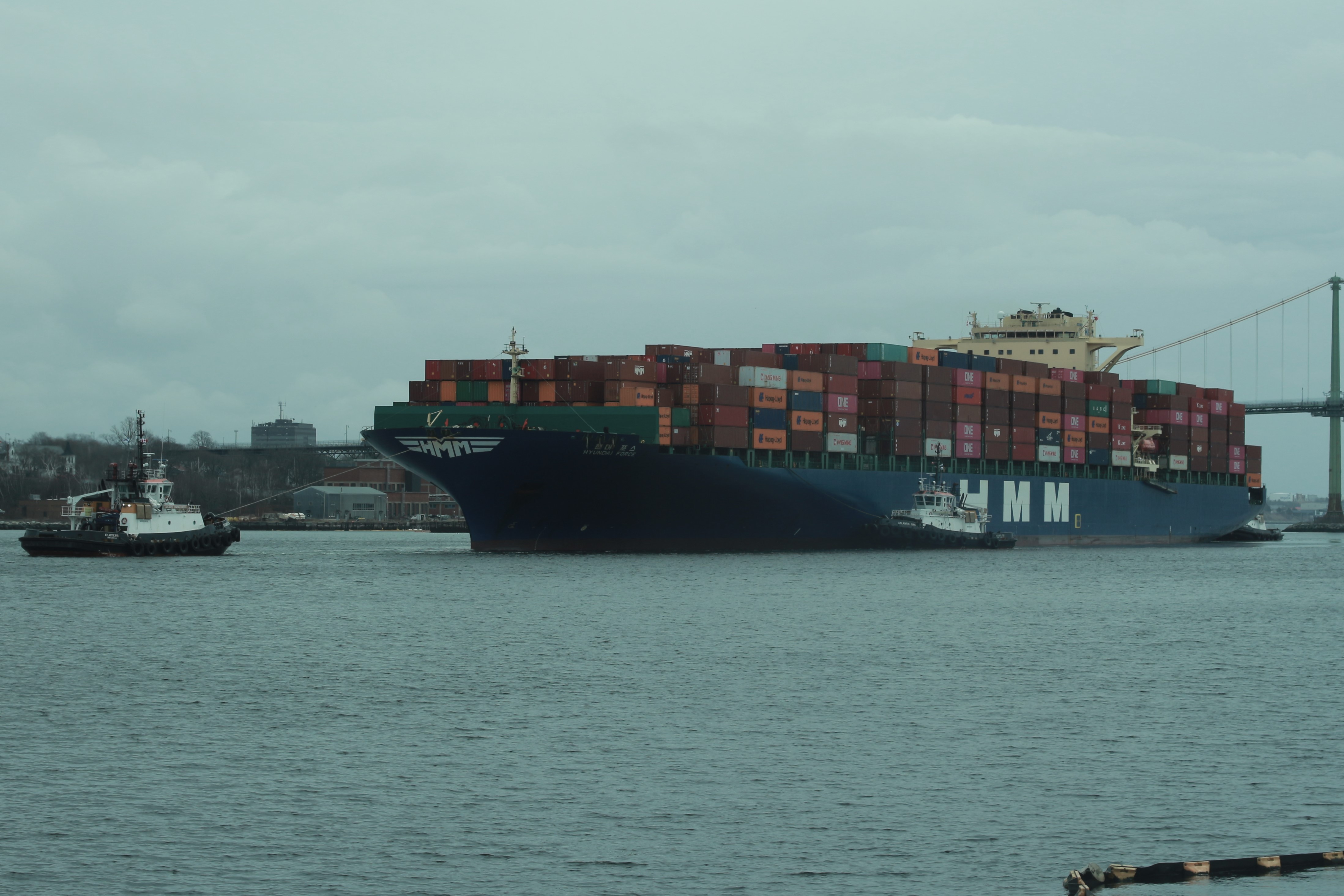
 The container ship Hyundai Force arrived today, March 28, with some sort of technical problem and tied up at Pier 9C. 

Although the ship is on THE Alliance's EC5 service (Asia-east coast North America) it was not scheduled to stop in Halifax on this westbound leg en route from Colombo to Savannah. Instead it was redirected here and was met by four tugs - one on a bow line, one on each side and one astern. There were also two pilots assigned to the arrival.

Built in 2008 by Hyundai Samho, the 95,681 gt, 99,043 dwt ship has a container capacity of 8562 TEU.  It carried the name CMA CGM Force for a brief time between 2008 and 2009, but reverted back to its orginal name, which it still carries.

On March 21, when just south of the Azores, the ship reported to be "Not Under Command" -  meaning that its  engine was not working, and the ship was drifting. No cause was given for that condition (it could be due to fire, software glitch, main engine breakdown or even crew mutiny or illness.) When it got underway again after about 12 hours, it was making just over 10 knots, instead of the usual 15 or more. 

The ship berthed at Pier 9C where there are no facilities to load or unload containers, so it is likely that it came alongside for repairs that require its main engine to be shut down, and/or that need shore support.

.


Sunday, March 27, 2022

Nukumi arrives

 Canada Steamship Line's newest ship, the Nukumi, arrived today, March 27, on its delivery trip from the Chengxi Shipyard in Jiangyin, China via the Pacific Ocean and Panama Canal.

Built especially to carry salt, the ship will operate from the Mines Seleine mine in the Magdalen Islands to ports around eastern Canada and into the Great Lakes. Salt is a notoriously hard cargo on ships, and this one has been purpose built, in cooperation with Windsor Salt, to withstand the rigors of that trade.

The ship has established many firsts, such as the first diesel electric powered "laker", and the first single point loader/ selfunloader. Measuring 22,715 gt, 25,800 dwt. The ship was temporarily registered in the Bahamas for the delivery trip, but will be re-flagged Canadian and registered in Halifax before entering service.

CSL has done a fine job in publicizing the ship, and providing additional detail; see: Nukumi

The ship is named Nukumi, pronounced "noo-goo-mee", for the legendary wise old grandmother figure of the Native American Mi’kmaq people, traditional occupants of the unceded lands of eastern Canada.

.

MSC Lucy and Manon

 MSC Lucy

"Going away" photos, especially backlit ones, are not the most desirable for those aficionados of ship photography, but when that is all you can get you take them anyway. Such was the case today ( March 27) with MSC Lucy. It had frustrated me on its visit in January when it arrived and departed in the dark when no photo was possible.

On that January call the ship had spent some days hove to in the Gulf of Maine waiting for the storms to pass before entering Halifax harbour. 

When MSC began calling Halifax with its Indus 2 service from northwest India via the Mediterranean to east coast North America in October 2021, there were eight ships in the rotation, but most of the first eight did not call again. MSC Lucy was the thirteenth ship when it made its first call in Halifax in January. 

With the pilot boat Capt. E.T.Rogers close alongside MSC Lucy has just cleared Pier 42 at PSA Halifax and is about to swing into the western (deep water) channel.

MSC Lucy is a 2005 product of Hanjin Heavy Industry and Construction Co Ltd in Busan, South Korea. It is a 89,954 gt, 104,954 deadweight ship with a capacity of 8089 TEU including 550 reefers. Its next port of call is to be Norfolk. The Indus 2 will be forsaking Norfolk next month and calling on Boston instead - this may be another opportunity for short sea traffic from Halifax.

Manon

Women's names have long been popular for ships (see MSC above.) The other departure today, Wallenius Wilhelmsen's Manon, is named for an opera character, the theme for all Wallenius ship names. Wallenius had either Puccini's Italian language opera Manon Lescaut or Massenet's French language opera Manon to choose from - both based on the same French novel.

I have seen this ship many times, particularly in its original Wallenius green and white paint scheme, but had not been able to get a clear shot of the ship underway since it was repainted in the combined fleet colours last year. (See an alongside photo at Autoport, exactly one year ago: March 27, 2021)

Built in 1999 by Daewoo Heavy Industry in Okpo, South Korea, the ship was orginally rated at 57,018 gt, 14,863 dwt. It was lengthened from 199.2 to 227.9 meters in 2005, thus increasing its tonnages to 67,264 gt, 28,360 dwt. Its capacity is now 7,194 RT43 Car Equivalent Units. It has a 125 tonne capacity stern ramp.

The pilot boat doesn't look quite so small in comparison to the ship from this angle.


.

Saturday, March 26, 2022

More regulars and some firsts

 As predicted in Shipfax March 17 the Panama flag cargo ship Franbo Lohas (ex Thorco Lohas) sailed for Portsmouth, New Hampshire on completion of work to fit the hold with fibreoptic cable storage racks.

With the assistance of the tugs Atlantic Fir (forward) and Atlantic Oak (aft) the ship turned in the Narrows directly off its berth at Pier 9C South this morning (March 26), and was soon outbound for sea.

 The steel cable racks take up space in the ship's hold but don't add much weight, so the ship is still at very light draft. Even when it loads the cable from the factory in Portsmouth, it will not be at full carrying capacity.

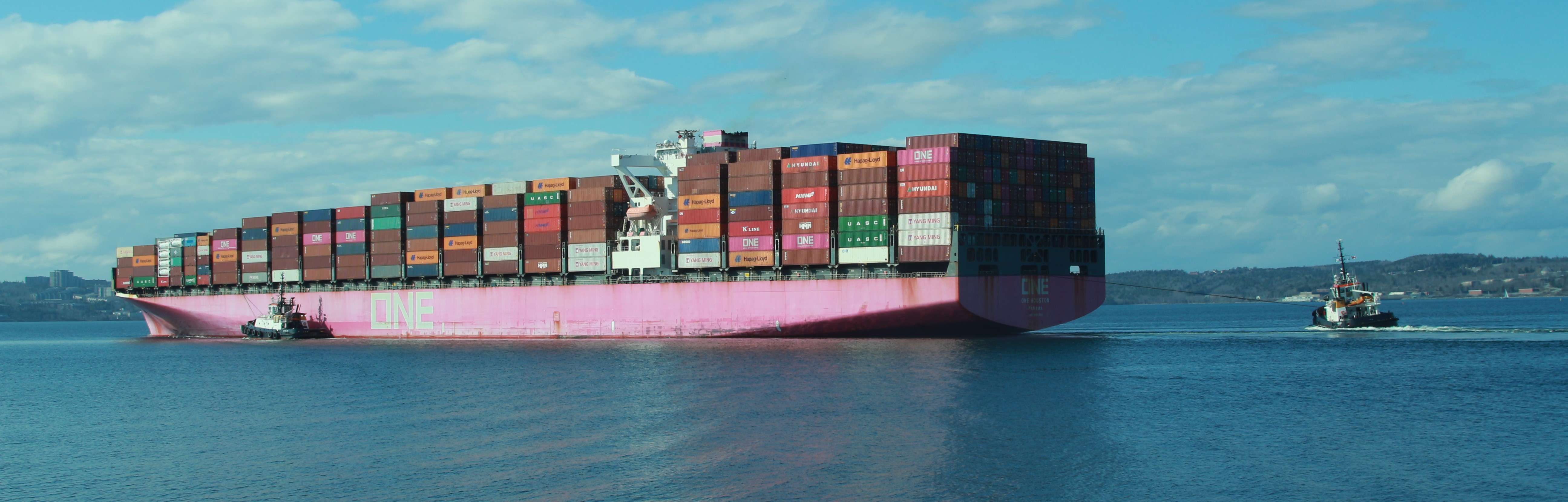
A ship that did appear to be at capacity - at least by volume of cargo - was this afernoon's arrival of ONE Houston on THE Alliance's EC5 service.

Built in 2012 by IHI, Kure as Houston Bridge for K-Line, the ship was renamed in 2019 when the major Japanese container lines merged into Ocean Network Express (ONE). Its 96,801 gt, 96,980 dwt give it a capacity of 8930 TEU. If it was not loaded to that capacity today, it must be very close. 

With the tug Atlantic Oak on the port side, Atlantic Fir to starboard and Atlantic Beaver tethered escort astern, the ship made a smooth passage through the Narrows to Bedford Basin and berthed at Fairview Cove.

The trademark magenta paint colour selected by ONE is showing signs of fading. The line will have to solve the durability issue or the ships will soon begin to look fairly scruffy.

Speaking of paint issues, I noted on its first arrival for Eimskip under its new name, that the ship Vivienne Sheri D did not yet have its name painted on the bow. (See Shipfax September 13, 2021) That was soon corrected, but the ship likely put to sea before the paint was fully cured, and it has since partly washed off. Not surprising as the ship maintains a tough schedule from Iceland.

As per the previous post the ship is now owned by the Doornekamp Shipping Ltd  from Odessa, ON, and Picton, ON. Doornekamp acquired the ship while it was still under charter to Eimskip, and the plan is to work out that charter before being assigned to Doornekamp's transatlantic line in cooperation with Spliethoff's. Doornekamp's other ship, the Peyton Lynn C is due in Cleveland, OH from Europe April 1 on that service.

Another first time caller arrived yesterday March 25 in the thick fog and tied up at Pier 28. Despite near impossible photo conditions at that pier, I did manage to poke my spycam through the fence for this:

Ruby Confidence is a 23,885 gt, 38,013 dwt bulk carrier built in 2016 by Minami nippon in Ozai, Japan. It was originally named Supreme Star and was renamed Sider Syros in 2020 and took its present name in 2021. It carries four 30 tonne cranes and three 24 tonne / 12 cubic meter grabs. It also has stanchions for timber deck loads.

The ship's last ports were Baltimore (March 8-22) and Riga, Latvia (February 3-14.)

.


Friday, March 25, 2022

The Regulars

 Shipfax usually makes note of new or different ships coming and going to Halifax, and tends to ignore the day to day regulars unless something unusual happens. To correct that imbalance, here are a few of the regulars, just going about their normal business:

Tropical Shipping

On Monday, March 21 the Tropical Lissette sailed on its regular run to the Caribbean for Tropical Shipping.

Tropical Shipping is one of the more visible shipping lines calling at PSA Halifax, thanks to its white reefer containers with large lettering. Tropic Lissette (new in 2019) is one of two ships, with sister Tropic Hope (new in 2018) serving the line with weekly calls in Halifax. The purpose built 15,215g, 20,313 dwt ships have a capacity of 1100 TEU with 200 reefer plugs.

Since 2014, Tropical Shipping has been part of the Saltchuck Family of companies which includes interests in logistics, air cargo, tugs (Foss, Cook Inlet, Young Bros), oil and the domestic US shipping company TOTE Services. The line moved its operations to Halifax from Saint John, NB in 2017.

Nirint Shipping BV

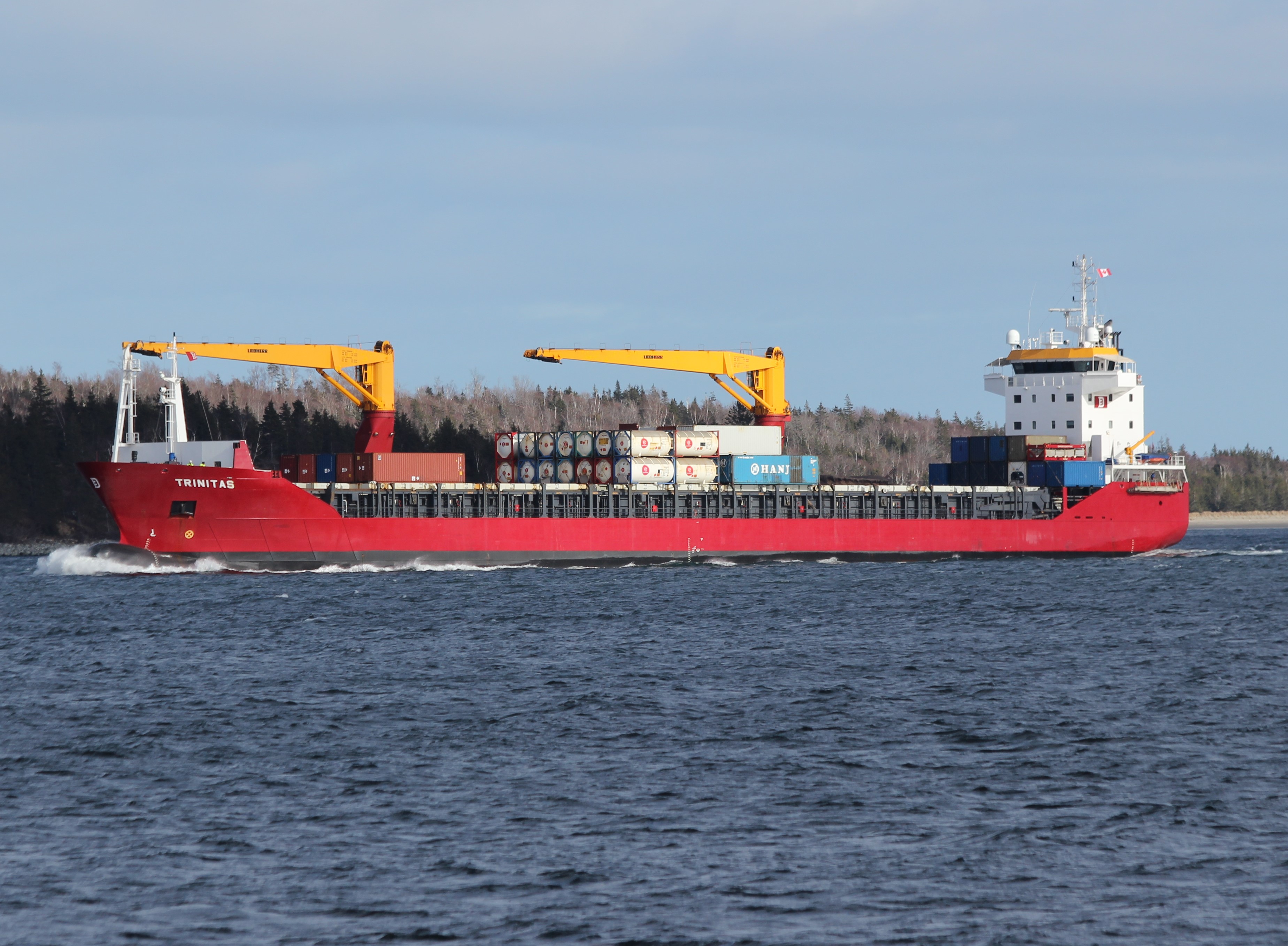
On Wednesday, March 23 the Trinitas arrived for Nirint Shipping BV, with a cargo of nickel sulfides and containers from Cuba.


Built as Trinitas in 2007, with the hull by Damen Okean, Mykolayiv and completed by Damen Hoogezand, Foxhol, the ship was delivered as Nirint Hollandia. It was renamed Hollandia in 2012, but remained on Nirint service. It started to call in Halifax in 2014 and was renamed Trinitas in 2019.

It is a 8,999 gt, 12,016 dwt vessel with a container capacity of 684 TEU, including 80 reefer plugs on deck. It uses a pair of 80 tonne SWL cranes to handle cargo, which in the case of the nickel concentrates is in bulk bags. It has movable tween decks and ventilated box shaped holds, so is an adaptable multi-purpose vessel capable of carrying bulk and general cargoes. Uusally it also has a number of tank containers on deck - which are rumoured to carry rum, molasses or sucrose.
 
Atlantic Container Line

Among the most regular of callers in Halifax are the five giant CONROs (the world's largest) of Atlantic Container Lines. In addition to the visible deck loads of containers, the ships also carry substantial quantities of RoRo, including new and used cars and trucks, machinery, and oversize loads.
 
Atlantic Sun arrived Thursday, March 24 on its regular run from Hamburg / Antwerp / Liverpool.
 
Delivered in 2017 by Hudong-Zhonghua, Shanghai, the ships have an immense gross tonnage of 100,430 gt and 55,547 dwt. ACL (owned by the Grimaldi Group) has been calling in Halifax since the late 1960s and had the ships built to clear the Halifax bridges to make their berth at Fairview Cove. They are the largest ships (by volume) to transit the Narrows of Halifax harbour. They have a capacity of 3800 TEU and 1300 plus autos in about 18,500 square meters of RoRo space.

Canada Steamship Lines
 
As an update to previous posts, I can report that Baie St.Paul sailed yesterday, March 24, for Hamilton, ON with a cargo of Gold Bond gypsum. (Compare the ship's draft in this picture to previous posts.)
 
 
After a brief "winter layup" (since Febraury 15) the ship returned to service as the St.Lawrence Seaway opened for the season. CSL ships, both domestic and international (through the CSL Americas pool), are regular gypsum haulers, but also deliver the occasional grain cargoes from the Lakehead during the Seaway season.  CSL will also be taking delivery of a new ship in the coming days - stay tuned.
 
.