Wednesday, April 6, 2022

Imperial Oil from Antwerp

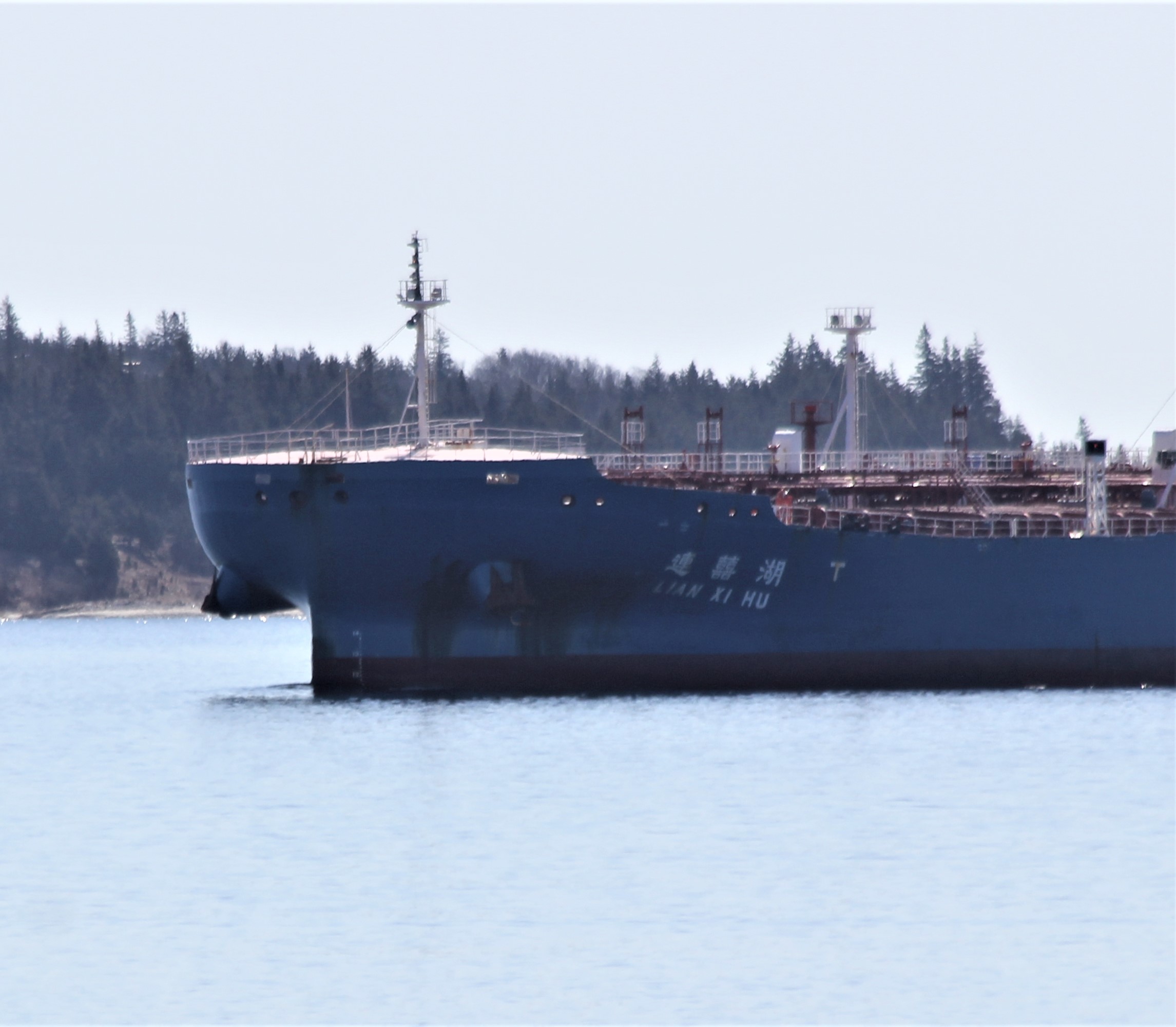
 After several loads of product from Canadian sources in recent weeks, Imperial Oil again received a cargo from Antwerp arriving April 6. The Belgian port has been the source for most of Imperial's seaborne cargo for the past few years, and the switch to Canadian refined product was thought to be a result of disruptions to European supply from Russia.

An odd aspect of the latest delivery was the ship carrying the fuel. Lian Xi Hu is a Hong Kong flagged ship owned by Cosco Shipping Energy Transportation. (COSCO is the China Ocean Shipping Company Ltd, the 1114 ship strong company has 120 tankers as well as container and other ships.)

As far as I can recall this is the first time a COSCO tanker has appeared in Halifax. The 29,848 gt, 49,999 dwt MR tanker was built by Guangzhou International in 2017. Unusual for a tanker, its foredeck is covered - a feature more commonly seen on cargo ships, to shelter winches (and crew) from weather or sea conditions, and to protect the main deck. It also has a significant bow flare, suggesting the ship was built to withstand very tough conditions.

.


Nukumi reflagged

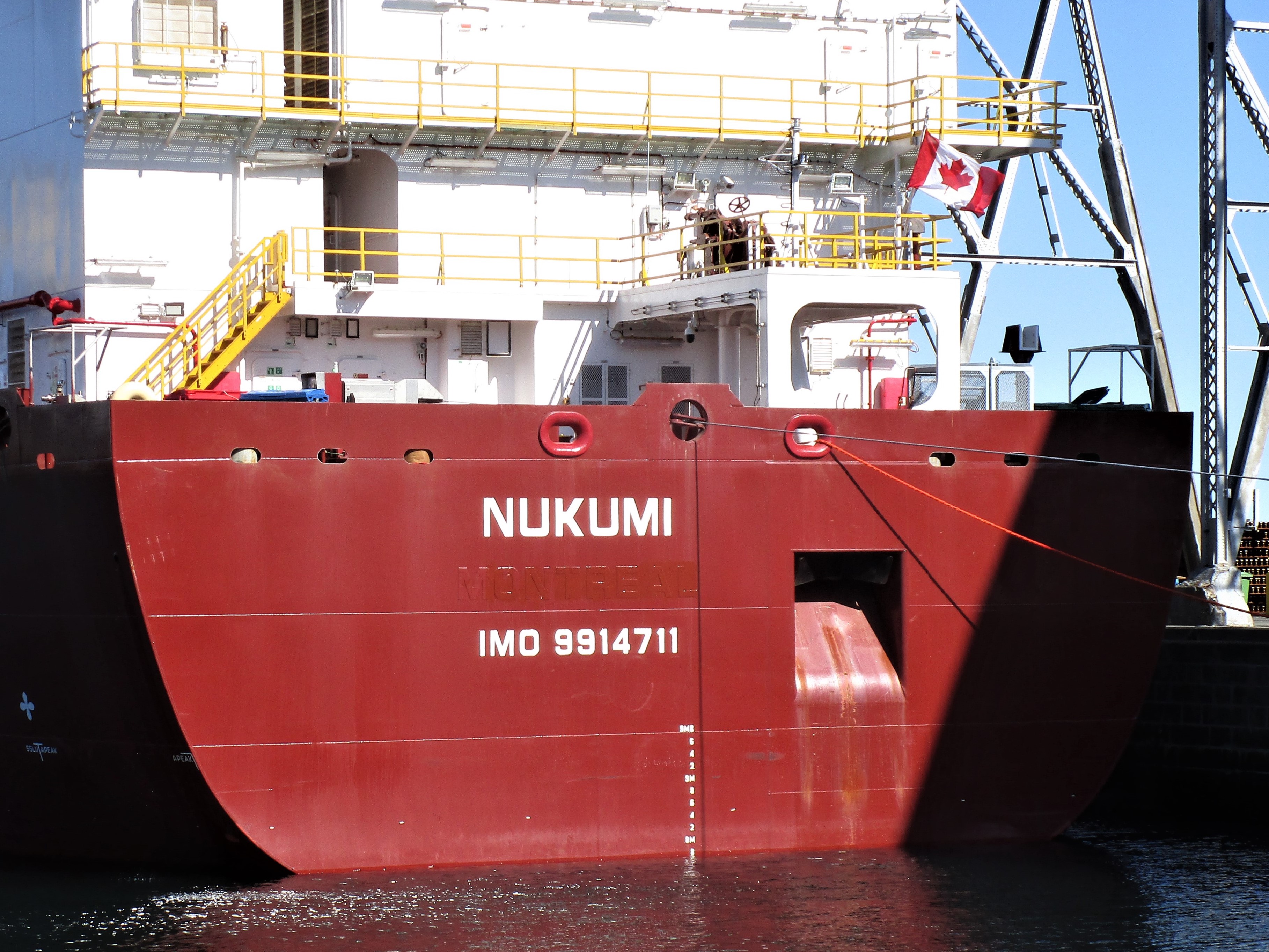
 The new bulk salt carrier Nukumi delivered to Canada March 27 arrived under the temporary flag of the Bahamas, registered in Nassau. 

The Bahamas flag is barely visible in this photo, but the port of Nassau is clear as is the Canadian flag flying in the courtesy position along with the pilot flag and the yellow "free pratique" flag.

It did not take long for CSL to enroll the ship under the Canadian flag, and it was registered in Montreal the next day, March 28.

With the "Canadianization" process under way, the permanent crew did not have a lot of time for repainting the port of registry on the stern, not to mention the rainy and even snowy weather of the past few days. Conditions improved yesterday, and "Nassau" was painted out, revealing the large welded letters for "Montreal" which had been applied at the shipyard. (The Canadian flag had been flying since the 28th.)


 Today the white paint appeared, and the ship looks complete.

The ship is also flying the CSL houseflag, although it is difficult to see.

Of note is the stern anchor. At one time all ships travelling in the St.Lawerence Seaway system were required to have a stern anchor. It is no longer required of foreign ships, but Canadian ships have one. They also have what are commonly called "Port Colborne fairleads" in specific locations. These are rotating rollers in the fairlead, such as the one amidships in the stern rail. They allow wire lines to be adjusted in the Seaway locks with minimal chafe. 

No sailing date has been posted yet for the ship, but it will be entering service soon.

.


Tuesday, April 5, 2022

New for 9C

 As PSA Halifax expands the back up area for the Southend container terminal (alias Halterm) A.K.A.  Atlantic Hub, work has begun to clear Pier A-1. That work will include demolition of the transit shed, and filling in the camber between Piers A-1 and B (eliminating berths 33 to 37. It has also meant the relocation of cargo operations at  Piers 30 - 31 to Pier 9C, in the Richmond * Terminals area between the bridges.

 The Pier 30-31 open area on Pier A-1, including the transit shed ,were leased to the stevedoring company Logistec, but that lease was not renewed and for the past week or so trucks have been shuttling Logistec's gear, including yard trucks, container trailers, Mafei trailers, lifting spreaders, etc., to the new location. Logistec handles the nickel sulfides cargo from Cuba on Nirint ships, which is stored indoors, then forwarded by rail to Alberta for processing. They also offload "high and heavy" and other non-automobile RoRo cargoes that do not go through Autoport.

Today saw the arrival of the first ship to Pier 9C for Logistec. It was the Wallenius Wilhelmsen autocarrier Thalatta.

Tugs met the ship at the Middle Ground as usual, but rather than turning into Eastern Passage for Autoport, they headed through the lower harbour and the Narrows, all the way to Bedford Basin.

 Once clear of the A. Murray MacKay bridge the ship went well north up into the Basin and turned, 

and redirected southward toward the Narrows again.

then alongside Pier 9C, in the shadow of the MacKay bridge,

where heavy load rail cars, and buffer cars, were waiting for some large cargo.

The ship's stern ramp is angled to starboard so the ship must tie up starboard side to the pier in order to unload. When it has completed work at Pier 9C it will move to Autoport to unload standard automobiles and light trucks. (Autoport is owned by CN Rail and receives imported autos, preps them, stores them and sends them out on demand by rail. It also has export facilities.)

Built in 2015 by Hyundai Samho, the 75,283 gt, 23,786 dwt Thalatta has a capacity of 8,000 cars and can handle the high and heavy cargo using its 320 tonne capacity ramp. Unlike earlier autocarriers, this one does not have a side ramp. However it does have gangway recesses on both sides (the port side also has the pilot door)  and a lifeboat recess on the port side. A small pilot door is located near the waterline on the starboard side.

There is also a second starboard side gangway near the stern that stows vertically in its own recess. (Pedestrian traffic on the stern ramp when vehicles are moving is very dangerous, so the gangway may be a safety feature - but apparently not here.)

Among the cargo offloading at Pier 9C are these JCB backhoes, that are too large for standard autorack rail cars. They will likely be dispatched out of Halifax by truck or by rail flat car. It will be interesting to see the large object destined for the big well car - likely an electrical transformer.

Sometimes cargo is moved off the ship onto the pier to make way for the oversize cargo, then reloaded. That may be the case for the JCBs which I have never seen being unloaded here before.

---------------------------

It is worth noting that the Port has kept the Richmond designation for the area of Pier 9 to Pier 9C. It was the Richmond neighbourhood that was almost completely destroyed in the 1917 Halifax Explosion and most of the 1,782 (confirmed) dead were residents of the area as were many of the 9,000 injured. The epicentre of the explosion was at Pier 6, which is between the current Richmond Terminal and Halifax Shipyard.

 .


Monday, April 4, 2022

Remember When

 It was March 27, 1987 when ice began to "invade" Halifax harbour. After blocking the entrance to the port for several day, chunks of ice started to work their way inside. 


 The RCN's reserve training trawler / gate vessel Porte St. Jean was not bothered by a few "ice cubes".

At first a few interant chunks did not cause much concern, and ships were able to go about their business as usual. However the ice continued to build and  by April 1 was packed in solid.

Priding itself as "ice-free", Halifax had some 'splainin' to do, and it was this: The ice did not originate in Halifax, but came from the Gulf of St.Lawrence and had blown and drifted out into the ocean. Currents and onshore wind then moved it down along the coast and into Halifax. The ice was heavily broken up but well compacted, and continued to build in. 


Although it does not need breaking, drift-ice is difficult to navigate through because of pressure. Wind "grabs" the rough surface and moves the ice, and packs it when it hits an obstacle such as the shore or a ship. Tidal forces only exacerbate the effect. If ships are at light draft, the ice can damage propellors.

The sight of drift ice in Halifax is very rare - this was the first time since 1960 - as was the sight of the CCGS William (ex Sir William Alexander (i))  going out to lift harbour buoys so that they would not be carried away.


(The new Sir William Alexander was removed from service due to a defective derrick system, and its predecessor of the same name was re-commissioned from layup. It was built by Halifax Shipyards in 1959 and was one of the finest ships in the fleet. It was renamed William when it was laid up pending sale. It was less tan 30 years old and still in good condition.)

 CCGS Louis S. St-Laurent was also called in to work in its home port for the first time, to clear tracks for ships.

Several regular callers were able to make their way surprisingly well, even though they rarely if ever had to navigate in ice.

Atlantic Cartier even made its way west of George's Island outbound past the iconic lighthouse.

Ships tied up in port were jammed in  by ice in the cambers between piers. In places the ice rafted up to 2 meters deep.

Common Venture was at Pier 28 for a cargo of grain.

Ships tied up at sea walls were at risk of being forced off the dock by ice working in between ship and pier. The force of the wind and tide-driven ice was strong enough to part lines. Tugs were called to flush the ice away, and ships were constantly adjusting their lines.

The tug Point Vigour stood by astern of the USSR ship Elton at Pier 21 for more than 24 hours, flushing ice away from the seawall and the ship's propellor. A crew man stood by on shore, with his signature fur hat on, to tend to the ship's lines and gangway if needed. The Elton was in port to load flour for Cuba and was very lightly ballasted, with some prop blades exposed.

A number of fishing vessels were caught in port too - some were small wooden inshore boats, but others were large foreign vessels. Their captains did not want to sail through 10 kilometers or more of ice to reach clear water offshore.

 The East German factory trawler Ludwig Renn, out of Rostock, tied up at Pier 30-31 for the duration.

The pilot boat was too fragile to operate in ice and so the tugs Point Valiant and Point Carroll were deputised. Sometimes they could not work themselves in alongside ships, so pilots actually walked across the ice to embark. The ice was at its heaviest April 1 and 2.

By April 3 most of the ice had moved back out to sea thanks to a wind shift, but remnants remained for some time. Shipping returned to normal.

 Wallenius Line's weird autocarrier Aida, converted in 1980 from a bulk carrier, made its way through some small patches of ice to reach Autoport April 4. The ship was scrapped in December of 1987.

 Harbour ferry service, which was cancelled, did not resume until April 6. At least one daring soul had in the meantime walked (or clampered) across the harbour on the ice.

.


Saturday, April 2, 2022

The usual suspects

There were several arrivals, departures and moves today, April 2. All but one of which were familiar ships going about their usual business.

The only unusual move was Irving Oil's tanker Acadian moving from Irving's Woodside terminal to Esso dock 3. Imperial Oil (Esso) has recently shifted supply from their usual European source in Antwerp and has been acquiring stock from competitor Valero in Quebec (see previous post and tanker Algoterra.) They are also "importing" by rail from their own refinery in central Canada.

Irving Oil's refinery in Saint John, NB is the largest in Canada (350,000 bbls per day or more), so apparently it can produce enough fuel to supply its own needs and those of others. Although not unheard of in recent years, Irving and Esso only rarely swap product.

The relatively rare sight of an Irving tanker at Imperial Oil.

The usual Saturday arrival of a ship on the Maersk / CMA CGM transatlantic service to Montreal and Halifax was Maersk Penang.

Due to winter conditions, some Halifax calls on this service have been bypassed in recent months, with ships returning from Montreal directly to Bremerhaven. Now that conditions are better and ice is retreating in the Gulf, the ships should be able to keep their regular weekly schedule.
 
Trade to Cuba has dimished in the past few years as the country has retreated into greater poverty. One of the two shipping lines running between Europe and Cuba is Melfi Marine Corp. The company reduced its sailings through Halifax from every 12 days to once a month in May 2021, using only one ship.  That ship is X-press Irazu which arrived today and anchored. (Melfi ships often arrive on the wekend and wait until Monday to load/unload.)

The ship dates from 2007 when it was built by Guangzhou Wenchang Shipyard Co Ltd. At 18,480 gt, 23,716 dwt, it has a capacity of 1732 TEU including 379 reefers. It also carries a pair of 45 tonne capacity cranes.

The Melfi route, called MEDCAN, is westbound from Livorno, Genoa, Barcelona, Valencia, Setubal (for Lisbon), Halifax, Mariel.The ship looked very lightly loaded today.

The other typical arrival was Eimskip's Lagarfoss, which is one of three ships providing a service to the much more affluent island nation of Iceland.

The Lagarfoss was built in 2014 by Shenfei Shipbuilding Co in Rongcheng, China. With a gt of 10,119 and dwt of 11,811 it has a container capacity of 880 TEU and carries a pair of cranes.The ship is on the east bound leg of its journey and is expected to sail this evening for Argentia, NL.
 
Among today's departures was the container carrier Hyundai Force. The ship has been the subject of a couple of previous posts.

With a stiff breeze blowing in from the north off Bedford Basin, the ship used three tugs to get away from the berth at Fairview Cove. Once clear the tugs took up positions to starboard, Atlantic Fir; port, Atlantic Oak; and Atlantic Beaver as stern tethered escort.

Once across Bedford Basin, they lined up for a quick passage through the Narrows, with a tail wind.

Those bow lines in the foreground belong to the familiar cable ship IT Intrepid which arrived this morning from Sines, Portugal, and tied up at IT International Telecom's Marine Base at Pier 9B.

The Barbados flag ship is nominally based in Halifax but works world wide. The owners have been granted a temporary Admission to the Coasting Trade of Canada to install a 130 km subsea fibre cable called Sunoque II from Sept-Iles, QC to Ste-Anne des Monts, QC. The work is to take place between April 15 and 30. It will involve trenching and burying the cable with a Subsea Cable Plough. They will also use a remotely operated tracked vehicle (ROV).

 The owners have a second coasting trade license application pending for the ship to recover and reinstall 35 km of undersea cable in the La Perouse Bank area of British Columbia. The work will include burying the cable using a submarine trenching plow and underwater splicing using an ROV. The plan is to carry out the work from May 13 to 20, subject to approval of the application. (A permit may be granted by the Minister of Public Safety if no suitable Canadian vessel is available.)

IT Telcom's IT Integrity is also at the IT base. It is a Canadian flagged vessel and recently returned from work in the Rose Blanche area of Newfoundland, which is a major cable landing station.

There is a third cable ship in port. That is the Durable which arrived at Pier 27 on March 30.


The ship is owned by Transoceanic Cable Ship Inc and was built by Keppel Hitachi in Singapore in 2002 as the Tyco Durable. When Tyco became over extended and failed, the ship was sold and renamed in 2010. Transoceanic has a huge contract with the US Navy, signed in 2018 and extending to 2023. Presumably it involves maintaining seabed communication and monitoring systems.


.


Friday, April 1, 2022

Even Mistier

 There is a fine dividing line between the definitions of mist, drizzle and fog, but today's conditions were somewhere on that line. At times visibility was quite limited, and others merely restricted. The state of the visibility did not seem to effect the movement of the ship Hyundai Force from Pier 9C to Fairview Cove* this afternoon, April 1.

The pilot and a ship's officer had a little shelter from the drizzly mist on the ship's bridge wing as it prepared to move. Normally the awning is to provide shade from tropical sun - not the case today.
 

Hyundai Force passes under the A.Murray MacKay bridge as a truck with an Oceanex container crosses above. That truck must travel all the way through downtown Halifax to reach the PSA Halifax terminal, after passing by the Fairview Cove terminal.
 

The ship initially arrived in Halifax on Monday, March 28 and tied up at Pier 9C with a main engine problem. Whatever that problem was it seems to have been resolved, and now the ship has moved to Fairview Cove to work cargo. As previously noted, the ship is on THE Alliance's EC5 service and was not scheduled to call in Halifax. Perhaps with the delays due to a period "not under command"  earlier and the repair period this week, the operators decided to get the cargo moving to destination, rather waiting for the ship to reach Norfolk.

---------------------------

*  We learned in the news today that the takeover of the Fairview Cove container terminal by PSA has cleared government hurdles. The facility had been operated by Cerescorp, which was taken over by NYK Logistics some years ago. Opportunities for rationalization of cargo activity and major upgrades to equipment are clearly in the cards. Coupled with the expansion of the south end terminal, other changes are hoped for, particularly in the routing of truck traffic.

By the way the southend terminal - once known as Halterm, and more recently PSA Halifax - will now be known as the "Atlantic Hub" . Fairview Cove will not change its name, and both facilities will now operate under the title "PSA Halifax".

I don't know what marketing genius thought up "Atlantic Hub", but when I heard it first I was sure it was an April Fool joke.

.


Thursday, March 31, 2022

Play Misty for me.

 Despite intermittent drizzle and mist, it was "clear sailing" for ships arriving and leaving Halifax today, March 31.

The container ship MSC Tamara got underway for Barcelona this morning after topping up its cargo to seagoing draft. The ship arrived yesterday from Montreal, where draft restrictions on the St.Lawrence River prevent the ship from taking a full load.


The MSC Tamara  sails on MSC's Canada Express 2 service to and from Spain and Italy. The ship dates from 2007 when it was built by Zhejiang Yang Fan Shipbuilding Co Ltd. It is a 41,225 gt, 50,446 dwt vessel with a capacity of 4254 TEU (including 550 reefers). In a previous post I showed the ship as it was loaded to St.Lawrence draft while passing Quebec City in 2016.

 Also arriving from the St.Lawrence River this morning, the tanker Algoterra has another load of refined product for Imperial Oil. This is the second cargo the ship has brought in recently from the Valero refinery in St-Romuald, Lévis, QC. That last visit was on March 12


Imperial Oil distributes fuel to several retail brands in mainland Nova Scotia from its terminal in Dartmouth. Until recently much of that product has been from Antwerp, but trading patterns have apparently changed due to current events in Europe. Imperial and Valero would normally be considered rivals, but apparently they have come to an agreement of some sort. Valero has also sent one of its chartered crude oil tankers, Laurentia Desgagnés, from its usual Montreal - Lévis route, to load Canadian crude in Texas.

Gasoline and diesel fuel prices have skyrocketed recently, but so far the oil companies are still able to meet demand.

.