Tuesday, March 8, 2022

Halifax - a nuclear port

 With the war clouds roiling in Europe, the population of Halifax cannot help but be reminded of the Port of Halifax's role in wartime. Halifax was founded in 1749 as a counter to the fortress of Louisbourg, and has been used by naval vessels ever since. It has also played an important role in merchant shipping during every major conflict ever since. The population has paid the price in various ways but has also benefited, with the military, defense based industries and HMC Dockyard as the major employers in the City.

As a member of NATO, Canada contributes ships to standing forces and participates in exercises with other NATO countries, most notably the United States. For the past few weeks, the next ship to be assigned to NATO in the Mediterranean has been working up off Halifax. HMCS Halifax put into port today (March 8) and anchored in the lower harbour.
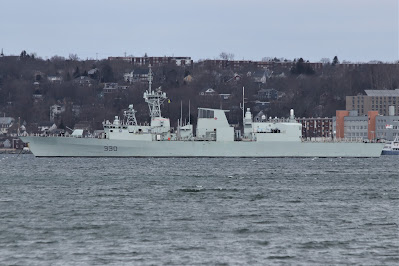
 It was announced in late February that the ship will be sent to Europe in direct response to the Russian invasion of Ukraine. Sister ship HMCS Fredericton Montreal sailed from Halifax January 19 for a six month deployment with NATO.
 

Halifax has seen very few United States warships recently, there was a very significant US Navy arrival today. (March 6).

An as yet to be identified US submarine arrived at noon time and tied up at Navy Jetty Alpha.
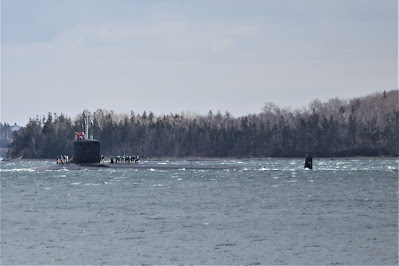
 Accompanied by four navy tugs and a fleet diving unit boat, the sub made its way to the Shearwater pier. All US submarines are nuclear powered, and they always tie up at Shearwater rather than at HMC Dockyard itself, which is in the centre of town.

As if we need more reminders of the nuclear age, the cargo ship CLI Pride made one of its seasonal calls in Halifax, arriving yesterday and sailing today. I have covered this ship many times in the past see: CLI Pride references
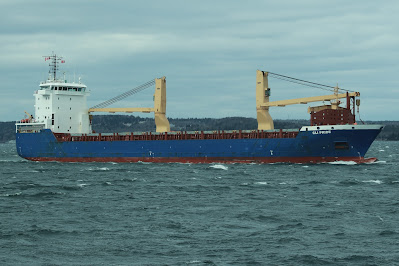
 We usually only see the ship in winter when it avoids the St.Lawrence River with its cargoes of uranium hexaflouride. This year however the ship did make its January trip to the St.Lawrence as there was not much ice. The ship is owned by Compass Schiffahrts and operated by SMS Bereederung of Haren (Ems), Germany.As with many German ships its flies the flag of Antigua and Barbuda.

On this trip the ship loaded in Ellesmere Port (near Liverpool UK), site of a large nuclear power plant called the Ince Power Station. Spent uranium from European reactors is sent to Canada for reprocessing to make it viable for long term storage or to be prepared for re-enrichment. Canada also exports uranium hexaflouride. As usual Wikipedia provides a potted story about the material see: Hex

.


Sunday, March 6, 2022

Fuel from Europe

 With events in Europe unfolding as they are, one has to wonder how much longer Canadian oil companies will be able to import refined product from Europe. Shortages of fuel are predicted in the medium term as supplies of Russian crude are blocked. Demand in Europe will likely lead to even more increases in prices for gasoline, diesel fuel and furnace oil.

Fuel users in Canada will suffer as world oil prices will govern the local price. Of course Canadian sourced crude, refined in Canada will also be sold at world prices - even within Canada, because the cost to produce the crude from oil sands is so high.

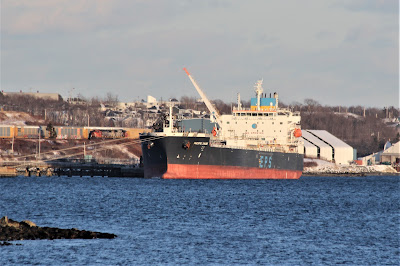
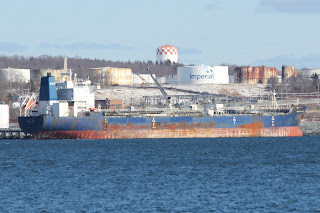
Imperial Oil (which wholesales fuel to others for sale under various brand names) has long been importing refined product from Antwerp for the Atlantic region. The latest tanker, Pacific Jade, arrived in Halifax March 5 and is due to sail this evening March 6.

 A typical MR tanker of 29,476 gt, 49,995 dwt, it was built in 2020 by STX Offshore and Shipbuilding in Jinhae, South Korea. It operates for Eastern Pacific Shipping Pte (hence the EPS on the hull). According to its website, the Singapore based company manages 191 ships totaling 19 million deadweight tonnes. They claim 44 tankers, including 11 chemical and 22 gas carriers, 38 bulkers, 55 container carriers and 9 autocarriers. (The arithmetic does not add  up so I am not sure where the error may be).

Irving Oil imports fuel from Amsterdam, where it has a blending facility. However it also has a refinery in Ireland, so may continue to import refined product from Europe into Canada. It also imports crude oil from various sources for refining in Saint John, NB, and other fuels from around the world. 

.

Saturday, March 5, 2022

MSC times two at PSA

 PSA Halifax handled two ships for the Mediterranean Shipping Co today March 5 - one east bound and one west bound.

The eastbound ship, MSC Sandra arrived last evening March 4 from Montreal on its regular Canada Express 2 service from Montreal to Spain. The ship stops in Halifax to top up cargo to seagoing draft after having to comply with St.Lawrence River draft restrictions.

Before sailing several crew members gathered on the forecastle head to clear lines. The ship had picked up a dusting of frozen spray on its way in. After previous posts on the subject, this is an example of an anchor being iced up, but apparently free to deploy if needed. (The mate may have been having a Jack Dawson moment).*

MSC Sandra dates from 2000 when it was built by Hyundai, Busan. A 43,575 gt, 61,468 dwt vessel it has a capacity of 4340 TEU including 150 reefers. On sailing late this afternoon it gave its destination as Barcelona.

Arriving at noon time today was fleet mate MSC Kim from Sines, Portugal en route to Montreal on MSC's Canada Express 1 service from Italy and Portugal.

MSC Kim is a slightly newer ship, built by Zhejiang Yangfan in 2008. At 41,225 gt, 50,547 dwt it has a capacity of 4254 TEU including 550 reefers. It is due to sail for Montreal overnight after unloading some containers to reduce draft.

A regular on the St.Lawrence River for several years, I photo'd the ship in August 2107, very lightly loaded and doing 18.5 knots. It is always i,mpressive to see these ships booming along at speed.

--------------------------

* My apolgies for a couple of perhaps oblique movie references in recent days.

The first was in the title to my post of March 3. It was a play on the title of a wonderful 1966 move entitled "The Russians are Coming, the Russians are Coming", which in itself was a play on the reputed Paul Revere cry "The British are Coming, the British are Coming". The movie was about a Russian submarine crew that sought help from a New England island village when their sub ran aground. If you haven't seen the movie, or haven't seen it for a long time, the Wikipedia entry is worth a read at: Russians

The second reference is in today's post to the fictional Jack Dawson in the 1997 movie "Titanic" who, perched on the very prow of the ship, proclaims that he is "king of the world". 

.

Thursday, March 3, 2022

The Russians are Not Coming

 Russian flagged ships have been fairly rare in Canadian waters recently, but Russian owned ships, flying the flags of Liberia or other flags of convenience have been fairly common. The huge SOVCOMFLOT (SCF) tanker fleet was the most often seen as they delivered refined product to ports in eastern Canada, including the St.Lawrence River. The recent ban on trade with Russia has brought an end to those calls.

Two SCF tankers have been in Canadian waters very recently. The SCF Ussuri was making its way inbound to the Gulf of St.Lawrence March 1 when it turned back off St.Paul's Island, just west of the Cabot Strait. It returned to disembark its ice adviser off Sydney, NS and after a time hove to in Canadian waters it returned to sea. Its cargo likely belongs to a Canadian company, so what will become of it is not known.

The most recent SCF ship to call in Halifax was Transsib Bridge which unloaded cargo at Irving Oil on February 20-21. It had previously loaded in Amsterdam February 1-2 and delivered some cargo to Saint John, NB, February 19.

When it sailed from Halifax it gave Amsterdam as its next port, but on approaching Europe that was changed to Ust-Luga, a Russian port on the Gulf of Finland.

From the 1960s to the 1980s there were Russian ships in Halifax almost constantly. Members of the fishing fleet such as factory trawlers, research ships, tugs and tankers were in and out of port regularly. There was also a large trade in bulk grain and shipments of bagged flour to Cuba. There was even RoRo traffic as ships of the USSR delivered the infamous Lada automobiles for unsuspecting North American buyers.

 See my series of posts from 2015: April 7, and April 8 and May 13

As world events evolve, there is little likelihood of seeing a Russian flagged or Russian owned ship in Halifax in the near future.
 

 .

Tuesday, March 1, 2022

Full out at PSA

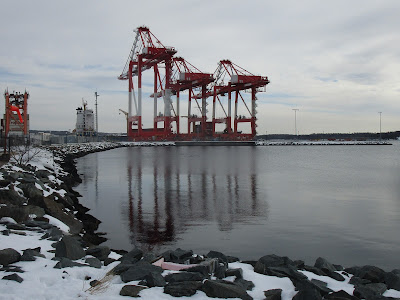
It has been a busy few days at PSA Halifax with a steady stream of ships and a cleanup operation thanks to recent snow falls. This morning the ZIM feeder ship Contship Leo had three cranes working to get its cargo moved before the next ship arrived.


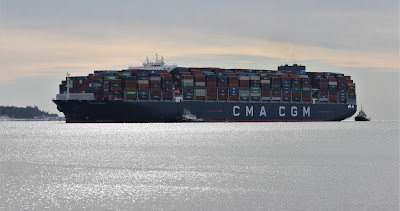
The cranes appear to be considerably oversize for a small feeder ship, but their height and long reach are needed for the next ship. That ship is another "UItra" class vessel, CMA CGM Mexico

It is a 15,000+ TEU ship that is one of five Argentina class ships. It is owned by Seaspan Corporation and operated by CMA CGM under a long term financing / charter agreement.

Although the ship displays CMA CGM on its side, it is actually sailing for the Ocean Alliance a slot sharing / vessel sharing agreement between three major shipping lines and their subsidiaries. CMA CGM (and its subsidiary APL), COSCO (and its subsidiary OOCL) and Evergreen Marine Corp (EMC) use the ship as part of their independant shipping services.

The large shipping Alliances are under fire from customers with charges of price fixing. Many major US retailers have banded together to charge the lines with pricing collusion in contravention of US competition laws. The three main alliances control a very high degree (some say 90%) of the main east-west trade lanes.

Halifax is also served by THE Alliance which is made up of Hapag-Lloyd, HMM (Hyundai Merchant Marine), ONE (Ocean Network Express) and Yang Ming. The third group is called 2M and consists of Maersk and MSC. 

There are still inepedants such as ZIM and ACL, but even they have slot charter agreements with other lines. In fact there are too many of these agreements to list here. However the Federal Maritime Commission has kindly published: FMC List

.


Thursday, February 24, 2022

Another Initial Day

 Initials, abbreviations and acronyms are much favoured by shipping lines as a way of reducing lengthty company names. Today (February 24) saw the arrival of two ships using intials in their names.

Item 1

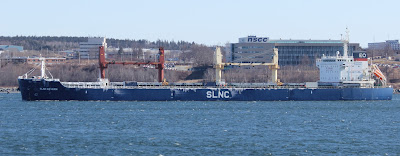
First in was the bulk carrier SLNC Severn en route from Auld's Cove, NS to a US port with a cargo of aggregates. A fairly unusual sight, it is a US flag ship. It was built in 2017 by Samjin Shipbuilding Industries Co in Wehai, China as the Frederike Oldendorff for Oldendorff Carriers of Germany.

 SLNC Severn picked up a bit of frozen spray on its trip down the coast from the Strait of Canso over night.

The 33,737 gt, 57,888 dwt bulker carries four 35 tonne cranes and four 12 cubic meter grabs. The cranes can be paired for 70 tonne lifts and the ship can carry containers. (The tops of the grabs are just visible near the bases of the cranes.)

The ship was chartered in 2020 by Schuyler Line Navigation Co LLC of Annapolis, MD, hence the "SLNC" initials. The choice of company name comes from the United States Merchant Marine Academy in Fort Schuyler, the Bronx, NY, where the company principals studied. The ship is still owned by Oldendorff America Ltd (hence the Egon Oldendorff funnel marking).

Schuyler Lines operates a varied fleet of about six ships, some of which were built in the US and qualify for domestic (cabotage) trade under the Jones Act. Others, like SLNC Severn, which was not built in the US, cannot trade between US ports, but still receives some of the benefits of US status.

The ship was here previously, in June and September of last year. Since then the two forward cranes have been repainted in a rust colour. 

Item 2

The next "initial" ship saves a great deal of paint and ink and a mouthful of words by reducing the Mediterranean Shipping Co Ltd to MSC.

 The crew are washing down the anchors as the ship enters port. [See footnote]

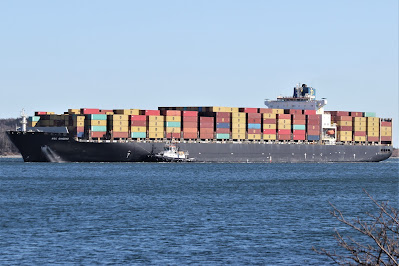
MSC Qingdao is making its first port call to Halifax on MSC's Indus 2 service from northern India. A 89,097 gt, 105,162 dwt ship, it dates from 2004 when built by Samsung Koje. It has a capacity of 8063 TEU including 1400 reefers. Originally named OOCL Qingdao it took its present name in 2019 when chartered in by MSC. 

[Ships owned by MSC typically carry women's names, whereas chartered ships use place names.]

Qingdao is a port city located in Shandong province in eastern China. The port handles more than 20 million TEUs per year (!) and is thus perhaps the third busiest port in the world for containers. (Halifax by comparison handled 595,751 TEU in 2021).

The name Qingdao has been used by other containerships, and ZIM Qingdao is a regular caller here. In fact it is due February 26, but it doesn't seem that the two ships will meet in port.

Footnote

 A ship must confirm that its anchors are free and ready for use before receiving clearance to enter the port of Halifax, particularly in winter, in case they are locked in place by frozen spray. On a day like today (minus 5C) it is unlikely that the rushing seawater will freeze, but I question the use of wash water when there is no evidence of frozen spray. Ships often wash down the anchor chain before anchoring to reduce clouds of flying rust as the chain deploys, but that is not the case today, since the ship will not be anchoring. However in an emergency, such as engine failure, the ship must be prepared to drop anchor at once. Perhaps the deck crew were just being cautious.

That brings up the case of the ZIM Vancouver - see yesterday's post - which lost both its anchors during the recent storm. Too much strain on the anchor chain may have resulted in the chain parting. However it is more likely that the two chains became entangled, and the crew had no choice but to let them go since they could not be retrieved. (There are shackles in anchor chain every 15 fathoms, or 90 feet, where the chain can be disonnected.)

In any event it was not safe for the ship to be at sea without anchors (in fact it is considrred to be unseaworthy without anchors.) The ship was given special clearance to enter port as long as it was under the control of tugs and pilot.

It will be interesting to see if any effort is made to recover the anchors. There may be others out there too, and with present day sonar it may be possible to find them if they are worth something.

.

Wednesday, February 23, 2022

ZIM Vancouver - new news

ITEM 1 :  Did you notice?

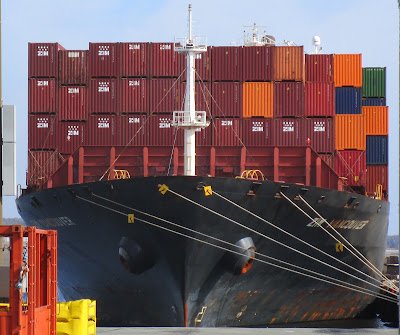
 A close inspection of my photo of the Zim Vancouver (posted yesterday) at Pier 36 reveals that the ship has no anchors. A report has reached me that the ship lost both anchors during the gales last Thursday / Friday February 17-18, 2022. The ship was in the outer anchorages off Halifax as the gales, with some very heavy gusts, blew through the area. Gusts of 90.8 km per hour and 103.7 km per hour were recorded at Shearwater and McNabs Island respectively.

The source also reported that new anchors have been dispatched from Houston, by truck.

ITEM 2

A sustained period of ship's whistle blowing last night (February 22) at about 2300 hrs AST has not been explained, but acknowleged by authorities as an "ISOLATED INCIDENT". That wonderful phrase loved by obfuscators world wide, neither explains the reason for, nor the source of the sound. 

Normally a series of blasts (usually five) is a warning from a ship underway. However there was no ship underway in the harbour at the time. Fifteen or more (I wasn't counting) blasts in quick succession would seem to indicate an emergency of some sort such as a person overboard or a medical issue. Neither of those seems to have been the case.

Due to the direction of the sound relative to my location I believe it came from the ZIM Vancouver

Could it have been a case of "crew exuberance", a "political statement", or a "malfunction"? We may never know.

.